How The Riley Institute Is Changing the Afterschool Landscape
by Melissa Charles
Afterschool matters for student success, family stability and workforce productivity. Afterschool and summer programs are more than just childcare or homework help: they are essential infrastructure for working families, community engagement and school achievement. Yet access continues to fall well short of demand, due to barriers including cost, transportation and limited availability.
The Riley Institute at Furman University is changing that through a dual approach that combines policy leadership with local capacity building. A top-down approach helps shape policy that secures sustainable funding and equitable access while a program-level approach equips local leaders to elevate program quality and expand capacity.
This dual approach is brought to life by two signature initiatives. The Riley Institute’s White-Riley-Peterson Afterschool Policy Fellowship and the South Carolina Afterschool Leaders Empowered (SCALE) network both equip leaders to advocate for their afterschool programs while learning how to run better programs that serve more people.
The White-Riley-Peterson Afterschool Policy Fellowship, made possible by the Charles Stewart Mott Foundation, is a premier leadership program that trains professionals from across the country to navigate legislative processes, build networks, enhance programming and access, and advocate effectively for afterschool and summer learning within their home states.

Terry Peterson greets 2023 White-Riley-Peterson Fellows.
The fellowship is more than a program. It’s a catalyst for change. By equipping leaders with policy expertise and a powerful network, it empowers them to turn vision into action.
As part of the fellowship, participants work on a state-level policy project in partnership with other leaders in their state. Years down the road, it’s exciting to see ideas that were incubated as part of the fellowship being fully realized. Taken together, the impact of the WRP Fellows’ network on afterschool policy and funding over the past 14 years has been remarkable.
“The fellows are a vital link to the success that we’ve had over the last few years in increasing state funding for afterschool and summer programs-from zero 30 years ago, to six billion dollars in 2025/26,” says Terry Peterson, senior associate for the Riley Institute. Peterson worked with U.S. Secretary of Education Richard W. Riley in the 1990s when no funding existed for the afterschool and summer field and has become one of the nation’s foremost experts in afterschool policy.
From Policy to Impact: Katie’s Story
Katie Landes, director of the Georgia Statewide Afterschool Network, works to advance, connect and support afterschool and summer learning programs across Georgia to increase program access for all youth.

Katie Landes at the 2025 WRP opening dinner.
The fellowship allowed her to think long-term about strategy for her organization, strengthen her knowledge of policy and build a network of peers and national thought leaders.
“Having this network, having this way to think, it’s one of those pieces that was an asset, a tool in my toolbox for growing our network,” Katie says.
With those tools and her network, she helped secure $85 million in federal grants for Georgia’s afterschool programs. When those funds expired, her team and partners were able to secure $12.5 million in state funding. Those dollars now flow to community-based afterschool and summer learning programs across Georgia, giving young people safe spaces to learn and grow.
Building Statewide Momentum: Felicia’s Journey
In Alabama, Felicia Simpson, co-director of the Alabama Expanded Learning Alliance, faced a different challenge: making afterschool a priority in a state budget.
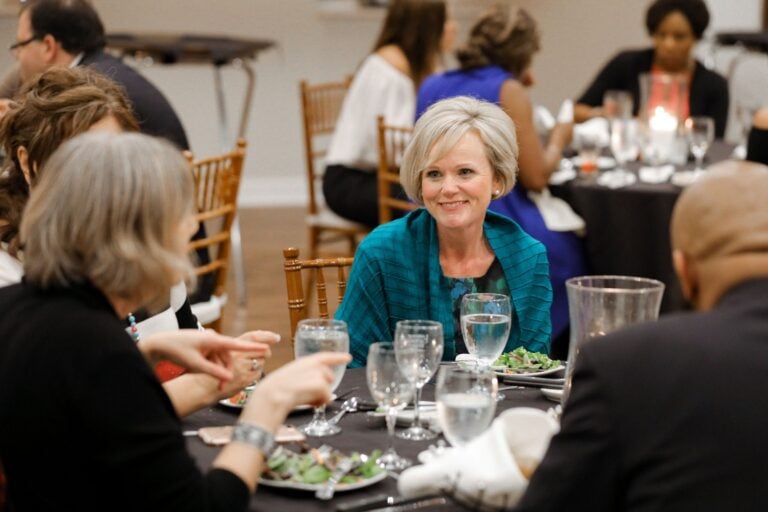
Felicia Simpson at WRP Fellows opening dinner in 2017.
The fellowship provided her with a strong, lasting network that had previously been unavailable. While Felicia’s background was rooted in grants, she had little experience in policy. The fellowship equipped her with the knowledge to understand legislation and navigate the legislative process effectively.
Felicia’s fellowship project focused on making afterschool and summer programming a state line item in the budget. Over five years, her efforts paid off as afterschool and summer learning became a state line item, growing from $1.5 million to $17.2 million in just three years.
The impact goes beyond funding. The Joint Interim Study Commission on Expanding Access to High-Quality Out-of-School Time was established to advise the legislature on expanding access and improving the quality of afterschool programs in Alabama. Felicia’s work has fueled innovative afterschool and summer programs that connect academics to real-world skills and career paths. They’ve also helped reduce retention of students during the summer and guided students toward their interests, helping ensure that at-risk students complete school.
“Without the White-Riley-Peterson Fellowship,” she says, “Alabama would not look the same.”
From Policy Change to Program Quality
While the White-Riley-Peterson Fellowship shapes national participants, the South Carolina Afterschool Leaders Empowered program strengthens local leaders.
South Carolina Afterschool Leaders Empowered (SCALE) cultivates a statewide network of skilled, connected leaders committed to advancing high-quality afterschool and summer learning. By combining an intense study of evidence-based theory and practical implementation, SCALE strengthens collaboration among professionals from diverse organizations, builds expertise, and drives innovation. This infrastructure—which has graduated 83 Fellows in its first four years—fosters transformative knowledge gains, meaningful partnerships, and collective momentum, ensuring that programs across South Carolina not only expand access but continuously improve to meet the needs of youth and families.
Rooted in Purpose: Nick’s Commitment to Afterschool

Nick Washington leading a group discussion at the 2024 Power Up! Afterschool Conference.
Nick Washington, program director at the Original Six Foundation (O6), leads initiatives that provide elementary and middle school students with safe, supportive environments designed to close learning gaps and foster academic growth. As part of the inaugural cohort of the SCALE program, he built relationships and networks that served as a trusted space for collaboration and sharing ideas, gained tools to elevate his voice and local impact, and developed clarity of purpose and influence.
“Afterschool is where I’ve seen firsthand how consistent, high-quality programs can change a student’s confidence, trajectory and sense of belonging,” Nick says. “That connection is what has kept me rooted in this work for two decades.”
Nick’s participation in SCALE has directly made an impact in the communities he serves. When he joined the inaugural cohort in 2022, O6 Afterschool programs served seven schools and 378 students. Today, O6 serves 13 schools and more than 1,000 students, driven by the insights and resources Nick has gained through SCALE’s innovative tools and collaborative community.

Tiffany Howard (left) and DJJ colleagues pose with SCALE Director Amy Keely (second from right).
Making Afterschool a Prevention Strategy: Tiffany’s Vision
Tiffany Howard, statewide prevention and intervention director for the South Carolina Department of Juvenile Justice, focuses on prevention, youth development and community-based interventions for at-risk youth.
“Afterschool is not just an add-on,” Tiffany says. “It is a key prevention strategy.”
Tiffany notes that the SCALE program blended leadership development, peer collaboration and data-informed decision-making with discussions about equity and access in afterschool programming. She was able to engage and connect with leaders from diverse sectors who all shared a commitment to improving outcomes for youth.
SCALE sharpened her approach to program oversight, accountability and quality assurance. As a result, she implemented SCALE principles to support and guide her 45 partner afterschool programs, ensuring they are meeting youth needs and creating stronger programs. SCALE has helped her find her voice to advocate for afterschool as a prevention and intervention strategy, not just a supplemental service.
“SCALE’s impact extends beyond individual participants; it strengthens the entire afterschool ecosystem in South Carolina,” she emphasizes.
Why It Matters
Research confirms afterschool’s impact on student achievement. Studies have demonstrated that high-quality programs lead to improved attendance, stronger academics, and critical character and interpersonal skills for students.
Additionally, afterschool learning contributes to economic development and eases burdens on working families. Afterschool and summer programs are consistently met with overwhelming public support. A 2024 poll conducted by Afterschool Alliance indicated that 87% of Americans agree that afterschool is essential in their communities.
The Riley Institute’s model helps states across the country meet the need for high-quality, sustainable, and accessible afterschool programs. Because when leaders have the evidence, practical strategies, networks, and confidence to advocate and innovate, afterschool programs thrive. Families stay in the workforce. Students discover passions and pathways. Communities grow stronger.