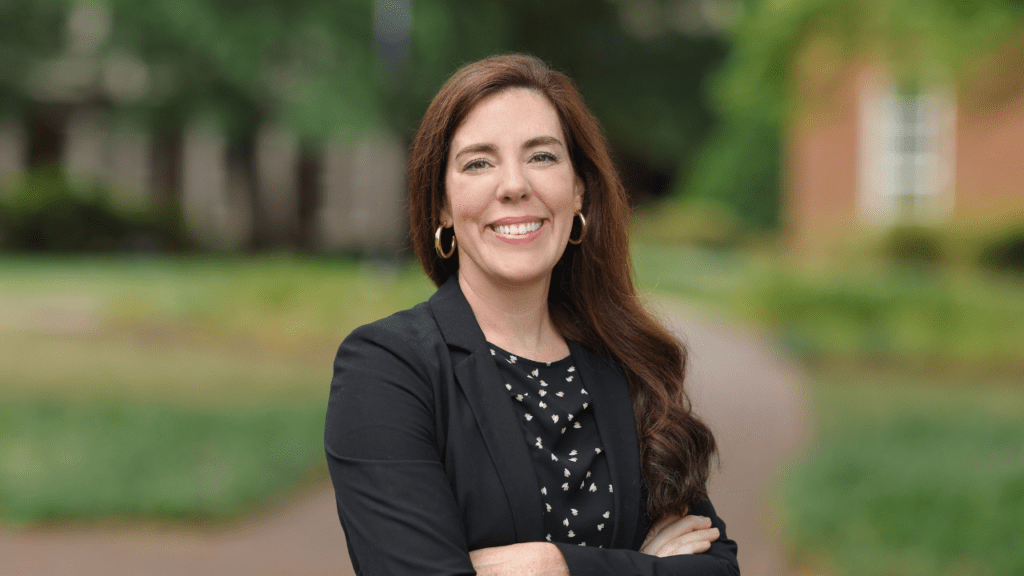
Kelly Gregory: A Life Shaped by Classrooms
For Kelly Gregory, public education has never been simply a profession; it has been the throughline of her story.
“I used to joke that my entire life revolved around a school calendar,” she says.
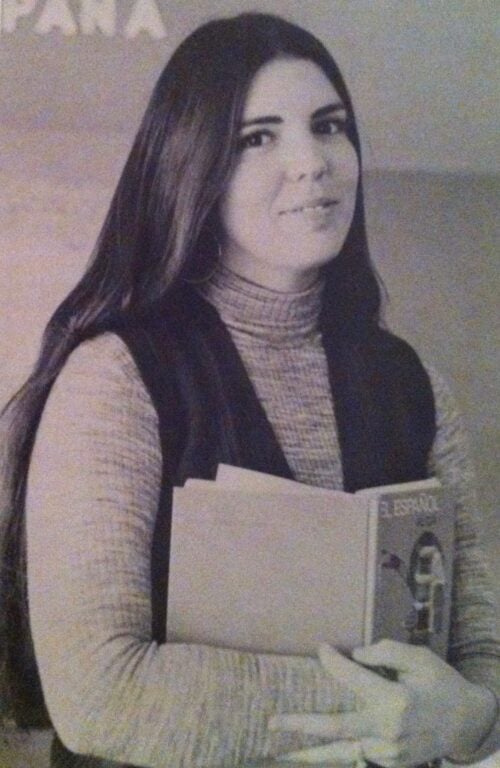
Kelly Gregory’s mother
The daughter of a public high school Spanish teacher, Gregory grew up not only around classrooms, but inside the culture of teaching itself: late nights spent grading papers, lesson plans spread across the bed, and a deep, lived understanding that education extends far beyond the hours of a school day.
“My mom devoted so much time to making learning meaningful,” Gregory recalls. “Helping students understand different cultures, see beyond their own experiences; it wasn’t just about teaching a subject.”
That example, combined with her own experiences as a public school student, teacher, and now a parent, shaped a core belief: Public education has the power to be an equalizer.
Today, as director for public education projects and partnerships at The Riley Institute, Gregory works to connect all the threads of her life experiences to help our public education system reach its full potential for every child.
All Roads Lead to Furman
Gregory’s path to her current role spans more than two decades and began right here at Furman University.
She entered her studies not planning to become an educator, but by her senior year she found that her psychology degree had prepared her well for a career in teaching.
“I realized I could use a lot of what I learned in my studies in the classroom, and it felt like I could impact more people,” says Gregory. “In Special Education, you really have to think about how a wide variety of factors and student needs intersect and determine the best way to address them. I felt like I was well-suited for that with my psychology background.”
After graduating in 2005, Gregory joined The Riley Institute as a research assistant while completing her master’s degree, contributing to one of the institute’s first major statewide studies on public education. She came back to The Riley Institute again in between teaching stints in 2015 to support the institute’s evaluation of OnTrack Greenville.
But for 11 years—five of them in a Title I middle school across the street from Furman—Gregory taught students, gaining the kind of firsthand insight that no dataset alone can provide.
“I learned from my mom that the role of a teacher reaches far beyond the hours of 8:00 to 3:00,” says Gregory. “Yes, teaching is about the development of knowledge and skills. But it’s also about relationships built on trust and empathy, especially for those students who might be under-resourced at home. Those students whose only meals might be the ones they eat at school or who might not have any lights on at home—that’s more common than many people realize. Teachers wear so many different hats on any given day, and even though I grew up watching my mom do that, I still don’t think I would have fully grasped the reality of the job if I hadn’t done it myself.”
Then, in 2022, an opportunity arose at The Riley Institute that Gregory couldn’t refuse. The institute was creating a new role focused specifically on K–12 public education research and partnerships for stronger policy and practice.
And so, she came back to Furman again.
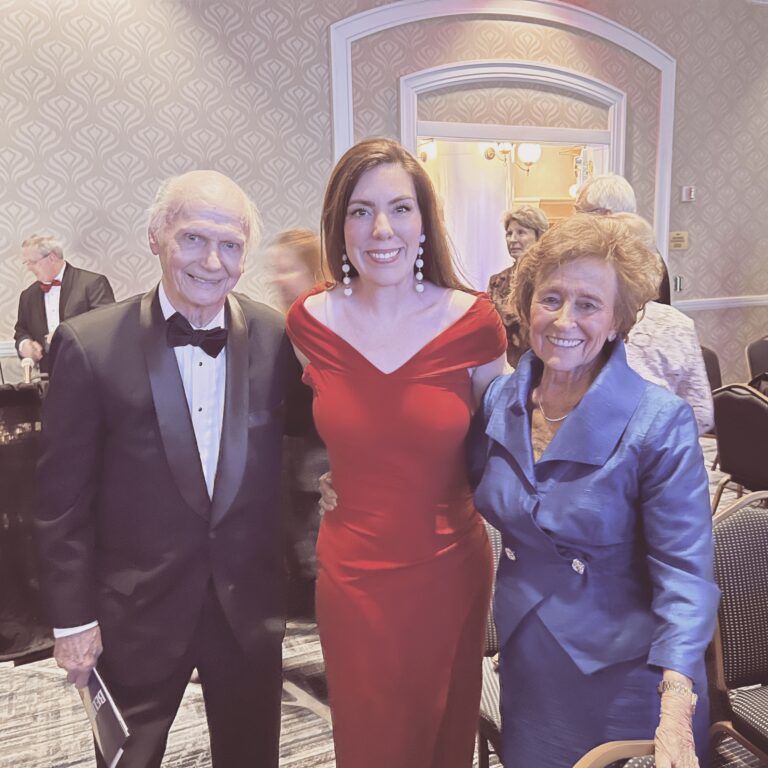
Kelly Gregory posing with Richard W. Riley (left) and Betty Farr (right).
More Than One Role: One Unified Mission
At first glance, Gregory’s work at The Riley Institute might seem like a collection of distinct responsibilities.
She collaborates on research and evaluation projects. She writes policy-focused content, including the institute’s Evidence Matters blog and Legislative Watch updates. She builds partnerships with organizations across South Carolina and beyond. She oversees the WhatWorksSC program.
But for Gregory, these aren’t separate tracks; they’re interconnected pieces of the same goal. “We want evidence to inform policy,” she says. “And policy to reflect what’s actually working in practice.”
At the center of her work is a challenge long recognized in education: the gap between research and practice.
“There’s so much great research out there,” Gregory explains. “But the people who are doing the work every day—teachers, administrators—they don’t always have the time to dig through it. And policymakers aren’t always directly connected to it either.”
Her role, in many ways, is to act as a bridge.
By translating research into accessible insights, elevating programs that demonstrate real impact, and connecting with partners across the field, Gregory works to ensure that knowledge doesn’t just exist, but rather that it’s used in practice.
What Works and Why It Matters
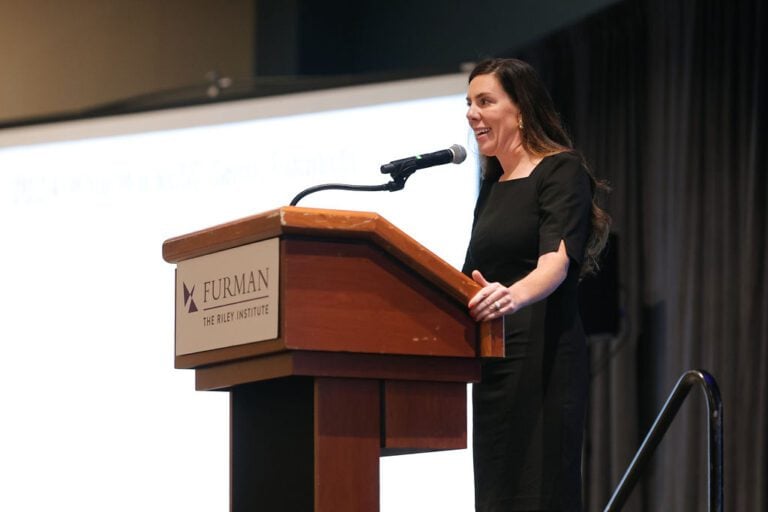
Kelly Gregory speaking at WhatWorksSC 2024.
One of the clearest examples of that mission is The Riley Institute’s WhatWorksSC program, which Gregory oversees.
The program recognizes organizations and initiatives that are making measurable, positive impacts in public education—but with the critical requirement that they must be able to prove it.
“To be recognized, organizations have to show the data behind what they’re doing,” Gregory says. “Not just that they have a good idea, but that it’s actually working.”
By elevating these programs publicly, The Riley Institute does more than celebrate success. It helps bring effective, evidence-based practices into broader conversations, including those happening at the policy level.
While the impact may not always be traced to a single bill or decision, Gregory sees the influence in the relationships The Riley Institute has built.
“We have strong connections with legislators who are paying attention to this work,” she says. “I believe that makes a difference.”
Looking Ahead
When asked what she hopes public education will look like by the time she retires, Gregory doesn’t hesitate to point to systemic change.
In her ideal future, school funding is no longer tied to property values, ensuring that a child’s zip code does not determine the quality of their education.
Teacher preparation programs are consistently high quality and grounded in research, and the teaching profession is not just verbally valued but supported through policies that reflect the realities of their work. “We say we value teachers,” she notes. “But we need systems that actually show that.”
Perhaps most importantly, the lines of communication between researchers, practitioners, and policymakers need to be open and working well.
“If we can improve that,” says Gregory, “then I think the outcome is that we improve outcomes for students, which is everyone’s ultimate goal.”
Bonus Story: Simon "The Rat"
Kelly Gregory will be the first to admit this is a little weird.
As a psychology major at Furman, she took a course where each student was assigned a lab rat. Kelly named hers Simon.
Over the semester, Simon became… hers. Not exactly a pet, but close enough that by the end of the course, she had a plan: she was going to take him home. She knew the rats weren’t reused for future classes, so in her mind, it made perfect sense.
After finals, she went back to the lab to get him. But all the cages were empty.
She found a lab assistant and asked where the rats had gone. The answer came a little too casually: they’d been sent to the biology department.
“For what?” she asked. “Food for snakes.”
“I absolutely lost my mind,” she says. To this day, colleagues know: if there’s an injured bird on campus, Kelly’s calling whoever the bird expert is in Furman’s biology department, hoping to save it.