Tocqueville Fellows Blog, by Ellison White: The Right Has Lost is Way: Neo-liberalism is the Path Back
Ellison White is from Durham, North Carolina, and studies International Business and Politics and International Affairs. Her piece reflects on a two-part lecture the Tocqueville Center hosted in the fall of 2025 featuring Liesbet Hooghe, Gary Marks, and Matthias Matthijs on how populism, geopolitical rivalry, and shifting U.S.–Europe dynamics are reshaping the transatlantic relationship and the future of democratic political order.
The Rise of TAN Parties and the Shift Away from Free Markets
Over the past twenty years, right wing politics around the world have taken a dramatic turn. The traditional neo-liberal values of Reagan and Thatcher have been cast aside, replaced by what Liesbet Hooghe and Gary Marks call “TAN parties,” orbiting traditional, authoritarian, and nationalist ideologies. This rhetoric has championed isolationism, limited immigration, and emphasized the preservation of cultural identity. While democratic practices historically dilute the pull of radical leaning parties on the left or right, TAN parties have risen in popularity throughout Europe, holding parliamentary seats in virtually every country, and even senior government partnerships in Italy and Hungary. This hyper-nationalist turn has weakened the conservative right’s ability to operate in the current globalized political system and pushed it to forget its most important principle: protection of the free market.

The Tocqueville Center two-part event featuring Liesbet Hooghe, Gary Marks, and Matthias Matthijs, examined the future of the transatlantic relationship amid rising populism and geopolitical change.
Nationalism, Trade, and the Costs of Economic Isolation
A key campaign topic for TAN parties in Europe is the negative outlook the European Union has on the independent nation state. This is an understandable concern, for hundreds of years these countries have had history of autonomy. Now, they are expected to act in a unionized interest. While it seems worthwhile to isolate from outside pressures, this is acting against the individual nation’s self-interest.
The nationalist response, blocking potential international trade, limits possibilities for citizens of TAN controlled countries, barring both individual and overall growth. According to the World Bank, the goal of national self-sufficiency would require “extraordinary amounts of capital and pay significant additional costs from efficiency losses,” (World Bank Group). This resistance to integration also weakens TAN-controlled governments’ influence within European institutions, limiting their ability to shape coalition policy outcomes while non-TAN countries navigate the globalized system more effectively.
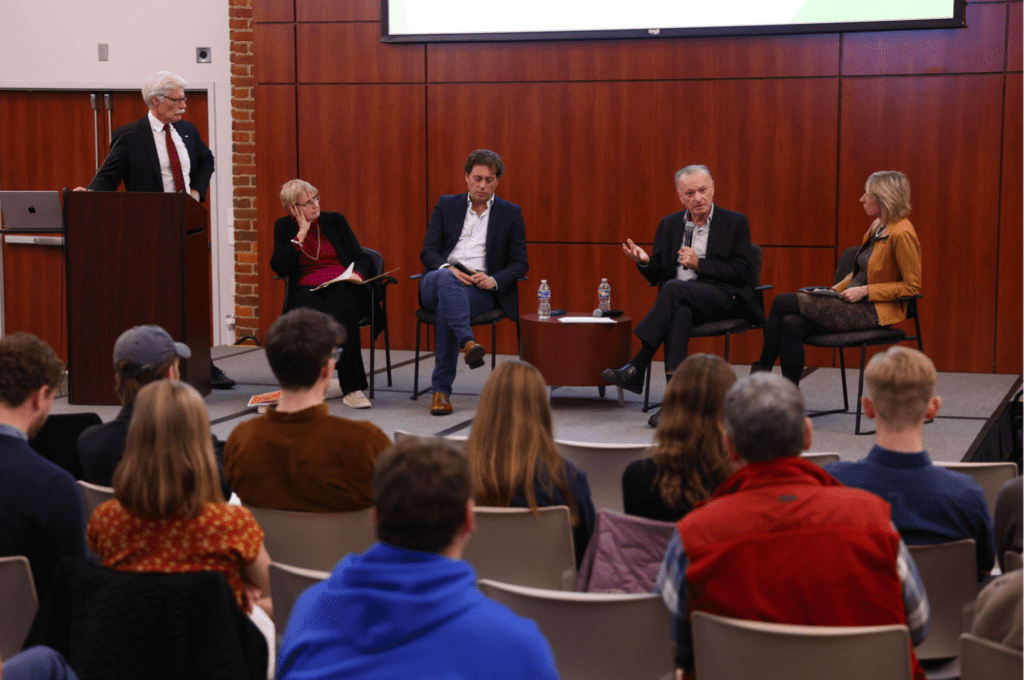
Brent Nelsen joins Marian Stroble, Matthias Matthijs, Gary Marks and Liesbet Hooghe in a Tocqueville Center panel on democracy and transatlantic politics.
Immigration, Identity, and the Future of the Conservative Right
Along with political isolationism, another key philosophy for European TAN parties is the disparaging of immigration. By restricting people from legally crossing borders to work, governments are limiting the influx of ideas and productivity, hindering long term growth. President of the European Central Bank, Christine Lagarde, proves the importance of international workers, exclaiming “In Germany, for example, GDP would be around 6% lower than in 2019 without the contribution of foreign workers,” (Lagarde).
Advanced economies require nuance, specialized skills, innovation, and mobilization of ideas. To regularly obtain these ideals, a constant influx of various viewpoints is required. Closing off borders does not allow people to exchange ideas and perspectives; it creates a bubble of limited viewpoints. This protectionism goes starkly against the once championed thought of free-market conservatism, replacing confidence in markets with a defensive policy that treats global competition as a threat rather than an engine of growth.
European countries take pride in holding stark national identities. Holding a national identity is pivotal to rallying public support and necessary to upholding natural rights and liberties. Lisbet Hooge and Gary Marks explain this by noting, “Tan parties, such as the French Front National or the Austrian Freiheitliche Partei, reject European integration because they believe it weakens national sovereignty, diffuses self-rule and introduces foreign ideas. They oppose European integration for the same reasons that they oppose immigration: it undermines national community,” (Hooghe and Marks). This makes it understandable that TAN parties want to retain this identity, but they overcorrect, limiting future economic prosperity. In doing so, they create economic and political costs that surpass the cultural benefit of preserving a distinctive national identity. The IMF’s Geo-Economic Fragmentation and the Future of Multilateralism show this, claiming that policy-driven economic fragmentation, such as rising trade barriers in the interest of national economic independence, undermines the transmission of globalization benefits across trade, migration, capital flows, and technology, suggesting long-term losses to global and domestic output and welfare. (Aiyar, Chen and Ebeke)
To navigate these challenges, the conservative right must return to the political and economic ideals of neo-liberalism: free market expansion, international trade, and labor mobility. These ideals are strategic in allowing nations to thrive in the domestic and international economies in the age of hyper-globalization. By engaging in institutions such as the European Union, independent nations still hold the power to influence policy and create political coalitions that help prioritize citizens, while also stimulating both bilateral and multilateral trade agreements that generate wealth for all parties. Measured immigration policies will also allow an inflow of innovation while also balancing the importance of culture. Returning to neo-liberal values does not mean the extinction of national identity but offers a solution in which cultural identity and economic prosperity coexist. In embracing a globally engaged neo-liberal platform, the conservative right can regain credibility, strengthen international relations, and instill national identity as a base for international growth instead of a hindrance.
Works Cited
Aiyar, Shekhar, et al. “Geoeconomic Fragmentation and the Future of Multilateralism.” International Monetary Fund (2023): 1-15.
Hooghe, Liesbet and Gary Marks. “A Postfunctionalist Theory of European Integration: From Permissive Consensus to Constraining Dissensus.” British Journal of Political Science (2008): 17.
Lagarde, Christine. Beyond hysteresis: resilience in Europe’s labour market . 23 August 2025. 10 December 2025.
World Bank Group. Protectionism Is Failing to Achieve Its Goals and Threatens the Future of Critical Industries. 29 August 2023. 13 December 2025.