Tocqueville Fellows Blog, by Anna Louise Panhorst: The Crisis in Higher Education: Citizenship, Learning, and Preparation for a Complex World
Anna Louise Panhorst is a Biology major on the pre-med track from Canton, Georgia. She is in the class of 2028.
On homecoming weekend, the Tocqueville Center invited the distinguished academics John Tomasi, Senator Ben Sasse, and President Elizabeth Davis to the stage to discuss the crisis in higher education. While their discussion ventured into issues of free expression, the purpose of the university, and the growing distrust surrounding higher education, they kept returning to one theme: the importance of higher education in preparing citizens to meet the demands of a complex world. If higher education is failing, perhaps the problem originates earlier in the educational pipeline and the status of high schools today is failing to prepare students for the demands of citizenship and lifelong learning in a complex world.
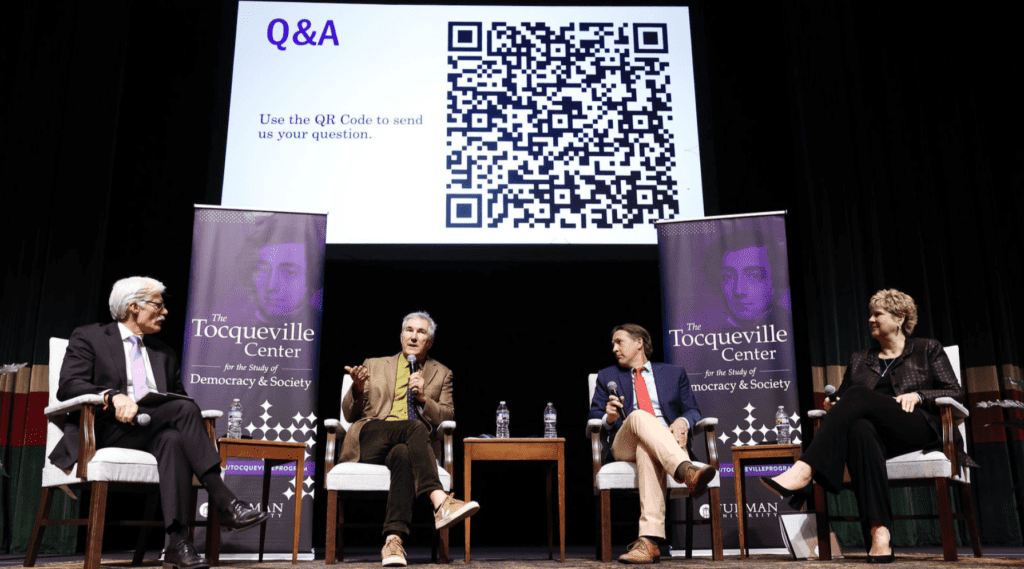
Panel discussion on higher education crisis at Tocqueville Center featuring Brent Nelsen (Director, Tocqueville Center), John Tomasi (President, Heterodox Academy), Ben Sasse (former University of Florida President and U.S. Senator), and Elizabeth Davis (President, Furman University)
Diversity of Ideas in Higher Education: How Liberal Arts Colleges Cultivate Intellectual Openness
Universities—specifically small liberal arts colleges like Furman—invite people to engage with a diversity of ideas. These ideas are a microcosm of the ones students would eventually encounter in their future communities and workplaces. However, these settings often do not allow for the curiosity and open-mindedness that characterizes university discussion.
Moreover, some topics—namely religion and politics—we are often told blatantly not to discuss. However, university is different. Universities ask students to enter a space where they can actively engage with sometimes controversial perspectives that differ from their own.
As Senator Sasse remarked, institutions of higher education are “still institutions of place where you get to know how to grapple with people that weren’t a part of your nuclear family and that share your whole worldview.” In the pursuit of higher education, people from different backgrounds often come together and are pushed to wrestle with ideas they have never encountered before; going to university gives students the opportunity to learn how to engage with the diverse, complicated world we live in.
These formative opportunities are limited, as not all institutions of higher education invite students to engage effectively with opposing viewpoints. However, I have found that Furman’s liberal arts education has made an intentional effort to create an environment where students encounter opposing viewpoints. From general education requirements that spread across disciplines to the diverse array of cultural life programs offered, Furman students are immersed in an environment where they encounter new ideas and opinions. However, this experience does not appear to be the same across all universities. Other schools seem to focus more heavily on career readiness rather than preparing them for good citizenship and meeting the demands of a complex world.
Higher Education Is Not for Everyone: Rethinking What Citizens Need for Lifelong Learning
As a result of differing experiences in the university and the fact that not every citizen pursues higher education, we cannot solely rely on institutions of higher education to provide the foundation for responsible citizenship. When asked whether higher education is a worthwhile pursuit for the majority of Americans, John Tomasi and Senator Sasse expressed their skepticism of this one-size-fits-all approach. Tomasi highlighted that the “experiences people have intellectually” are more important than getting a bachelor’s degree. Similarly, Senator Sasse emphasized the importance of people being adaptable especially in the workforce and having an open mindset, which could be gained through continued education or life experience.
What matters more than a college education is adaptability in work and the ability to question. Some individuals will foster these skills in college, but not everyone needs to or has the ability to attend college to achieve a lifelong learning mindset.
Where Do We Learn to Become Lifelong Learners?: The Missing Institutions That Shape Citizens
The idea that individuals need a mentality of continual learning—even if they do not pursue higher education—raises questions about whether we have institutions capable of instilling these values. Are there other institutions fulfilling the need to create lifelong learners? If higher education is not for everyone, are we providing high school students with the foundation they need to develop these capacities?

Cracks in the Foundation: How College-Prep Culture Undermines Real Education
The problem with higher education does not begin at the university level, but in the foundations laid by prior education. High schools today often fail to prepare students for the real world. Rather than creating well-rounded, educated citizens, many high schools push college-prep courses and place immense value on standardized test scores.
I saw this in my own public high school experience, where I was encouraged to take as many AP classes as I could fit into my schedule because they would look good on college applications. However, for the most part, these classes taught me how to take a test rather than how to think critically or function in a world of varied perspectives. The SAT and ACT were the same. Looking back, much of my high school education trained me to take a test so I could get into college. The courses left little room to explore my interests or engage meaningfully with the world around me.
I acknowledge that the high school experience looks different for everyone and that I made decisions based on my desire to pursue higher education. Nevertheless, the emphasis on college prep for a public that may not wish to pursue higher education needs rethinking.
The Pressure of Grades: How a Grade-Centric Culture Discourages Deep Thinking
In addition to focusing on college preparation, high schools place extreme value on grades. My own experience reflected this. Especially among top students, class rankings were cutthroat, and I remember feeling immense pressure to excel in every academic pursuit. There was no room to slip up, let alone fail. This grade-centric learning instills anxiety and impedes deeper thinking by encouraging memorization over understanding and critical thought.
Students become afraid to be wrong or to make mistakes, even though mistakes are opportunities to learn and grow. I find it deeply troubling that we have stopped asking students what they learned and instead ask what their grade is. In their current state, I do not believe our public high schools effectively prepare students for the real world.
Rethinking the Issue: Why the Crisis in Higher Education Starts Before College
Higher education is certainly in crisis. President Elizabeth Davis cited a Pew Research study that revealed that 70% of people believe higher education is headed in the wrong direction. Perhaps when looking for solutions to this crisis, we need to take a step back and view the education system as a whole. If the foundational education everyone receives is flawed, how can we focus solely on universities?
If college is not the road for everyone, maybe we need to reevaluate how we prepare students at the high school level. Perhaps then, we could cultivate better citizenship for all, unrestricted by standardized test scores and collegiate pressures, but still fostering a deep appreciation for the good, the true, and the beautiful.