Summary of the Tocqueville Homecoming Event: The Crisis of Higher Education
Watch the recordings:
“Campus Free Speech. Discuss.” – October 23
“The Crisis in American Higher Education”- October 24
A Summit on the Crisis in American Higher Education
The inaugural Tocqueville Homecoming drew students, alumni, faculty, and friends into McAlister Auditorium to grapple with a pressing question: why has trust in higher education collapsed — and how can universities rebuild it?
Brent Nelsen opened the program with a reminder of purpose:
“The Tocqueville Center exists to prepare thoughtful, informed, and ethical persons… Not just trained workers or knowledgeable citizens, but responsible heirs and members of the human culture.”
He spoke plainly about public skepticism toward universities’ willingness to “welcome diverse and competing viewpoints,” and insisted the answer lies not in retreat but in renewed intellectual courage:
“To regain trust, we need to actively engage in just those activities.”
With that, Furman President Elizabeth Davis, former University of Florida President and U.S. Senator Ben Sasse, and Heterodox Academy President John Tomasi took the stage.
President Elizabeth Davis: “Free inquiry and free expression are foundational”
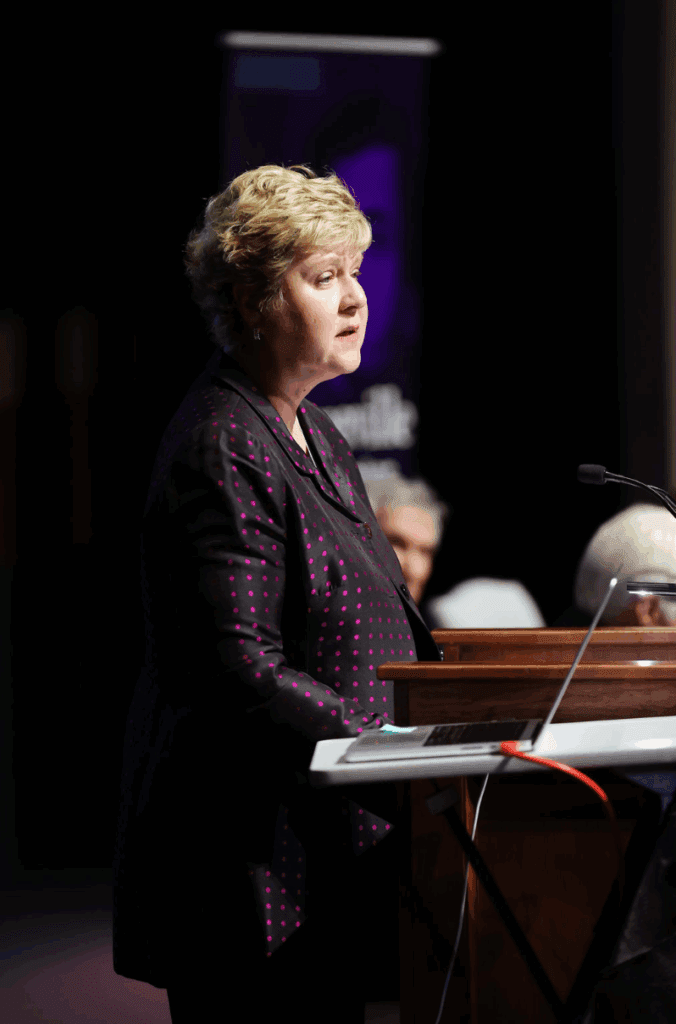
President Davis began at the root:
“Free inquiry and free expression are foundational to higher education.”
She acknowledged national distrust and private hesitation among students who “say they self-censor… for fear of being ridiculed,” calling such an atmosphere “not acceptable.”
Davis emphasized Furman’s commitment to preparing graduates not only for careers but for principled citizenship:
“Engaging thoughtfully and empathetically with those who share different beliefs or values is critical.”
She also addressed policy pressures and employment concerns with clarity:
“The indiscriminate firing of faculty cannot and will not happen.”
Her speech drew a clear line in the sand for academic integrity and institutional independence. She cautioned that the newly announced federal ‘compact’—tying preferential treatment to policy conditions—threatens academic freedom, and reaffirmed Furman’s commitment to free inquiry regardless of shifting political winds.
Ben Sasse: “Communities of place and communities of idea”
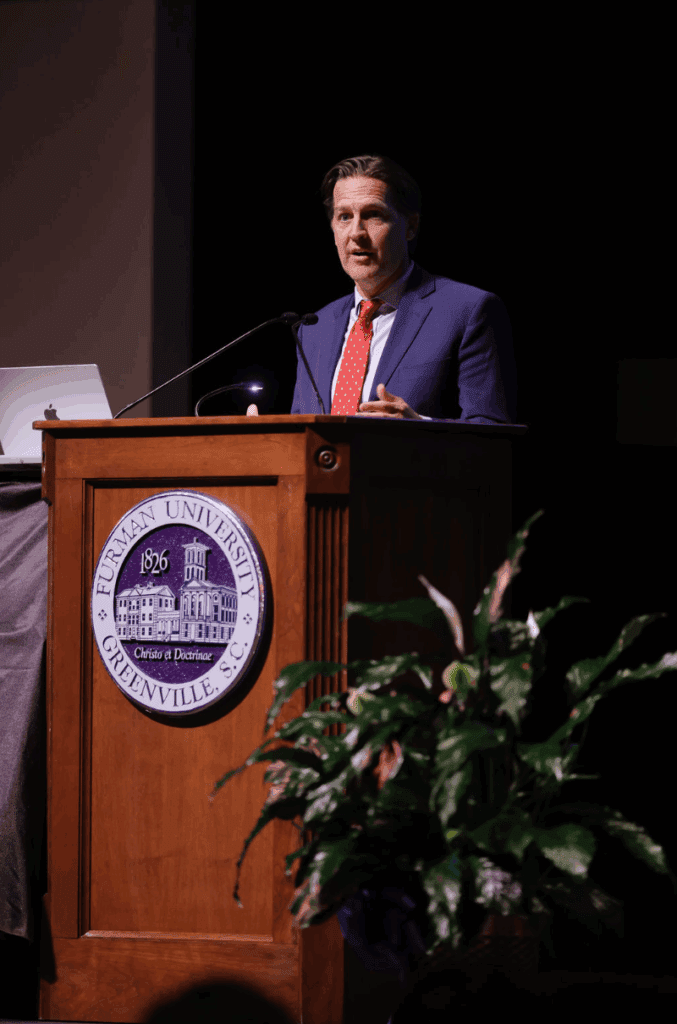
Ben Sasse situated the discussion within a broader civic transformation, arguing that America is undergoing change “as significant as the Industrial Revolution,” and that institutions must adapt without surrendering their core mission.
He drew a sharp philosophical distinction:
“There are communities of place and there are communities of idea.”
Universities, he argued, must remember which they are — or risk dissolving into either partisan enclaves or mere vocational pipelines. He emphasized that institutions can be economically relevant without becoming economically defined, and politically aware without becoming politically captive.
Sasse urged universities to resist media-driven polarization and reclaim the work of orienting students toward “the good, the true, and the beautiful.”
John Tomasi: Loving Universities “the way Socrates loved Athens”
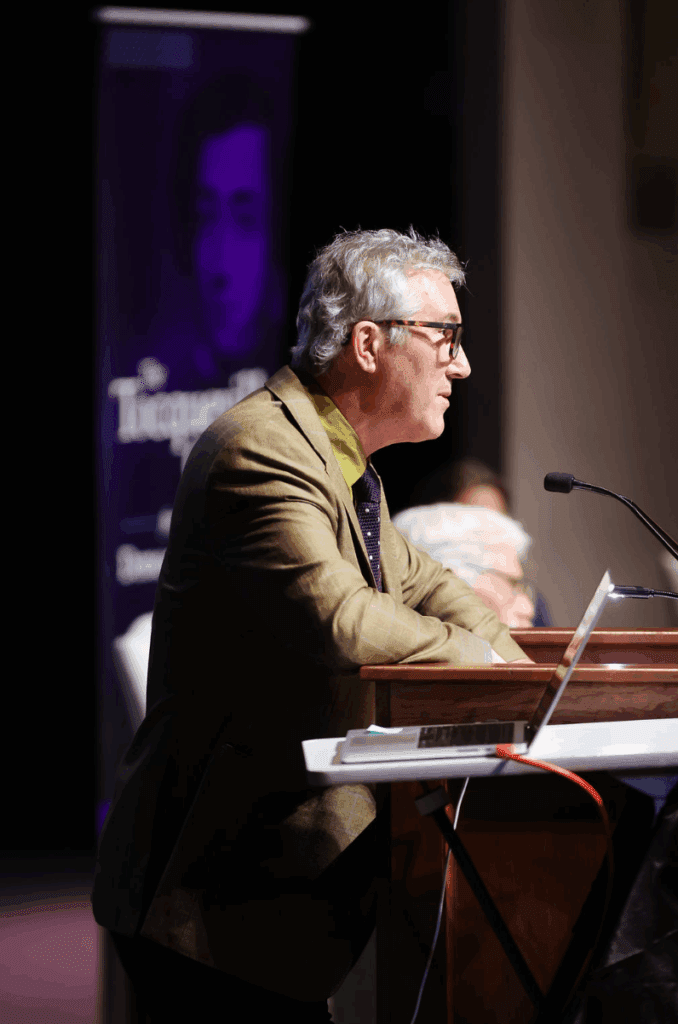
Tomasi began with a provocation delivered with warmth:
“We love our universities the way Socrates loved Athens — not uncritically, quite critically, but passionately.”
He warned against weaponizing free speech as a partisan tool:
“We don’t want a safe-space culture for the right.”
Tomasi emphasized that intellectual life requires vulnerability, candor, and the willingness to be wrong — publicly — in pursuit of truth. He quoted former Brown University president Ruth Simmons’ convocation address:
“Our covenant is rooted in quarrel and in opposition.”
Here, disagreement is not pathology; it is the lifeblood of higher learning.
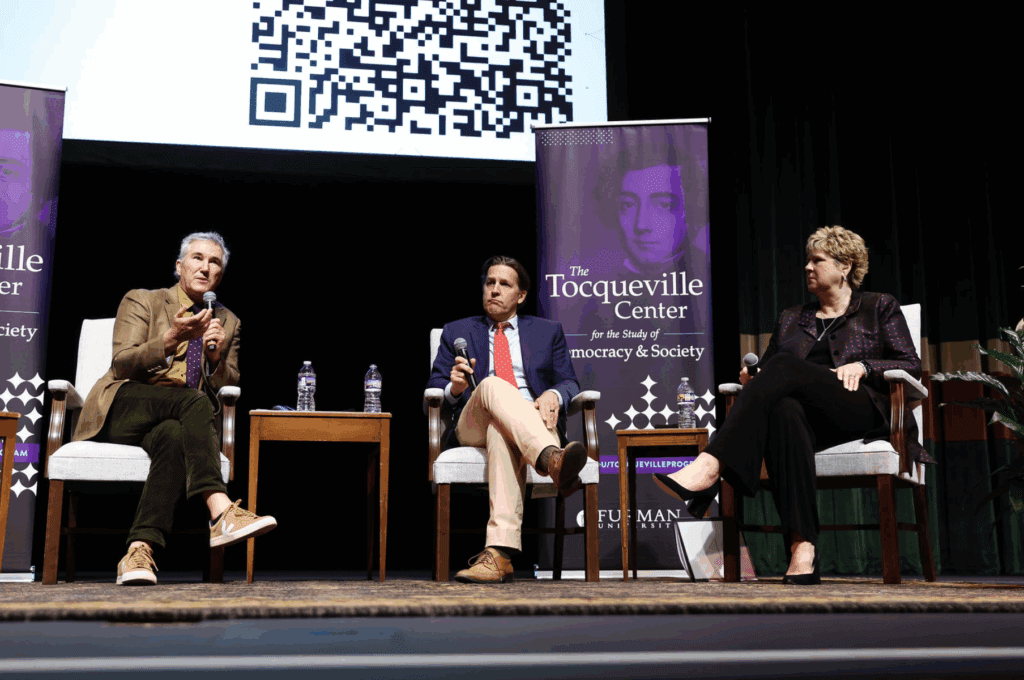
A Conversation That Refused Easy Answers
Rather than trading slogans, the panel kept circling back to a deeper question rarely asked in public life: what is a university for? President Davis grounded the answer in formation and belonging rooted in free thought. Tomasi emphasized the discipline of disagreement. Sasse widened the frame to civic trust and democratic culture. Sparks never erupted, yet there was tension — a kind rooted not in hostility but in the rigor of being forced to think in real time, in front of an audience, without hiding behind stock answers. In that sense, the conversation itself became a defense of the liberal arts: unfinished, searching, and alive.
On Discourse: Practicing Free Expression with John Tomasi
The evening before the Homecoming panel, John Tomasi led an On Discourse workshop that asked students not simply to listen, but to practice the habits of a free university.
“This is not going to be a lecture experience for the strong, silent type,” he began, setting the tone for a session built around thinking aloud, writing ideas, sharing them with strangers, and risking being wrong.
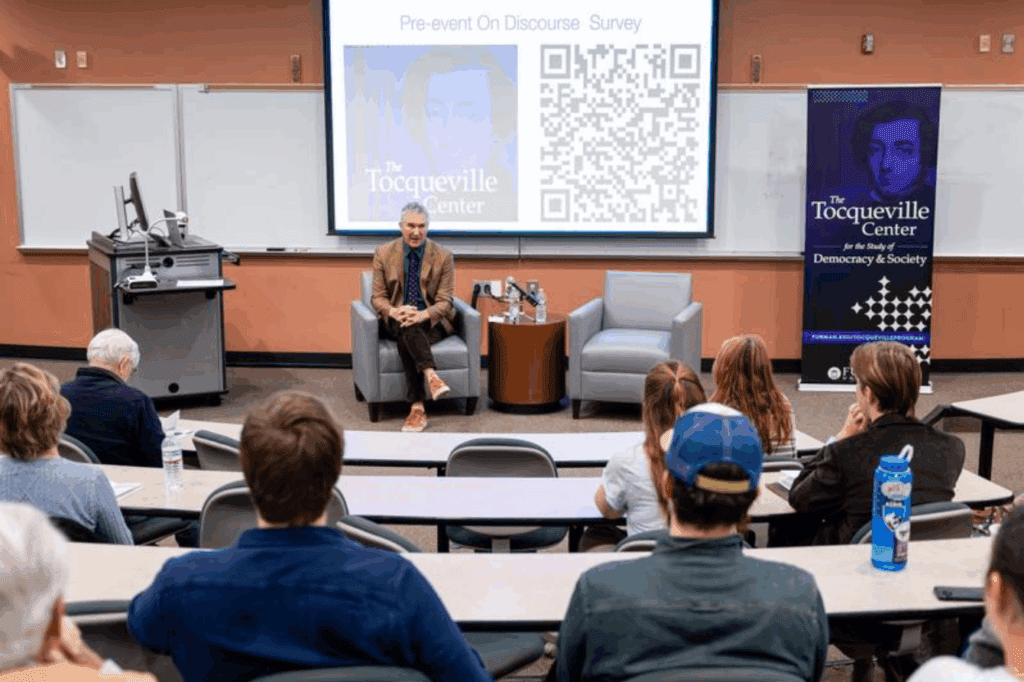
Tomasi opened with a question: what is a university for? He drew on Plato’s Academy — a grove outside the city, apart from politics and economic necessity — and described a campus as a “garden for curiosity,” where disciplines grow like trees, professors are gardeners, and students are “quadrennials” cultivated for a brief but formative period.
Speech and thought, he argued, rise or fall together. Free speech is not chaos, just as “free driving” is not swerving across every lane; shared norms and mutual risk make freedom meaningful.
Students reflected privately on the meaning of free expression, then turned to one another to compare answers. Some argued for civility and persuasion; others insisted that confronting power sometimes requires sharper language and protest. One student also raised the question of the limits of tolerance. The room wrestled with how to balance openness, courage, respect, and truth-seeking.
Tomasi emphasized the university as cultivating the discipline of disagreement — the willingness to be challenged and to speak anyway.
Rather than concluding with consensus, the session ended in shared seriousness. The point was not to settle arguments, but to experience the work of academic freedom: thinking with others, in public, with humility and nerve.

Audience Questions: What the Community Wanted Answered
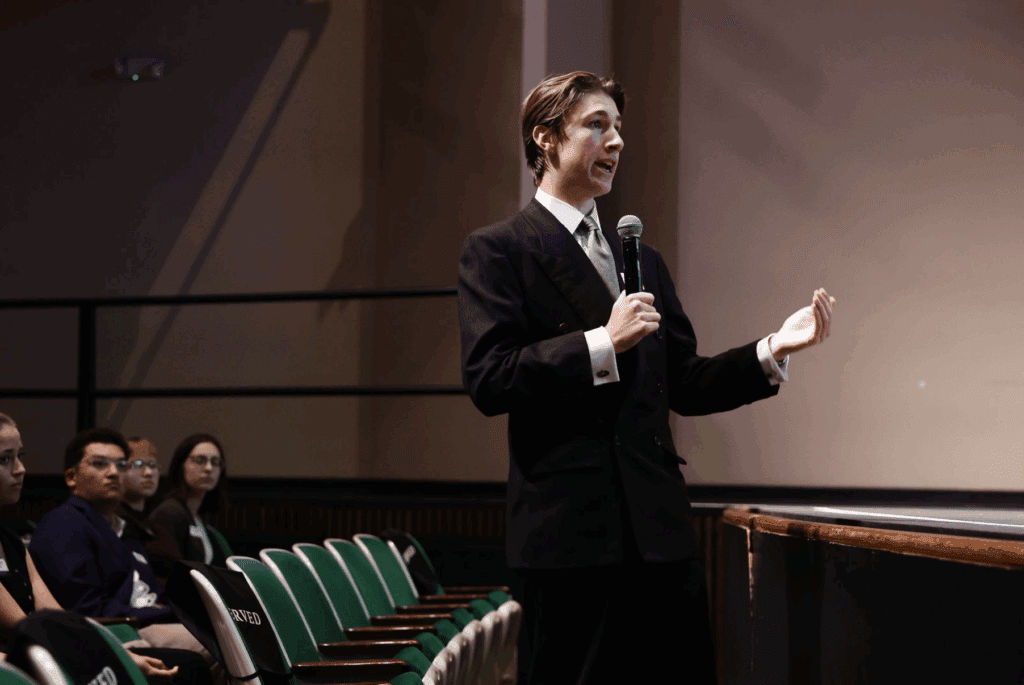
Not all questions could be addressed from the stage at the Homecoming panel. In the spirit of open inquiry, we are sharing the concerns and curiosities raised by students, alumni, parents, faculty, and friends.
Free Speech and Intellectual Culture
What speech ought to be considered intolerable, if any, and on what grounds?
Do universities restrict speech today through social pressure rather than rules?
How should campuses balance free inquiry with students who say they feel unsafe hearing opposing views?
How can institutions protect dissent without turning “viewpoint diversity” into a partisan refuge?
Trust, Legitimacy, and the Public Role of Universities
Is declining trust in higher education necessarily bad?
Should fewer Americans go to college?
What role does financial transparency play in restoring confidence?
Mission, Governance, and Reform
If one reform could be enacted in the next two years, what should it be?
Where should reform begin — trustees, faculty, students, legislators?
How do universities remain independent amid political legislation and compacts?
Diversity, Pluralism, and Campus Community
How do we build inclusive communities amid disagreement on immigration, religion, and sexuality?
Does rejecting DEI initiatives risk abandoning real commitments to pluralism?
How do we prevent classrooms from becoming ideological pulpits?
The Future of Learning: Technology, AI, and Formation
What is the impact of social media on campus discourse?
How will AI tutoring reshape the role of professors?
Does heavy reliance on technology weaken critical thinking and formation?
A Tocquevillian Charge
Both events returned to a single, animating conviction: democratic citizenship requires intellectual fortitude. Universities must cultivate those citizens, not by avoiding conflict, but by engaging it seriously, empathetically, and in common pursuit of truth.
The Tocqueville Center will continue this work — through debate, dialogue, and disciplined inquiry — with confidence that the future of democracy depends on the habits learned in spaces like these.