The Tocqueville Fellows’ Retreat: Education, Friendship, and the Work of Thought
Each spring, the Tocqueville Center takes its Fellows to Asheville for a weekend retreat. This year’s gathering, held April 10–12, was arranged to allow for sustained attention—something difficult to achieve in the normal flow of the semester.
The retreat was held in Asheville, North Carolina, at the Crowne Plaza Resort, a setting that lends itself to the rhythm of the weekend. Set against the Blue Ridge Mountains, the location provides a degree of separation from campus without feeling remote. The grounds allow for easy movement between seminar space, dining, and informal conversation, while the surrounding landscape—wooded, open, and quiet—gives students room to step away and reflect between sessions.

The Crowne Plaza Hotel, Asheville, NC
The retreat centers on a single seminar, extended across four sessions, with time built in for meals, conversation, and reflection. The aim is depth. Students stay with a set of questions long enough for them to become genuinely difficult.
Nietzsche and the Problem of Perspective
This year’s seminar, led by Paul Wilford, took up the work of Friedrich Nietzsche—especially his reflections on history, culture, and morality. Wilford is a political theorist affiliated with the Chase Center for Civics at Ohio State University, where he teaches and leads seminars in classical political thought. His work focuses on modern European philosophy and the problem of how individuals and societies understand themselves in relation to the past. In seminar, he is known for a demanding but clarifying style: close attention to the text, careful distinctions, and a refusal to allow questions to be settled prematurely.
That approach set the tone for the weekend. Nietzsche’s claim—that the philosopher must learn to “overcome his time in himself” —framed the central difficulty. If everything is understood historically, what becomes of judgment?
The seminar approached this as an educational problem. What habits of mind follow from historical awareness? What capacities does it leave underdeveloped?

History and Its Uses
The first session focused on On the Advantage and Disadvantage of History for Life. Nietzsche’s concern centers on the dominance of historical consciousness. When it becomes the primary mode of understanding, it reshapes how individuals relate to their own beliefs and commitments.
Nietzsche distinguishes between monumental, antiquarian, and critical history, but the deeper issue concerns proportion. Historical knowledge can illuminate, yet it can also unsettle. A person who sees every value as contingent may find it more difficult to commit to a course of action without reservation.
Wilford pressed the point in a straightforward way: students are accustomed to contextualizing arguments before they are asked to judge them. The discussion asked whether that sequence should always hold. At what point does explanation begin to displace evaluation?
The conversation remained close to the text, but it drew on the experience of education more broadly. The question stayed open: how much historical awareness supports a well-ordered life, and when does it begin to erode conviction?
Culture and the Formation of Character
The second session turned to the cultural implications of Nietzsche’s critique. If historical consciousness weakens commitment, what follows for the formation of character?
Nietzsche’s account of the “surfeit of history” suggests that excessive awareness of contingency can produce indifference. When norms and values appear endlessly variable, detachment can become habitual.
Students examined whether this description applies to contemporary academic life. Many recognized a tendency to analyze without affirming, to hesitate before making claims that carry weight. Wilford did not resolve the question. He returned repeatedly to the text, asking what Nietzsche is diagnosing and whether the diagnosis fits.
The discussion centered on education as formation. If education shapes the person, it must address the conditions under which conviction becomes possible.
Morality and Its Genealogy
The third session addressed Nietzsche’s analysis of morality, particularly his account of master and slave morality. The discussion brought into focus the historical character of moral concepts.
Nietzsche’s argument—that dominant moral frameworks may have emerged from specific social and psychological conditions—raises questions about their present authority. If moral values have histories, their justification requires more than widespread acceptance.
Wilford’s approach here was methodical. Students worked through the distinction between explaining the origin of a moral belief and evaluating its truth. The two are connected, yet they are not identical. The conversation often returned to a single passage until its implications were clear.
This close reading of the texts led to a more general question: how should one assess moral claims that are widely shared and historically contingent?

Progress and Judgment
The final session considered Nietzsche’s critique of progress. Modern societies tend to understand themselves as having advanced beyond earlier forms of life. Material improvement, expanded rights, and increased freedom often serve as markers.
Nietzsche asks whether these developments correspond to an increase in human excellence. The question requires a standard of evaluation, and it is not immediately clear where such a standard is to be found.
Students considered what it would mean to assess progress without relying solely on narratives of historical improvement. Are there criteria by which different forms of life can be judged? If so, how are they established?
Wilford returned to the earlier concern with judgment. To evaluate progress, one must have some measure that does not simply mirror the present.
The Structure of the Weekend
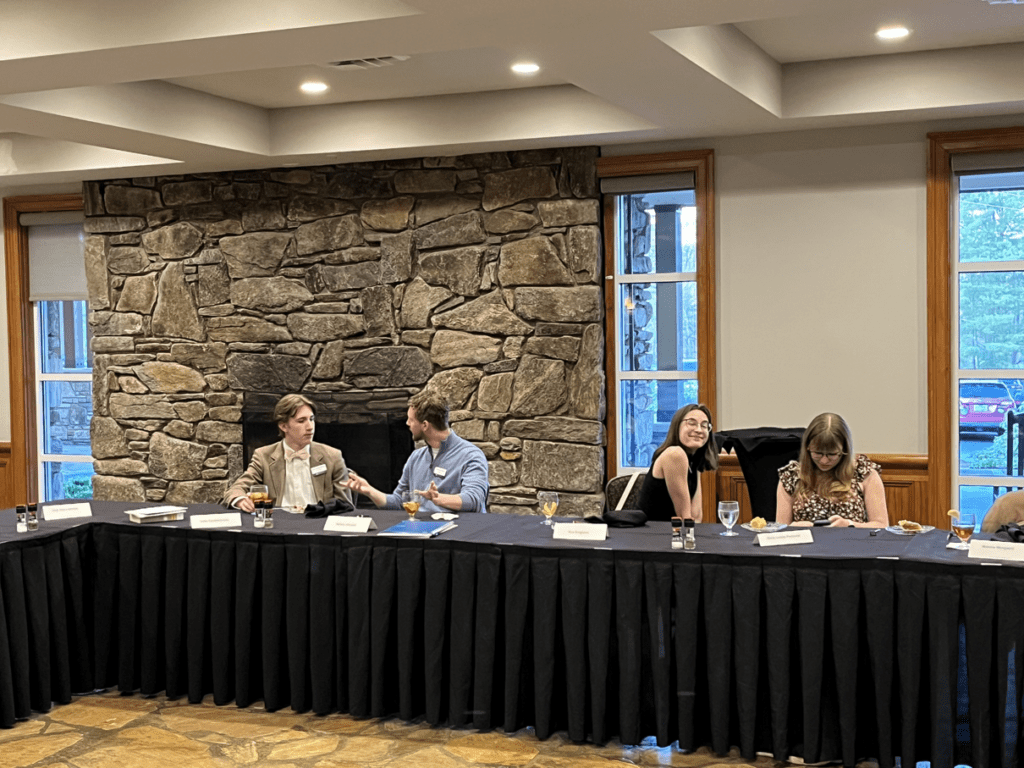
The intellectual work of the seminar depends on the structure of the retreat. The schedule—sessions interspersed with meals and informal time—allows conversations to develop gradually. Discussions begun in one setting continue in another, often with greater clarity.
Saturday included three seminar sessions, with time in the late afternoon for rest or smaller conversations, followed by dinner off-site and continued discussion into the evening. By Sunday morning, the group returned for a final session before departing after lunch.
This continuity allows for sustained engagement. Students return to the same questions from different angles, testing them over time.
Conversation and Intellectual Friendship
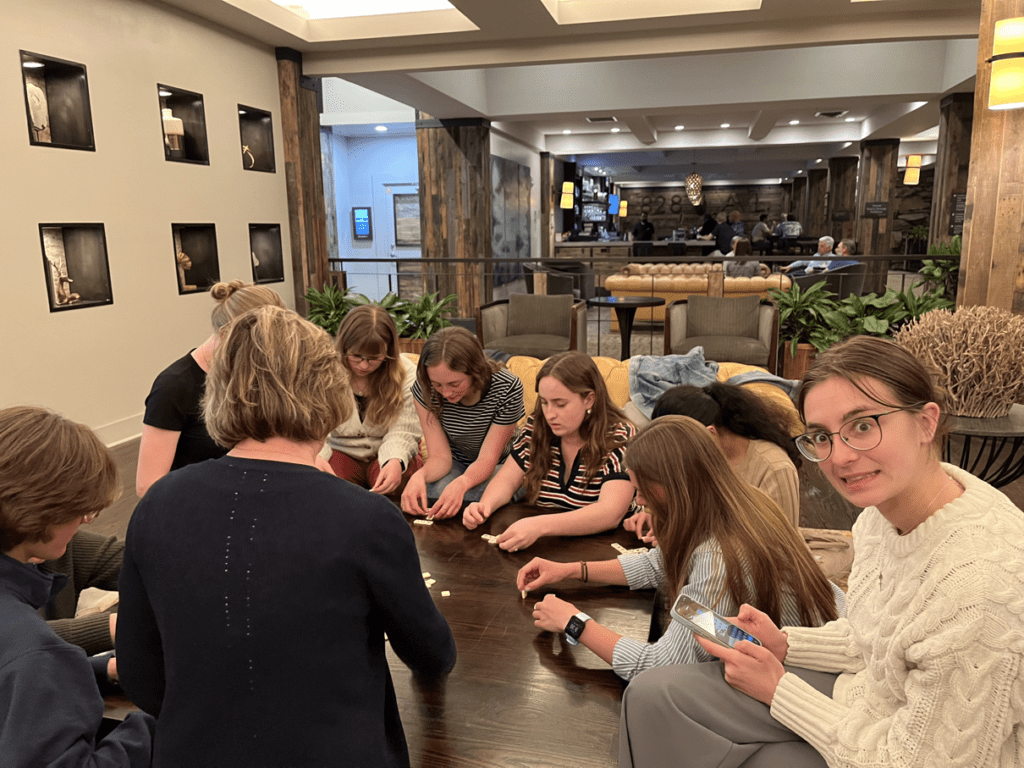
The retreat also creates space for conversation beyond the formal seminar. Students come to see one another as partners in inquiry, capable of disagreement without hostility.
This dimension supports the work of the seminar. Exchange depends on a certain level of trust and attentiveness. Without it, discussion becomes cautious or rigid. Over the course of the weekend, a different pattern can emerge. Students ask questions, revise positions, and respond to one another over time.
The result is sometimes agreement, sometimes disagreement, but the goal is to cultivate a more serious form of engagement.
Tocqueville and Democratic Education
Tocqueville saw that democratic societies have a way of settling into shared assumptions, less through pressure than through habit. People look sideways, take their bearings from one another, and over time the range of opinion can narrow without anyone quite noticing.
Education has to push against that tendency. It asks students to take their own thinking seriously—to examine what they’ve inherited, to listen closely to views they might resist, and to sit with questions that don’t resolve quickly.
The retreat creates a setting where that kind of work can actually happen. With time set aside and the usual distractions removed, students find themselves returning to the same questions across conversations, hearing them reframed, challenged, and sharpened in the company of others.