Summary of Europe and America: Democracy, Power, and the Transatlantic Moment
In November, the Tocqueville Center for the Study of Democracy and Society concluded its fall lecture series with a two-part event that brought together three of the most influential scholars of European politics and political economy to address a question that now presses with renewed urgency: what is happening to the transatlantic relationship—and what does it mean for democracy, sovereignty, and political order on both sides of the Atlantic?
Over two evenings in the Watkins Room of the Trone Student Center, Liesbet Hooghe, Gary Marks (both of the University of North Carolina at Chapel Hill), and Matthias Matthijs (Johns Hopkins University, SAIS) examined Europe’s internal political transformations and their external consequences in an age shaped by populism, geopolitical rivalry, and renewed American unilateralism.
The result was not a set of isolated lectures, but a sustained conversation—one that moved from empirical analysis of party systems to structural theories of European integration, and finally to the strategic dilemmas facing Europe in the shadow of a changing United States.

Brent Nelson, Director of the Tocqueville Center
The Tocqueville Center and the Big Questions
Opening the second evening, Tocqueville Center Director Brent Nelsen situated the event within the Center’s broader mission.
“We’re about the big questions in the Tocqueville Center. We like to ask questions like what does it mean to be human and what does the good society look like and how do we govern ourselves without destroying the possibility of human flourishing?”
Yet, as Nelsen emphasized, big questions require grounding in political reality. Data, institutions, and power relations matter—especially when democratic norms themselves are under strain.
That balance between normative concern and empirical rigor defined both evenings of discussion.
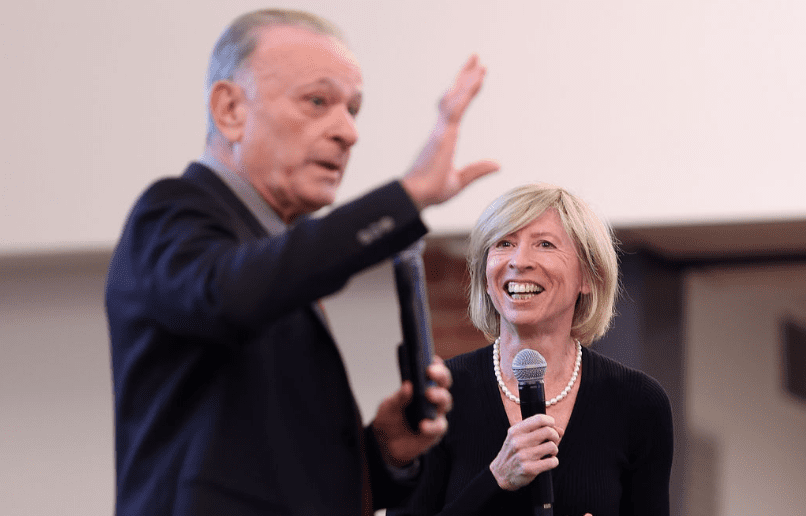
Liesbet Hooghe and Gary Marks speaking at the Furman University Tocqueville Center event on European politics.
Part I: The Rise of the Radical Right and the Future of Europe
November 11
The first evening, “The Rise of the Radical Right and the Future of Europe,” featured Hooghe and Marks, whose collaborative work has shaped the study of European integration, multilevel governance, and party competition for decades.
Drawing on the Chapel Hill Expert Survey (CHES)—the leading dataset on party positions across Europe—their presentation traced the steady rise of what they term TAN parties: parties organized around Tradition, Authority, and Nationalism. Unlike earlier Euroskeptic movements, these parties now operate not at the margins but increasingly at the center of European politics.
Their argument was not that Europe is experiencing a simple rightward swing, but that political conflict has been restructured. Economic left–right competition has been partially displaced by cultural and territorial conflict—over national identity, immigration, sovereignty, and the authority of supranational institutions.
What emerged was a picture of Europe as politically fragmented yet structurally interdependent: electorates increasingly skeptical of integration, but states increasingly unable to act alone.
This tension—between national political pressure and functional interdependence—set the stage for the second evening’s discussion.

Matthias Matthijs on Europe, the United States, and the transatlantic challenge.
Part II: The Transatlantic Trump Trap
November 12
If the first night examined Europe’s internal political realignment, the second night widened the lens. In his lecture, “The Transatlantic Trump Trap,” Matthias Matthijs asked a deceptively simple question:
Under what conditions does crisis actually produce meaningful political change?
Matthijs began by challenging one of the most familiar clichés of European studies—the oft-quoted line attributed to Jean Monnet that Europe is “forged in crisis.”
“What I find annoying about this line is that of course there’s some truth to it… but it’s massively overdetermined. There are so many crises where nothing happens.”
For Matthijs, the real task is to explain when crises lead to deep transformation—and when they result only in temporary fixes or strategic retreat.
From Rules to Tools: A Structural Shift in Europe
Matthijs proposed a long-range, structural account of European integration, organized around three major phases:
-
Postwar Embedded Liberalism – shaped by full employment, welfare states, and American security guarantees.
-
Neoliberal Integration – marked by rule-based governance, market integration, and constraints on national discretion.
-
The Emerging Geoeconomic Era – defined by economic security, resilience, and strategic autonomy.
“We live in a very different world today where what governments are after… is economic security or economic resilience.”
This shift, he argued, has pushed the European Union away from being a purely regulatory project and toward developing geoeconomic tools—investment screening, industrial policy, trade defense mechanisms, and coordinated fiscal responses such as NextGenerationEU.
The EU, in other words, has begun to act more like a geopolitical actor—even if uneasily and incompletely.
The Return of Power Politics
Yet this emerging European sovereignty has been tested by a dramatic external shock: the return of Donald Trump to the White House.
Rather than strengthening European unity, Matthijs argued, Trump’s second presidency has exposed a profound strategic vulnerability.
“Since Trump’s return… Europe’s reaction has been one of appeasement.”
He identified a three-fold pattern:
-
Defense and Security: Rapid accommodation of U.S. demands, deepening reliance on American defense supply chains.
-
Trade and Investment: Acceptance of asymmetric tariff arrangements rather than coordinated retaliation.
-
Democracy and Rule of Law: Strategic silence in response to democratic backsliding in the United States.
The result, Matthijs warned, is a dangerous feedback loop.
“Appeasement is very different from autonomy. It entrenches hierarchy…. Europe became too dependent on Russia for its energy, on America for its security, and on China for its growth.”
Domestic Politics and the Populist Constraint
Why has Europe chosen accommodation over resistance?
The answer, Matthijs suggested, lies not only in geopolitics but in domestic political fear. Centrist elites, facing strong nationalist and populist parties at home, are reluctant to risk economic disruption or security confrontation.
Yet this caution may be self-defeating.
“As Europe gets humiliated, populists gain.”
Appeasement makes American unilateralism appear successful—and strengthens precisely the political forces that oppose European integration from within.
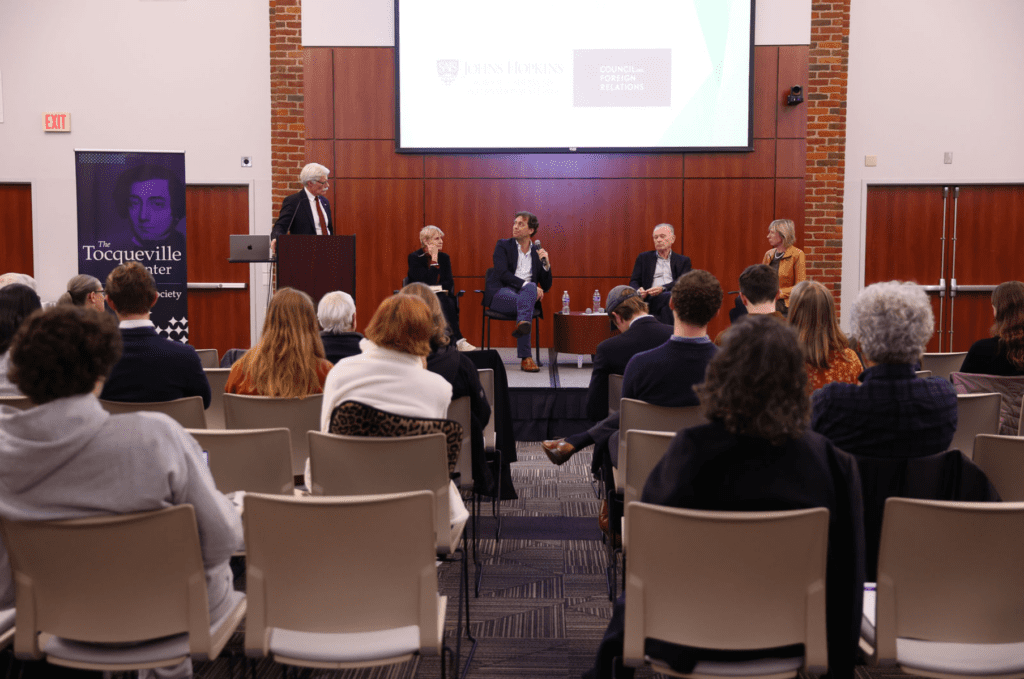
Panel discussion with Brent Nelsen, Marian Stroble, and guest speakers Matthijs, Marks, and Hooghe.
Panel Reflections: History, Geopolitics, and the Long View
The response panel—featuring Hooghe, Marks, and Furman historian Marian Strobel—deepened the discussion by placing the present moment in historical and theoretical context.
Hooghe: Denial and the Hope of Reversal
Hooghe emphasized that European elites may still be operating under a mistaken assumption: that American politics will soon “return to normal.”
“There probably is still a bit of denial of what is happening in this country… a reliance on a domestic reversal in the US.”
This hope, she suggested, may explain Europe’s reluctance to pursue full strategic autonomy—even as transatlantic trust erodes.
Marks: Europe’s Unused Power
Marks returned to the foundational question of geopolitics.
“The European Union began in geopolitics… and then we started to say the European Union exists in isolation from geopolitics.”
That illusion, he argued, is no longer tenable. Europe possesses immense latent power—economic, regulatory, demographic—but has been hesitant to wield it strategically.
“The European Union and China together have a greater GDP than the United States.”
The danger of Trump’s approach, Marks warned, is not only immediate disruption but the long-term incentive it creates for Europe to rethink its strategic alignments.

Marian Strobl, Brent Nelsen, and Matthias Matthijs during the Tocqueville Center panel on Europe, America, and transatlantic politics.
Strobel: Cycles of American Unilateralism
Strobel offered a historian’s caution. American ambivalence toward alliances, she noted, is not unprecedented.
From the interwar tariff regime to isolationist impulses before World War II, the United States has periodically retreated from cooperative leadership—with destabilizing consequences.
“Are we seeing a cyclical pattern in U.S. policies, or is Donald Trump suggesting something new?”
Her conclusion was sobering: Europe now faces not just uncertainty abroad, but volatility rooted in the U.S. political system itself.

The Audience: Democracy as a Lived Question
Student questions pushed the discussion further—probing whether a European defense coalition could emerge, whether nationalism would ultimately fragment or consolidate Europe, and whether American pressure might paradoxically strengthen European identity.
The answers were cautious but clear. Europe’s future will not be decided by rhetoric alone, but by hard choices—about defense, energy, trade, and political solidarity.
Choosing Europe
In his closing remarks, Matthijs offered a final clarification.
“Strategic autonomy is not anti-Americanism. It just means you choose Europe.”
That choice, the speakers agreed, is becoming unavoidable. The transatlantic relationship is no longer sustained by habit or shared assumptions alone. It must now be renegotiated under conditions of uncertainty, pluralism, and power politics.
What emerged across both nights was not a single forecast for Europe’s future, but a clearer sense of the forces now shaping it—from nationalist backlash and institutional constraint to geopolitical pressure and strategic dependence. The Tocqueville Center’s task is not to resolve those tensions, but to illuminate them—and in doing so, to equip students and citizens to think more clearly about democracy under strain.
The Tocqueville Center reconvenes in January with a program on the American Constitution. Details can be found here.