Lecture Summary: “American Patriotism. Discuss.”
A Furman University event featuring civil disagreement and viewpoint diversity to counter increasing polarization
Is it possible to have a civil disagreement about politics or find viewpoint diversity at a university campus in present-day America?
There’s no question that university campuses are often hotbeds of America’s increasing polarization, with protests at times turning violent, de-platforming of controversial speakers, and cancelation of those with views deemed unacceptable to the dominant culture.
The Tocqueville Center and Furman’s newly minted On Discourse initiative aim to counter these trends by building capacities for civil disagreement.
On Discourse states that its mission is “to teach and engage the campus community in constructive discourse, debate, dialogue, discussion and conversation with those who think differently than they do on issues that concern Furman, our nation, and the world.”
The Tocqueville Center hosts “curricular and extracurricular activities designed to help students and faculty to engage seriously with the most powerful arguments behind diverse and competing religious, political and ethical points of view.”

On Thursday, November 14, 2024, the Tocqueville Center and On Discourse combined forces to promote civil disagreement by co-hosting an event titled “American Patriotism. Discuss.”
Facilitating dialogue across differences by combining diverse panelists with audience small-group discussions
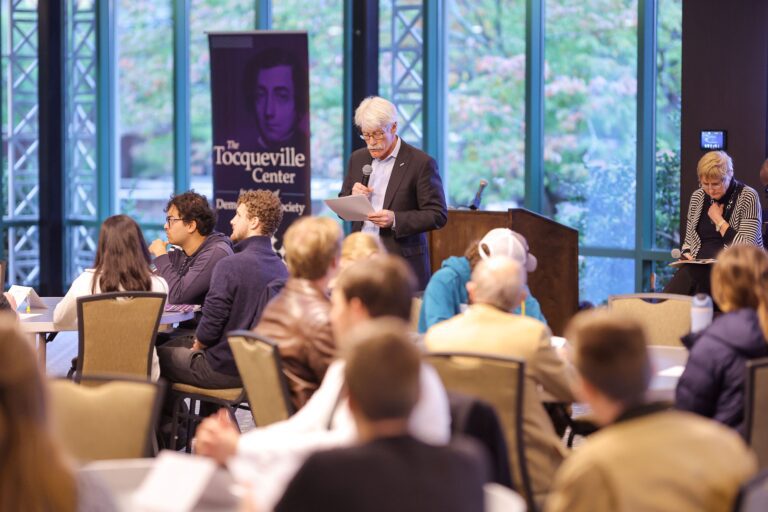
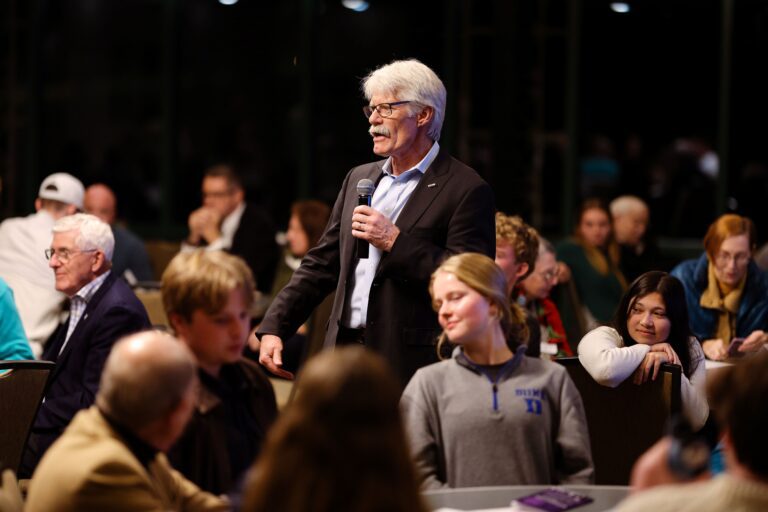
Breaking with the usual set-up of a lecture, where speakers on a stage face a theater-style audience, the event featured bar stools for the speakers and round tables for the audience with randomly assigned seating.
In the panel portion of the event, three speakers presented to the audience in the style of a traditional CLP event. But the speakers were selected for their distinctly differing views on patriotism, and their time was equally balanced with time allotted for small-group discussions among audience members.
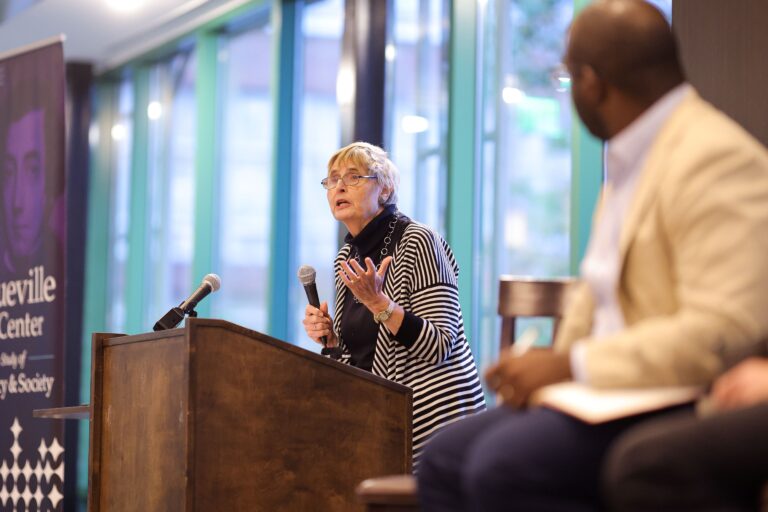
Furman historian Marian Strobel began with an 8-minute overview of American exceptionalism—the belief that the United States is uniquely blessed by God to spread freedom worldwide—from John Winthrop to Donald Trump.
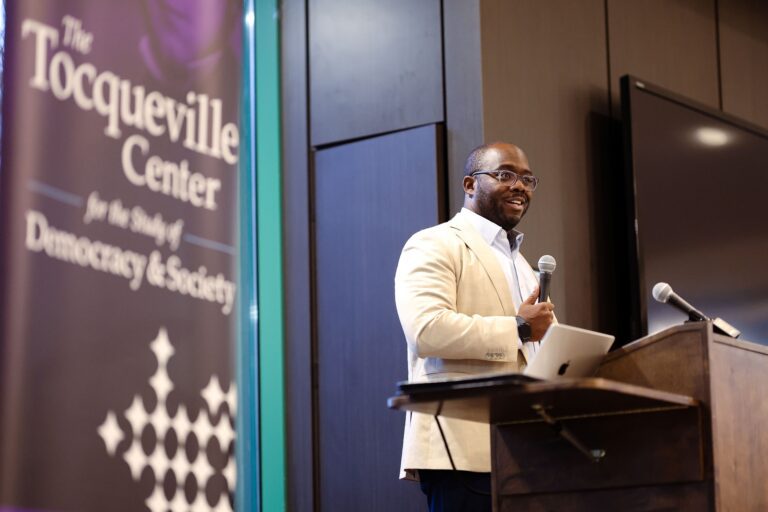
Wheaton College New Testament scholar and New York Times columnist Esau MacCaulley followed with insights from his July 4th column on what patriotism means to a black man. In a blog for the Tocqueville Center, Tocqueville Fellow Sim Colson described MacCaulley’s view as follows: “feelings of ‘love, pride and regret can reside in the same heart,’ … [which] is a critical patriotism that exhibits a deeper love of country”.
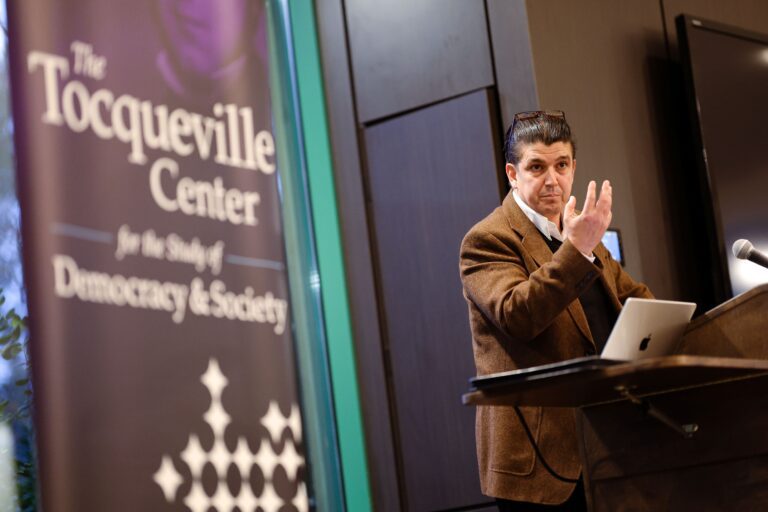
Finally, Furman political scientist Akan Malici critiqued the concept of patriotism itself, calling it “cheap grace”—protection without sacrifice.
Responses to this presentation of viewpoint diversity were enthusiastic and promoted self-reflection. Students surveyed after the event commented:
“It was interesting to hear all three speakers share their perspectives on American patriotism. As a Nepali, I had always assumed that all Americans viewed patriotism in the same way, but I was wrong.”
The panel presentations sparked a spirited yet respectful debate among the speakers, who had a chance to comment on each other’s views before the audience broke into group discussions. Their ability to disagree civilly provided a strong model for the audience.
Small-group discussions aimed at practicing civil disagreement and viewpoint diversity
For much of the 90-minute event, attendees engaged in discussions at their tables using a set of prompts. They began with:
Which of the three perspectives on patriotism outlined by the panelists do you feel best represents your position? Why? Is there a fourth perspective that better reflects your view?
and concluded with:
Is it possible to be patriotic and still protest—such as kneeling, sitting, or turning away from the American flag—during the national anthem?
The table discussions were lively, with trained facilitators available to address any issues. At the end of the evening, several tables shared a summary of their discussions.

One table revealed that their discussion over flag burning had elicited strong feelings from entirely opposite perspectives.
Another told attendees the surprise that members of their group felt when one member shared having faced a situation as an immigrant to America where they felt forced to hold the American government to their own ideals, as enumerated in the United States Consitution.
A student who was surveyed after the event continued the theme of immigration and patriotism, commenting
“For me, navigating my identity meant reconciling the idealized image of America with the lived reality of being an outsider, of being constantly reminded that my family’s story didn’t neatly fit into the grand narrative of American exceptionalism.”
A student originally from South America told how he had connected with a professor in his group, who was also an immigrant to America, over their shared preference for America over their home countries, detailing how their views of American patriotism had been shaped by a loss of love for their homelands of origin.

Forging a new path to restore civil disagreement on college campuses
Addressing challenging topics is never easy. However, committing to respectful dialogue and listening to differing perspectives is a crucial step toward building community across divides.
Exposing campus communities, especially students, to these kinds of events marks a promising shift away from political polorization and cancel culture.
Furman’s students are responding positively, stating
“I found the event both thought-provoking and inspiring. It provided a nuanced view of nationalism….”
and
“The biggest thing I learned was how different people define patriotism vastly differently.”
On Discourse claims the initiative aims “to forge a new path—one of robust engagement rooted in free expression and inquiry, critical thinking, and deep listening.”
 The Tocqueville Center has a nine-year history promoting deep dives into the diverse arguments for the enduring questions of political, religious, and ethical life.
This event, and those like it, reminds us that one thing we all indisputably share in common is an ability to ask the questions that matter most, such as, What is patriotism? Our common humanity as questioners engaged in difficult conversations across diverse viewpoints is something surely worth remembering, especially in these increasingly contentious times.