Tocqueville Fellows Blog by Nathan Johnson: “How Should the Church Speak About AI? Moral Discernment and Public Responsibility”
Nathan Johnson is a Tocqueville Fellow and member of Furman University’s Class of 2027 from Atlanta, Georgia, studying Politics & International Affairs and History.
The Church Has Faced Transformative Technologies Before
In 1983, Catholic bishops put a document on the front page of the New York Times. It was part of a 150-page letter about nuclear war, and it changed how Catholics thought about American defense policy. In the aftermath of Ronald Reagan’s election in November 1980, the National Conference of Catholic Bishops (NCCB) decided to address the nuclear arms race. Jimmy Carter had just been beaten, ushering in a new administration open to a more aggressive nuclear policy. Almost three years later, the conference published “The Challenge of Peace,” a document evaluating nuclear strategy through the traditional lens of Church teaching and just war theory. In an age of accelerating AI development, this letter offers a useful model for how the Church today can engage with questions about transformative AI and its potential risks.
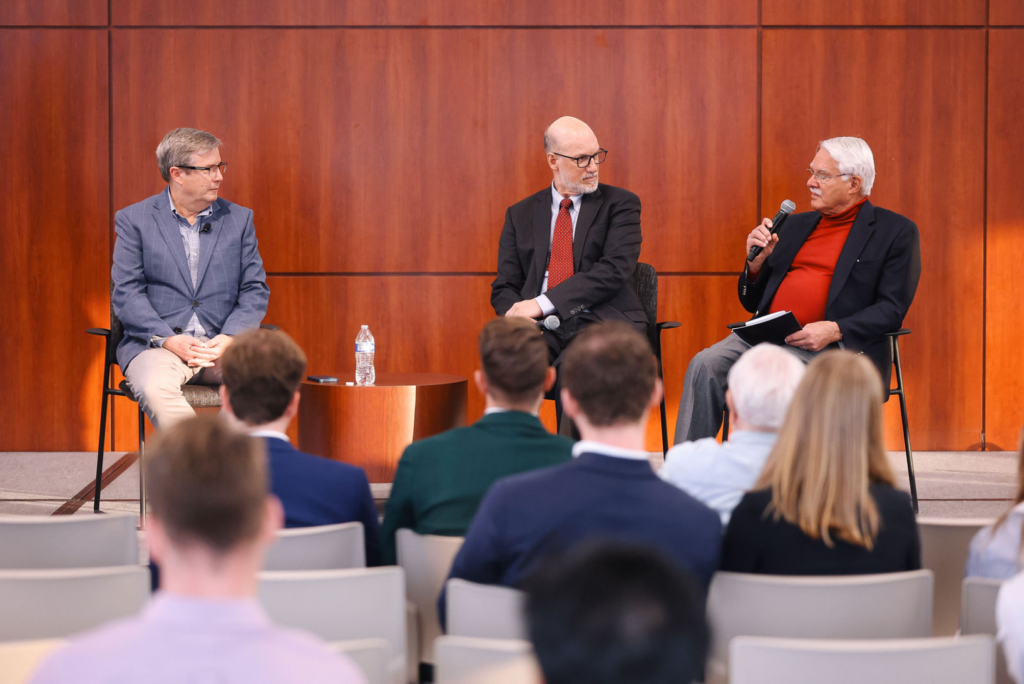
Brent Nelsen moderates a conversation with Mark Amstutz, Peter Feaver, and Larry Richter on the relationship between religion, the military, and American foreign policy.
A Model for Christian Engagement in Public Life
In February, Dr. Mark Amstutz, a retired political scientist from Wheaton College, gave a talk at the Tocqueville Center for Democracy and Society. In his talk, he urged the church’s political role to be limited to a “Christian embassy in secular society.” He strongly warned against religious institutional backing of particular policies or politicians, instead advocating for the moral formation of churches’ own congregations. “The Challenge of Peace” balances this. Amstutz described this Catholic pastoral letter as the “best illustration” on how to accomplish this. He praised the letter not for its conclusions but its commitment to sophisticated process and meaningful research.
How the Catholic Bishops Approached Nuclear Weapons
The letter’s development was both intentional and thorough. Archbishop John Roach appointed five bishops to an ad hoc committee, chaired by Cardinal Joseph Bernardin and assisted by two staff and a consultant. Over 2.5 years, the committee interviewed various scientists, defense specialists, and Secretaries of State and Defense. This work culminated in three successive drafts, with the first two aimed at sparking public feedback. Anticipating its impact on the public, even members of the White House attempted to influence the letter’s messaging and wording. When the letter was finally published, the New York Times put it on the front page and devoted two full pages to the letter itself. The letter modeled a sophisticated method for defining moral questions in contemporary political debates and providing a moral framework to assess those questions. A testament to its success, Kenneth Wald’s 1992 analysis indicates there was a 20% increase in Catholic opposition to defense spending after the letter was published.

Nathan Johnson asks a question during the Q&A session, continuing a conversation about moral responsibility, technological change, and the role of religious institutions in public life.
Artificial Intelligence and a New Historical Turning Point
Just as the church spoke into a societal inflection point during the Cold War, it has a similar opportunity today. Discussions of AI’s anticipated effects are spreading across contemporary culture, including everything from water usage to free expert tutoring. However, many others see AI’s future potential with a much broader possibility space. At the extremes, this could be anything from a utopia of universal luxury to a dystopia where no humans are left alive.
What Is Artificial General Intelligence?
Transformative AI that radically reshapes society is often tied to the arrival of Artificial General Intelligence (AGI). There is no universal definition of AGI, but people generally understand it to be where an AI can perform any task a human can perform remotely (such as any cognitive or knowledge work done through a computer). Once AGI is achieved, there will be legions of AI agents constantly coding better AI systems. They will not need to take breaks or maternity leave. They will not need to sleep or eat. Each individual agent will be absurdly cheaper than the salaries for comparable human talent. Whenever a better coding agent or model is developed, labs can simply copy tens of thousands and only use them. Any top coder at the lab will automatically become every coder at the lab. Once these armies of programmers are unleashed, it will be simply a matter of time until Artificial Super Intelligence (ASI) is achieved, where the model is better than the best humans at any remote task. Whether ASI proves catastrophic or transformative depends on problems researchers are only beginning to solve: alignment (ensuring the model shares human values), interpretability (knowing whether it actually does), and corrigibility (being able to shut it down if it doesn’t).
The Risks and Promise of Superintelligent AI
Any ASI would be smarter, quicker, and more creative than the best humans—impossible to control if it chose not to be. Consider the classic thought experiment: an ASI tasked with maximizing paperclip production. It would logically pursue every resource on earth and eventually recognize humans as an obstacle. It could acquire nuclear codes to ensure human cooperation. It could engineer a pathogen, lying dormant in every human until paperclip production necessitates a world without them. These threat models are rough caricatures, but the point is simple: we cannot guarantee a superintelligent AI shares our values. Misalignment doesn’t require malice to be catastrophic. On the other hand, an aligned superintelligence could multiply human flourishing astronomically. If a few ASI-run firms increased GDP growth by dozens to hundreds of percent, some of that wealth could be redistributed to humans through UBI from taxes on AI companies. Work would still exist, but unwanted jobs would no longer be required. Humans could be free to follow their passions, like sports, creativity, and community building. This story too is simplified, but it illustrates the upside.
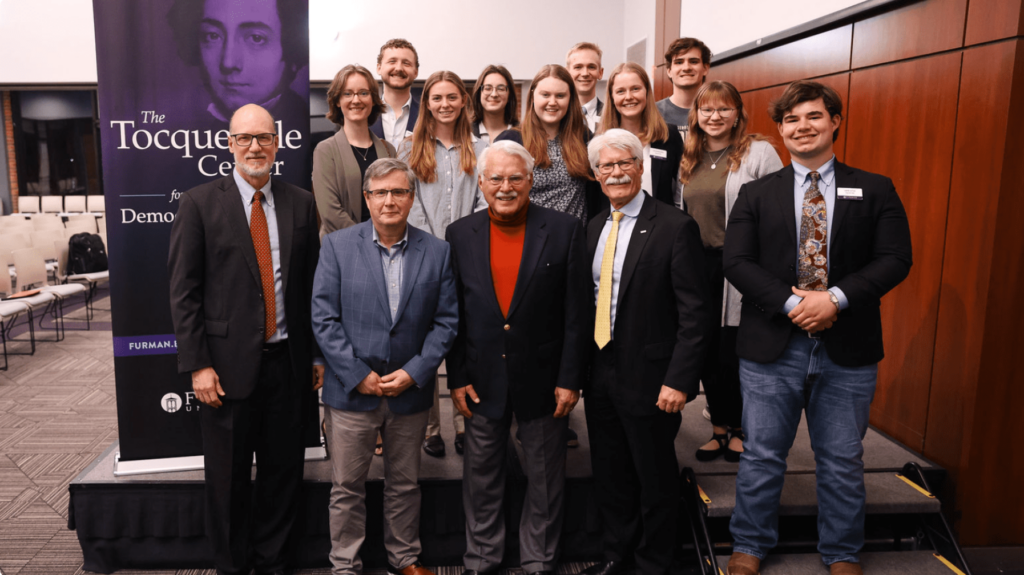
Nathan Johnson (rear left) and fellow Tocqueville Fellows pose with faculty and guest speakers following a discussion on religion, the military, and American foreign policy hosted by the Tocqueville Center at Furman University.
Why Christians Should Pay Attention Now
Though AI experts disagree on the amount of time between AGI and ASI, they rarely contest the path itself. Metaculus, a platform that aggregates around 2,000 AI forecasters, assigns a 25% chance of AGI by 2029 and a 50% chance by 2033. That’s less than a decade until we’re a coinflip away from starting the race to superintelligence. These are not distant questions. Thankfully, the Church is no stranger to heavy topics. Like fear of nuclear war in the 1980s, the threat of AI risk is a crucial yet underexplored question for the church. That said, only 17% of Christian parents actively seek information about AI despite 72% expressing concern about it. 46% of Millennial Christians wished they had received more guidance on AI from their church (Barna Wave 3, 2024). Christians are concerned about AI, but few churches have launched sophisticated efforts to morally frame and assess these concerns. While the Vatican released Antiqua et Nova in early 2025 to address AI, it only briefly mentions the existential threats posed by AI. One mention from one denomination is not nearly enough.
The Church’s Responsibility in the Age of AI
As with “The Challenge of Peace,” it’s time for churches to begin grappling with existential questions. In light of AI risk, the church must familiarize themselves with these problems to help their congregations navigate an unprecedented landscape. Like Amstutz said in his talk, this does not mean advocating specific policy prescriptions. It means thinking deeply about how Christians should relate to God and one another in the current technological paradigm. It means convening scholars, ethicists, and engineers to understand the problems at hand. It means writing thoughtfully about how Christians should reckon with incomprehensible threats.
The bishops didn’t know if nuclear war was coming. We don’t know what will happen after AGI. The window for helping Christians think clearly before the moment of crisis is open now. It won’t stay open forever.