Tocqueville Fellows Blog by Lane Lytle: “Onward Christian Soldiers: The Role of Church and Military in American Foreign Policy”
Lane Lytle (’27) is a Tocqueville Fellow at Furman University from Greenville, South Carolina, majoring in Politics and International Affairs and Communication Studies.
What is the role of the Church and the military in foreign affairs? Eyes are on both institutions, as fears that partisan politics is becoming more and more entrenched in our civil society. The Tocqueville Center event earlier this spring, Religion and American Foreign Policy, offered a variety of opinions that attempt to answer this question.
The recent lecture series included distinguished speakers Mark Amstutz (Professor of Political Science Emeritus at Wheaton College) and Peter Feaver (Professor of Political Science and Public Policy at Duke University).
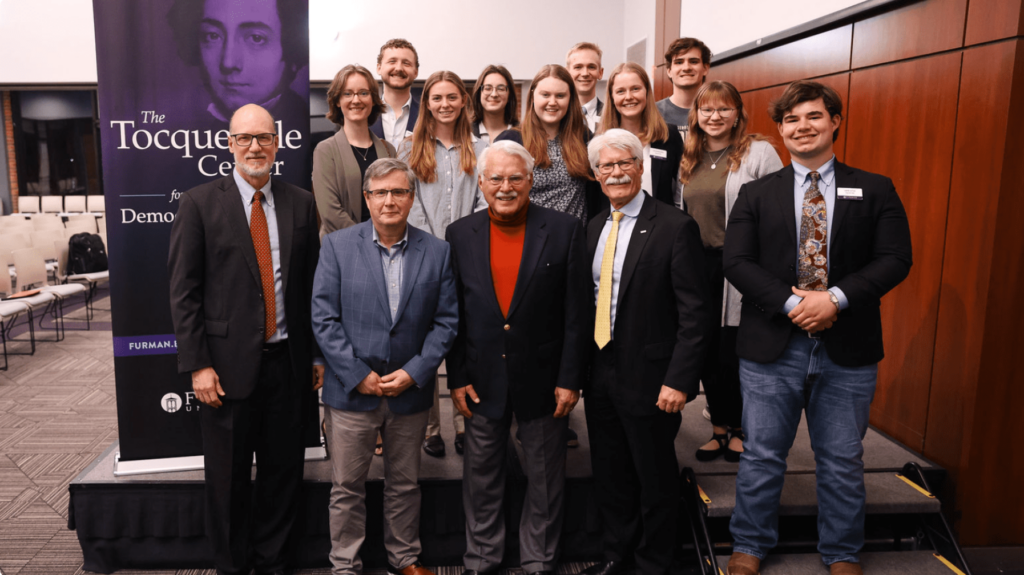
Lane Lytle (far right) and fellow Tocqueville Fellows pose with faculty and guest speakers following a discussion on religion, the military, and American foreign policy hosted by the Tocqueville Center at Furman University.
Moral Formation, Not Policymaking: The Church’s Primary Task
Dr. Amstutz spoke on the role of the Church in shaping foreign policy, arguing that character development to raise moral and educated civic citizens should be the role of the Church, not “pontificating” or deciding policy as an organization.
Dr. Feaver spoke about the role of the military in an increasingly partisan government. He argued that the role of the military is not to shape foreign policy. They should, however, uphold their oath to defend the Constitution. Feaver interpreted this oath as a call to be bipartisan, to not “pick favorites.” The ones who shape policy and dictate who gets to govern are supposed to be the people. “The role of the military is to defend, not govern.”
While Dr. Feaver’s talk was not directly about religion, both Dr. Amstutz and Dr. Feaver came to similar conclusions.
Both Amstutz and Feaver agree that the institutions they discussed in their lectures should not be directly involved in foreign policy. I disagree slightly with Dr. Amstutz. The Church’s role in foreign policy must be expanded to curb the surge of partisan politics. I agree with Dr. Feaver that the military’s role is not in nation-building or leading foreign policy. The Church is not the state in that it should enact foreign policy; however, it should be more involved.

Larry Richter, a retired U.S. diplomat, continues the conversation with students after the Tocqueville Center’s Religion and American Foreign Policy event.
Pluralism and Partisanship: Why Institutional Limits Still Matter
The issue with “the Church” directly leading foreign policy is that the United States is a melting pot of many religious identities, firmly protected in the First Amendment. The further issue of “the Church” directly leading is the many denominations in the United States. While many churches can agree on basic theological thresholds (the divinity of Jesus, Trinitarian theology, and the atonement needed for sin), not all do, and many have different interpretations of scripture and experience that shape their outlook on foreign policy.
Dr. Amstutz suggested developing moral character in people who come into contact with the Church, so that they go out as moral citizens. While this is essential, the Church (the majority of Christian denominations that agree with the aforementioned threshold) should speak out in support of policies rooted in Christian morals. To get to a place where the church can speak with a more unified voice, internal reconciliation between denominations is needed. With reconciliation between the denominations, not in becoming one denomination, but in becoming more like-minded, then the church can stand and speak.
Toward a Stronger Moral Voice: Expanding the Church’s Role Without Becoming the State
The morals that the Church can stand on are: caring for the poor, the widows, and the destitute; caring for the stranger; and treating your neighbor as yourself. The Church should lift up its voice together to weigh in on policies as it seeks to fulfill its purpose of spreading the gospel, yes, but also to “Honor everyone, Love the Brotherhood. Fear God. Honor the Emperor” (1st Peter 2:17).