Summary of Religion and American Foreign Policy, Feb. 18-19 2026: Faith, Force, and the Republic
Tocqueville Center Hosts Mark Amstutz, Peter Feaver, and Larry Richter on Faith, Foreign Policy, and the U.S. Military
Over two evenings in February, the Tocqueville Center for the Study of Democracy and Society at Furman University hosted a rich conversation on religion, American foreign policy, and the role of the military in a polarized age.
The two-part series brought together three voices with distinct forms of expertise: political ethicist Mark Amstutz, civil–military relations scholar Peter Feaver, and retired diplomat Larry Richter. Across the two events—“The Church and Global Peace” and “The American Military and the Culture Wars”—the speakers examined how moral conviction, democratic institutions, and military power shape America’s role in the world.
Faith and the Moral Foundations of Global Order
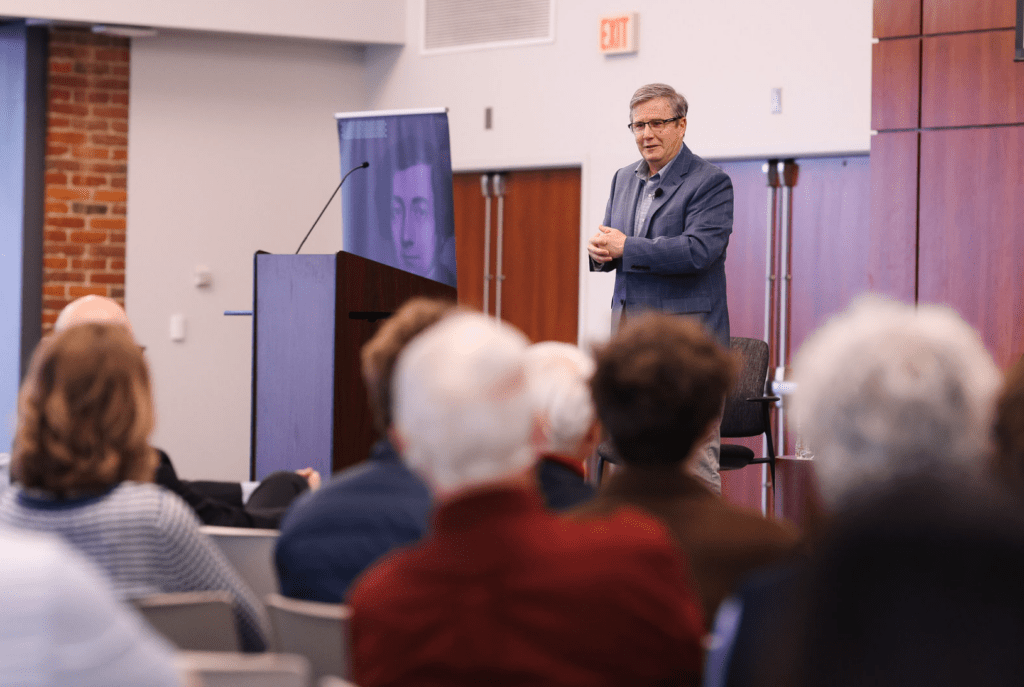
In the first lecture, Amstutz posed the evening’s central question directly: “Can the church contribute to global peace and prosperity?” He immediately clarified what he meant by “church”: not merely denominations or buildings, but “the body of Christ in the world,” believers committed to serious discipleship.
Amstutz argued that Christianity offers genuine moral resources for political reflection, but he also insisted on a crucial distinction. “The Bible is God’s revelation for authentic discipleship. It is not a manual on government.” Scripture, he argued, offers principles, perspectives, and moral rules that can guide political judgment, but it does not relieve believers of the hard work of prudence, institutional knowledge, and responsible analysis.
“The Bible is God’s revelation for authentic discipleship. It is not a manual on government.”
He then laid out a kind of biblical framework for public life, emphasizing principles such as the sovereignty of God over nations, the moral legitimacy of states, the equal dignity of persons, the universality of sin, the centrality of justice, and the Christian calling to peacemaking. He also pointed to the resources of Catholic social thought, especially its attention to solidarity, the common good, subsidiarity, and participation.
From there, Amstutz turned to the structure of international politics. He reduced the major approaches to global affairs to two broad orientations: realism and idealism. Realists attend to the world as it is, while idealists focus on how to overcome the limits of the existing international order. Amstutz made clear that however attractive abstract universalism may sound, political life still depends on functioning states. As he put it,
“If you want a better world, you need strong states that are good.”
That line was one of the most memorable of the evening because it captured a central tension in the lecture. Amstutz insisted that Christians must care about the whole world because God’s love is universal, but he also argued that human rights and prosperity are only possible in societies where governments are capable of maintaining public order, the rule of law, and basic welfare.
The Church’s Role: Moral Formation Rather Than Partisan Advocacy
The most provocative part of Amstutz’s lecture concerned the proper political role of the church. In his view, churches should not function as partisan lobbies or policy shops.
“In my view, the church should be the church. It should function as a Christian embassy in secular society.”
That meant, for Amstutz, that the institutional church’s central task is the moral formation of its members. Churches should teach truth-telling, promise-keeping, forgiveness, compassion, justice, and reconciliation. They should help form Christians who can think and act faithfully in the world. But on most complex policy questions, he argued, the work of integrating faith and public life is best undertaken by believers acting individually and collectively outside the formal structures of the church.
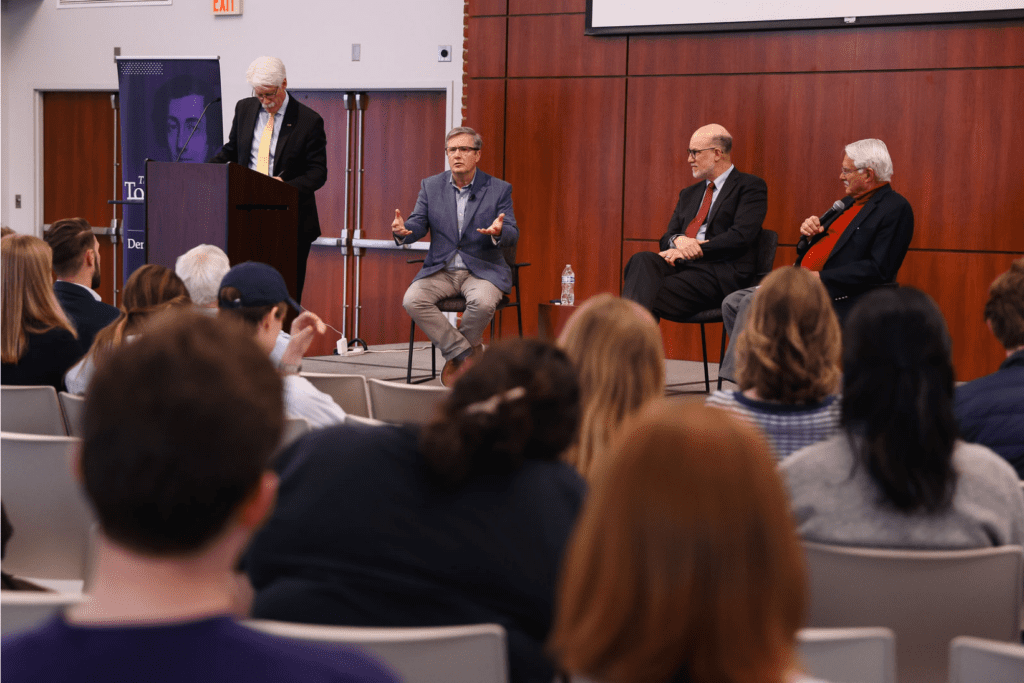
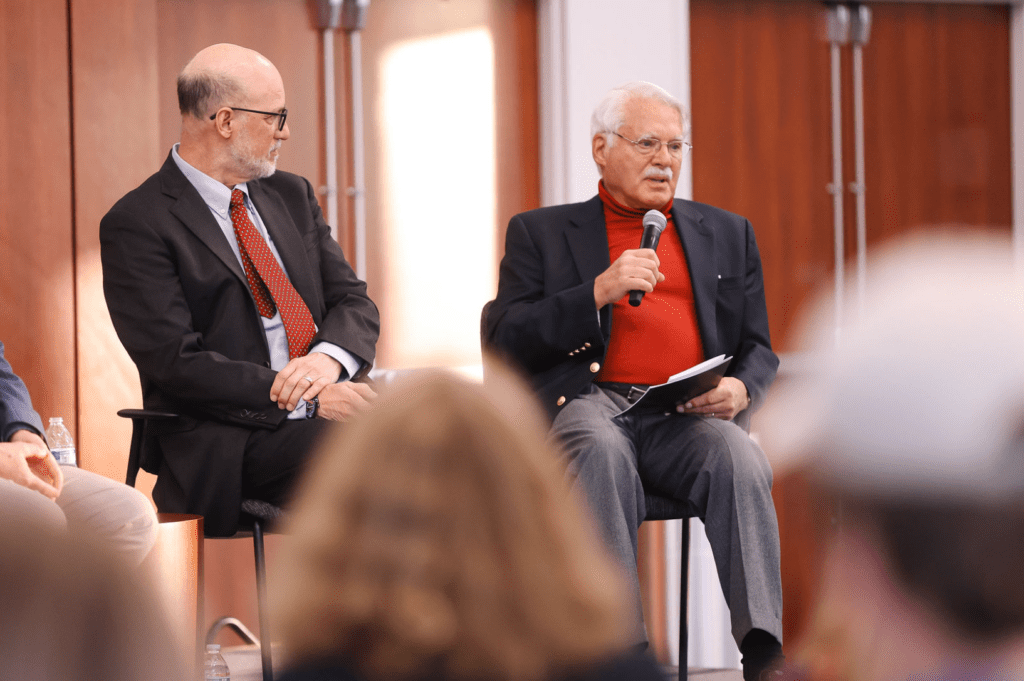
He returned to this point during the panel discussion, warning against churches “mouththing off” on detailed policy questions they do not adequately understand. His concern was not political quietism, but moral seriousness. The church should form Christian minds capable of judgment, not substitute slogans for thought.
Amstutz illustrated the difficulty of this work through the example of international migration. Christian concern for the stranger, he argued, is real and indispensable. But migration policy also involves competing goods, tradeoffs, and institutional constraints. The moral task is not merely to invoke compassion, but to think responsibly about order, law, social solidarity, and human dignity at the same time.
In his concluding reflections, Amstutz returned to the ordinary but demanding work of service. “Christians are called to love and serve their neighbor,” he said, whether through personal acts of care, support for public institutions, or vocations in government and civil society. The common good, he argued, is not advanced only by large gestures, but in the ordinary work of giving one’s time, knowledge, money, and love to others.
“Christians are called to love and serve their neighbor,”
Civil–Military Relations and the American Republic
The second evening turned from international ethics to the political institution most directly tied to questions of force, authority, and national purpose: the U.S. military.
Feaver began by framing civil–military relations as one of the central but often overlooked questions in republican government. Healthy civil–military relations, he said, are like oxygen: something no one thinks about when it is present, but something that becomes all-consuming when it is lost. The United States, he noted, has maintained an extraordinary record of civilian control of the military. Yet precisely because of that success, Americans often fail to appreciate how delicate the arrangement really is.
Feaver distinguished between two dimensions of civil–military relations. The first concerns interactions between civilian leaders and senior military leaders in matters of strategy and war. The second concerns the broader relationship between the military as an institution and the society from which it comes.
It was the second issue that became the focus of his lecture. The American public, he argued, holds the military in high regard, but at a social distance. That combination creates a dangerous dynamic. Civilians admire the military, thank it for its service, and celebrate it publicly, but often do so without much direct connection to military life. The result can be pedestalization: placing the military on a pedestal in a way that separates it from the rest of society and encourages mutual misunderstanding.

The Military and the Culture Wars
Feaver’s sharpest warning concerned the increasing politicization of the military in American public life. Because the military remains one of the few institutions still broadly trusted by the public, political leaders are naturally tempted to wrap themselves in its prestige. But that temptation, he argued, is corrosive.
His most striking formulation came when he urged the audience to “grant the military non-combatant immunity in the culture wars.” Political disputes over abortion, gender, sexuality, race, or identity may be real and consequential, but they should be fought in the political sphere, not through the military as an institution. Once the armed forces are made into visible participants in partisan conflict, public trust in their nonpartisan character begins to erode.
“grant the military non-combatant immunity in the culture wars.”
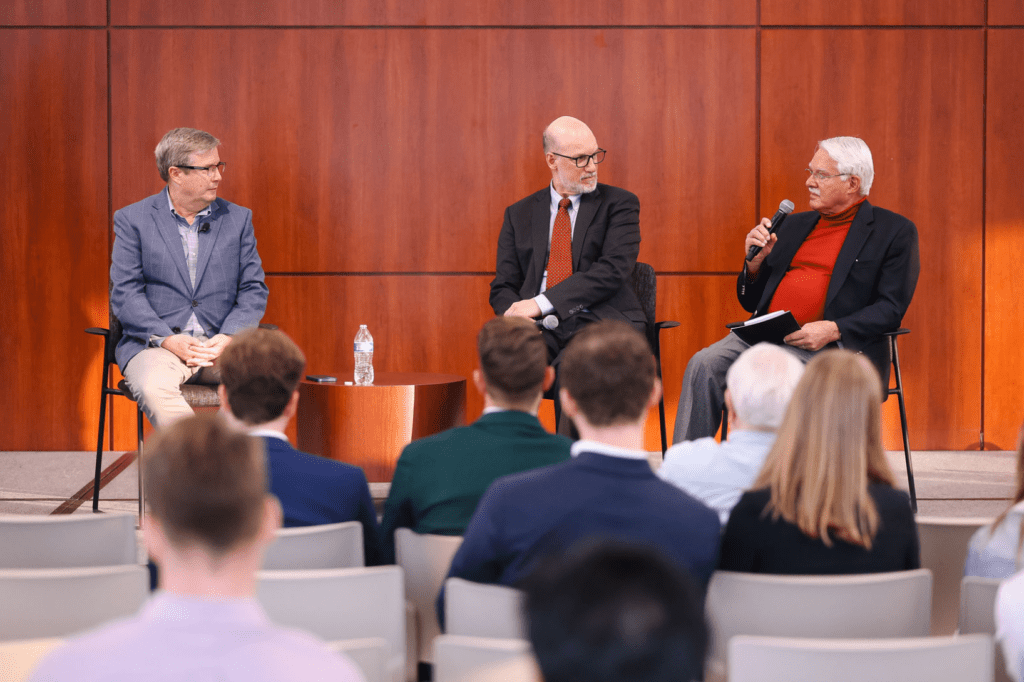
During the panel, Feaver returned to this concern with concrete examples. Civilian political leaders, he said, are allowed to be partisan; military officers are not. That distinction matters. A professional military must obey lawful civilian orders, but it must do so without becoming identified as an arm of one party or ideological camp.
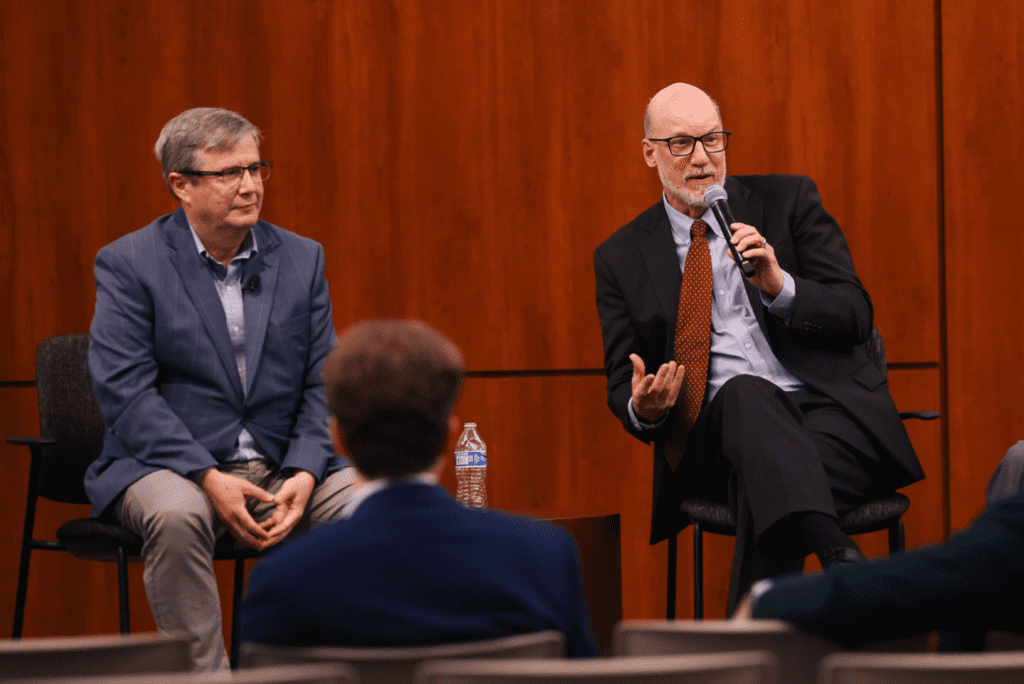
Richter’s contributions helped widen the frame by drawing on his decades in the State Department. He noted that the same questions of trust, professionalism, and continuity can arise whenever one administration inherits a bureaucracy shaped by another. But he also stressed the importance of religious literacy in foreign affairs, recalling how many policymakers treat religion as either irrelevant or something to be overcome rather than as a real force in political life.

Citizenship as Service
Though the two evenings focused on different institutions—the church and the military—they converged on a shared theme: citizenship requires service.
Feaver concluded by urging students to consider national service in whatever form suits their gifts: military service, diplomacy, teaching, or other forms of contribution to the common good. Amstutz echoed that call in explicitly moral terms. “Don’t just pursue your narrow short-term interest,” he told students.
“Develop your gifts and then give them away to a cause that’s greater than your own interest.”

That exhortation captured something essential about the event as a whole. At a moment when public life often feels fractured by cynicism, polarization, and institutional distrust, these conversations pointed back to a more demanding but more hopeful vision of democratic citizenship—one grounded in responsibility, moral seriousness, and service beyond the self.
The Tocqueville Center hosts lectures, discussions, and student programs throughout the year exploring the ideas that shape democracy, citizenship, and public life. Students interested in deeper engagement are encouraged to apply to the Tocqueville Fellows program or participate in the Beaumont Forum.