Lecture Summary: “The American Family. Discuss.”, with On Discourse
On February 13, 2025, the Tocqueville Center at Furman University hosted a compelling panel discussion on The American Family, featuring distinguished scholars Dr. Melissa Kearney, Dr. Brad Wilcox, and Dr. Kelsey Hample. The conversation examined the evolving structure of family life in the United States, the socioeconomic effects of these shifts, and potential policy solutions.
A video recording of the speaker portion of the event is available here:
“The American Family. Discuss.” Watch here!
Brad Wilcox spoke the day before on “Mammon or Marriage: How to Maximize Happiness in Life and Love”, which is available to watch here.
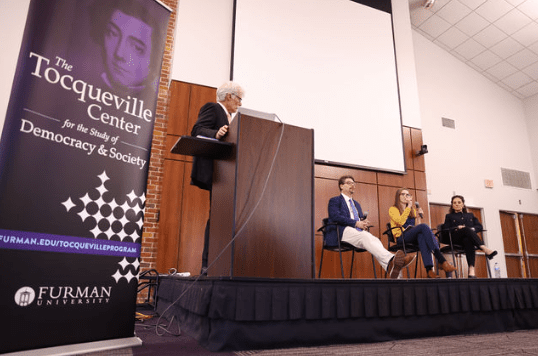
Rooted in the On Discourse initiative’s mission of fostering open, evidence-based dialogue, this event provided a platform for civil discussion on one of today’s most pressing societal issues. Panelists explored the role of marriage, economic mobility, and alternative family models, offering a range of perspectives to challenge and enrich public understanding.
Dr. Melissa Kearney: A Data-Driven Look at Family Structures
Dr. Melissa Kearney, an economist from the University of Maryland, set the stage with insights from her book, The Two-Parent Privilege: How Americans Stopped Getting Married and Started Falling Behind. Drawing from decades of economic and sociological research, she highlighted:
- Declining Marriage Rates – Marriage has become less common, particularly among lower-income and less-educated populations, contributing to a widening class divide.
- The Impact on Children – More children are growing up outside of two-parent households, a shift correlated with higher rates of poverty and reduced educational attainment.
- Economic Inequality – Family structure is increasingly linked to economic outcomes, with children from married-parent households generally experiencing greater financial stability and mobility.

Dr. Melissa Kearney discusses marriage and the American family at a Tocqueville Center panel
Dr. Kearney emphasized that her conclusions stem from empirical evidence, not ideology, though she acknowledged the debate surrounding her findings.
Diverging Perspectives: Panelist Responses
Dr. Brad Wilcox: Strengthening Marriage Through Policy
Dr. Brad Wilcox, a sociologist at the University of Virginia and author of Get Married: Why Americans Must Defy the Elites, Forge Strong Families, and Save Civilization, largely concurred with Kearney’s assessment but argued that cultural and policy shifts—beyond economic forces—have contributed to marriage’s decline. He pointed to:
- Public Policy Incentives – Government assistance programs often favor single-parent households, unintentionally discouraging marriage.
- The Military as a Model – Higher marriage rates among enlisted personnel suggest that structural supports and financial incentives can encourage family stability.
- Potential Policy Solutions – Wilcox advocated for tax benefits and other marriage-friendly policies that promote long-term family stability, particularly for working-class Americans.
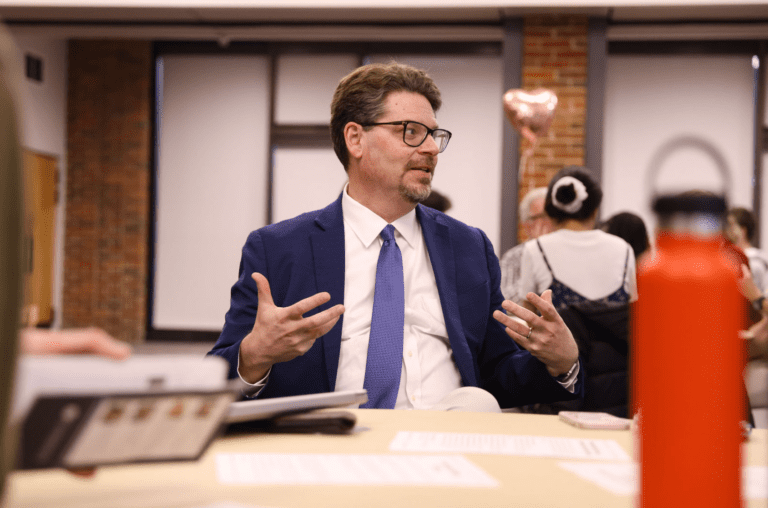
Brad Wilcox joins a table discussion at “The American Family. Discuss”
Dr. Kelsey Hample: Rethinking Family Structures
Dr. Kelsey Hample, an economist at Furman University, took a more critical stance, questioning whether public policy should prioritize marriage over other forms of family support. She argued that:
- Expanding Family Definitions – Two-parent households may provide economic benefits, but multi-generational and communal living models can offer similar stability.
- Shifting Gender Roles – With women surpassing men in educational achievement, Hample challenged traditional assumptions about marriage, urging greater support for stay-at-home fathers.
- Beyond Traditional Marriage – Rather than returning to conventional marriage norms, she encouraged society to embrace broader definitions of supportive family structures.
While the panelists disagreed on specific solutions, their exchange reinforced the importance of rigorous, respectful debate when tackling complex social issues.
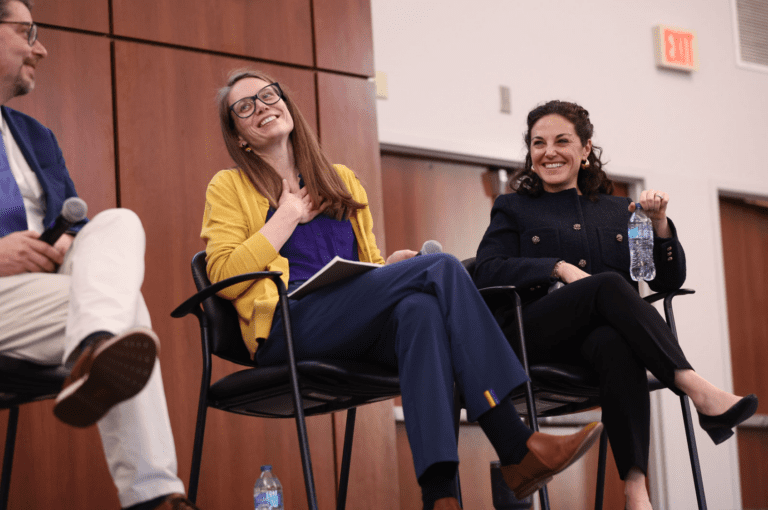
Brad Wilcox, Kelsey Hample, and Melissa Kearney discuss the American family
Practicing Dialogue: Audience Conversations
Following the panel, the On Discourse co-sponsored event transitioned to its central feature: table discussions.
Attendees engaged in small-group conversations, using guided questions to explore their own views and respond to panel insights. Professor Meghan Slining, an experienced dialogue facilitator, was present to support productive discussions.

Table Discussion Questions:
- Should society encourage marriage? Why or why not?
- Should government policies support marriage? If so, what policies would be most effective?
- Did anything from tonight’s discussion challenge your perspective? Why?
Afterward, the panelists returned to engage with participants, responding to reflections and questions. Each speaker then offered a final two-minute takeaway, closing the evening on a thoughtful note.

This format mirrored the On Discourse event on patriotism last fall, which similarly encouraged active audience engagement and nuanced debate. You can read more about that event here.
Conclusion: Fostering Meaningful Civic Discourse
The Tocqueville Center’s event underscored the importance of thoughtful, evidence-based discussions on sensitive societal topics. While panelists offered differing perspectives on marriage and family policy, they shared a common goal: identifying ways to support economic stability, child well-being, and social mobility in an evolving America.

As debates over the definition and role of family continue, the Tocqueville Center remains committed to facilitating informed, constructive dialogue—bridging ideological divides and promoting a deeper understanding of the issues shaping our society.
We look forward to continuing our co-sponsored events with the On Discourse initiative! And watch the full Part 1 and Part 2 of “The American Family” on our YouTube channel.