Fellow in Focus: Julius Scott
“I think back to the things we could have done [when I was a principal] had I known then what I know now: if you really invest in a high-quality afterschool program, it will absolutely change every fiber of your school.”
Julius Scott serves as the Community Support Services Coordinator, School District Five of Lexington and Richland Counties. Prior to assuming this position, Scott worked for 12 years as the principal of Dutch Fork Elementary.
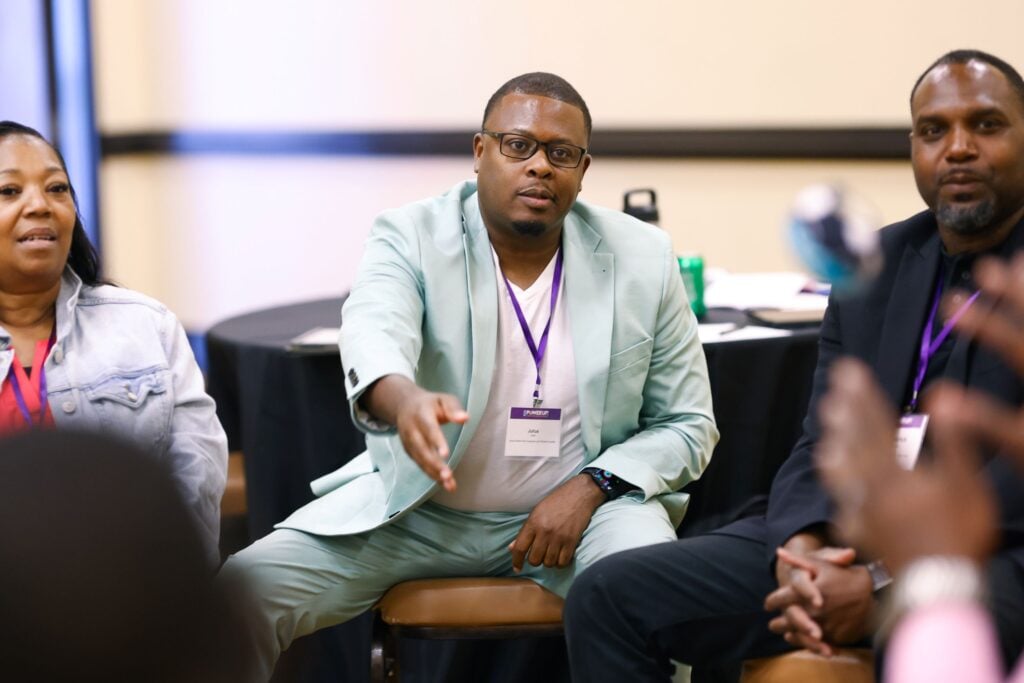
Revolutionizing—that’s how Julius Scott describes his experience with the Riley Institute’s South Carolina Afterschool Leaders Empowered (SCALE) Fellowship.
Just a little over a year ago, Scott was 12 years into his career as the principal of Dutch Fork Elementary, and, by his own admission, afterschool programming was not a priority. But when Scott took on a new role in 2023 and became a member of SCALE’s third cohort, his perception of the importance out-of-school-time changed dramatically.
“I’m embarrassed to say that I did a disservice to our students and to our families when I was a principal,” reflects Scott. “I think back to the things we could have done had I known then what I know now: if you really invest in a high-quality afterschool program, it will absolutely change every fiber of your school.”
Scott, who serves as the community support services coordinator for School District Five of Lexington and Richland Counties, is now deeply invested in quality out-of-school time as he develops pilot partnerships and programming with and for two specific communities: Harbison Gardens, which feeds into Harbison West Elementary, and 14 apartment complexes that feed into Seven Oaks Elementary.
Scott’s charge is to improve outcomes along several measures, including out-of-school time participation. A central related task is helping secure federal funding and placing children he serves into available afterschool programs.
“Because of what I now know through SCALE, I’m not interested in partnerships with organizations solely because they offer programming. We’ve developed clear guidelines concerning program quality that we look for as part of the vetting process.”
Scott has seen firsthand the effect that quality afterschool and summer programs has had on children attending Irmo Middle School, where he carried out his job-embedded capstone project for SCALE.
Working with the middle school’s director of the Hub for Interdisciplinary Values and Enrichment (HIVE) summer program, Scott helped shift thinking away from “having fun” being the sole focus of the program, to structuring it around research and evidence-based practices, specifically, the “four pillars” he learned in the fellowship: active, hands-on activities; opportunities for student autonomy and choice; student engagement and enjoyment; and positive social relationships.
These pillars, developed by Dr. Deborah Vandell, became central to HIVE summer programming. Students were invited to take ownership of their learning and became more invested. The effect on the children—and school staff—was profound.
“Our staff were able to see kids who typically got in trouble or didn’t have confidence to speak suddenly demonstrating that they do have major intellectual capacity. That absolutely started to shift the way people thought about these students. And that was because of a summer program.”
Some of the summer program practices started cropping up in regular class time. A whole seventh grade team at the middle school adopted “brag tags” to celebrate kids for qualities such as honesty, integrity, or creativity.
“By using these tools, you are projecting these kids to be something that they didn’t even identify for themselves. If you have a kid who thought he was the dumbest kid in the classroom and someone says to him, ‘You’re brilliant,’ do you realize the power behind that? It’s such a huge thing.”
SCALE’s “revolutionizing” effect hasn’t just been seen in Scott’s immediate circle, but has started to trickle out into his wider community. Through his careful attention to quality and overall stick-to-itiveness, Scott is building credibility among parents, one of the key constituents he needs buy-in from to ultimately be successful in his mission.
“The scope of our work goes well beyond the hours of 7 to 3. We are in community, working with community to change the outcomes for students and families.”
Scott means this quite literally, having shifted the model from hosting informational events that invite parents into the school, to meeting families right where they are in their living spaces.
He has been successful in getting property management to sign on as partners and hosts for these events, because they also reap the benefits of more stable, stronger communities. A local deputy recently relayed that crime and calls to one of Scott’s assigned neighborhoods have gone down, attributing that change to Scott’s work.
“When we improve the most challenging neighborhoods in our area, we improve the entire community. That is a win whether you live directly in this neighborhood or not,” Scott says. “We know that if kids are going to school better prepared, if they have greater opportunities upon graduation, and if they aren’t sitting at home, but are meaningfully engaged, what the research says will happen, and we’re starting to see that.”
Since participating in SCALE, Scott’s personal mission goes beyond well improving the two pilot communities he’s been charged with serving.
“I’m on a crusade to get kids in better programming, but I’m also asking those around me to think about how we disrupt what we do in public education, because we don’t invest in afterschool the way we should. We in my district are starting to ask the question: How do we bring the needs of afterschool workers and providers to the forefront of what we do at a systems level?”
Scott’s hope is to get others to see what he sees and spark a true revolution that elevates afterschool and summer programming to its rightful status as a core element of a child’s educational journey.