Tocqueville Fellows Blog, Featuring Anna Lloyd: “Social Media and Tocqueville’s Understanding of Association”
Anna Lloyd, a Tocqueville Fellow from Charleston, SC (class of ‘26), sees important implications of the rise in social media use and Tocqueville’s understanding of associations in American democracy.
Anna’s insightful commentary on Sarah Gustafson’s September talk on Tocqueville and the welfare state concludes that Tocqueville’s warnings about democracy’s tendency to exacerbate individualism at the expense of communal associations has become more relevant, even as more people connect and create communal associations online.
Anna Lloyd is a Junior at Furman majoring in economics, with a minor in data analytics.
Social Media and Tocqueville’s Understanding of Democratic Association
by Anna Lloyd (Tocqueville Fellow, Class of ‘26)
Alexis de Tocqueville’s great work, Democracy in America, offers valuable insights into the strengths and weakness of America’s system of democracy. He stressed the necessity for community and association, believing them to be essential to maintaining the best parts of democracy. Now, with the introduction of social media in modern society, the dynamics of individualism and association have shifted, redefining connection and engagement. While social media may increase visibility on new ideas, it also amplifies individualism and materialism in new ways, creating questions on whether it may benefit America’s democracy or contribute to its decline.
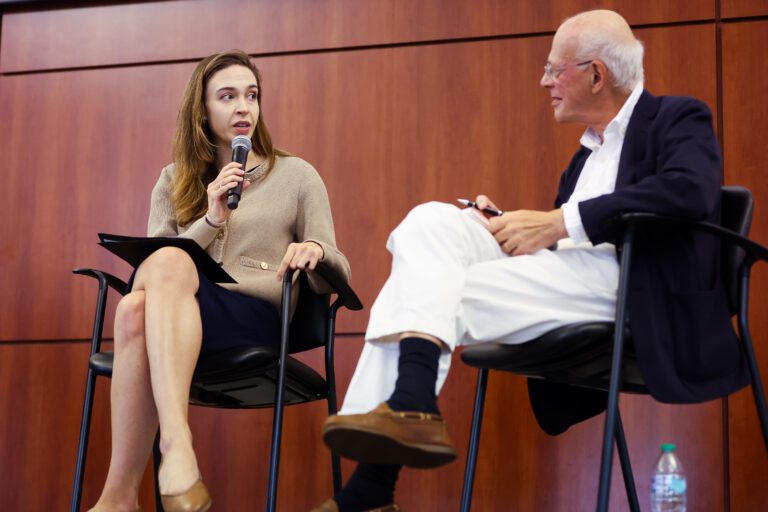
Sarah Gustafson speaking on Tocqueville and the Welfare State at the Tocqueville Center in September, ’24
Sarah Gustafson’s recent lecture discussed the balance Tocqueville saw between individualism and association and the potential downfalls society may face if this balance goes unchecked. Individualism, seen as neither a virtue nor a vice by Tocqueville, is a product of the equality and liberty that democracy offers in America. Far from the aristocratic hierarchies that Tocqueville was accustomed to in France, Americans are free to pursue personal goals and interests. Unchecked, this individualism may cause higher rates of self-interest, leading to isolation in favor of chasing success through materialism, rather than a focus on creating social bonds within communities. Tocqueville believes that association helps to check individualism and materialism and reminds Americans of fundamental virtues and the collective good.
According to a study done in 2024, social media has seen a significant increase in users over the past two decades, with 72.5% of adult users in the US, a drastic increase from the 7% of American users in a 2005 study. Built, supposedly, to establish relationships and connect people, it has quickly become much more than a way to communicate. People, businesses, and other types of organizations use these platforms to market products, share ideas, and engage globally with millions of people. Reaching around the world, social media has become a central element in the culture of the modern world, with new updates and additions at every turn.
Social media and Individualism
Tocqueville identified individualism as both a strength and a weakness in democratic society because it plays a role in establishing the freedom individuals need to pursue their personal and common interests. However, it also creates self-interested tendencies, causing many to turn more to themselves instead of to their communities. In some ways, social media has revolutionized individualism. It creates platforms that allow people to connect with others and express their ideas. However, these platforms are specially curated by users, only showing specific parts of their lives. This “selectivism” breeds new vices, such as self-obsession and a focus on perfectionism, drawing people away from their responsibilities to build social bonds. Though some argue that the bonds made over social media are important, they lack the real, face-to-face characteristic, shown to be a much stronger way to establish social ties.

When not posting, users have access to other aspects of social media, such as short posts or videos created by other users. These posts, created using the same selective tendencies of the average user, are not representative of normal life. Many people compare the experiences and lifestyles that they see online to their own, fostering a continuous sense of comparison and discontent. Curated to personal interests, this scroll disengages a person from reality, taking away valuable time that could be spent developing relationships or other moral virtues. Tocqueville’s fear, that individualism creates isolation, is further heightened through the use of social media, as its features of comparison, chasing after achievements, and detachment from reality, all contribute to the degradation and removal of oneself from society.
Social media and Materialism
Tocqueville criticized the American tendency towards materialism, believing it distracted from higher moral and social pursuits. Today, materialism is greatly impacted through social media’s trends, which contribute to a fixation on both overconsumption and lifestyle comparisons. This fixation replaces the virtues developed through association, such as an interest in the common good, with a search for happiness and contentment through consumption. Less time is devoted to higher moral and social pursuits that help to build relationships within society and foster a sense of community.

Recently, platforms such as TikTok and Instagram have even added a shopping feature within the app and increased the number of ads by influencers and businesses. Tailored to the user’s interests, users are constantly exposed to new products, causing social life to center around the opportunity to purchase more. As the use of social media grows, new ways to promote and sell products will further increase materialism among Americans.
Increasing Isolation Amidst the Rise of Online Communal Associations
Overall, democracy is based in equality, with equal access to opportunities and expression. Tocqueville recognized the many benefits of individualism when balanced with communal associations, but also warned against individualism that leads to materialism and overconsumption. Unchecked individualism causes an isolation from society, weakening an essential part of human nature. Without new ways to remind ourselves of the fundamental virtues that should shape our life and interactions with others, society will fall more into states of self-interest, with less regard for our neighbor and the common good. Though social media finds new ways for people to connect online, it may negatively contribute to a decline in association. Tocqueville’s warning is ever present in this modern time and should be considered when moving forward with new forms of social media.

Anna Lloyd, Tocqueville Fellow (Class of ’26)
By Anna Lloyd, Class of ’24
Tocqueville Fellows are a select group of Furman undergraduates interested in cultivating the philosophic perspective on politics exemplified by Alexis de Tocqueville. Tocqueville, a 19th-century Frenchman, was one of the first to witness the momentous new force of modern democracy, and his observations on the far-reaching changes that democracy would bring are still hailed as prophetic today. Tocqueville’s perspective was informed by a thorough understanding of the political alternatives articulated by the philosophic tradition, and characterized by the conviction that a wise appreciation of the goods of an irrevocable past can guide our attempts to navigate an unprecedented future.
The Tocqueville Center strives to form democratic citizens who are capable of seeing, as Tocqueville did, the variety of issues facing the modern democratic soul.
You can learn more about Anna Lloyd and our other Tocqueville Fellows by clicking here!