Lecture Summary: Olivier Zunz and Sarah Gustafson at “Alexis de Tocqueville in America”, Sept. 10-11, 2024
Olivier Zunz On “The Great Debate between Alexis de Tocqueville and Astolphe de Custine on the Political Fortunes of America and Russia”: Tocqueville Biographer and Sarah Gustafson Headline “Alexis de Tocqueville in America” Event at Furman’s Tocqueville Center
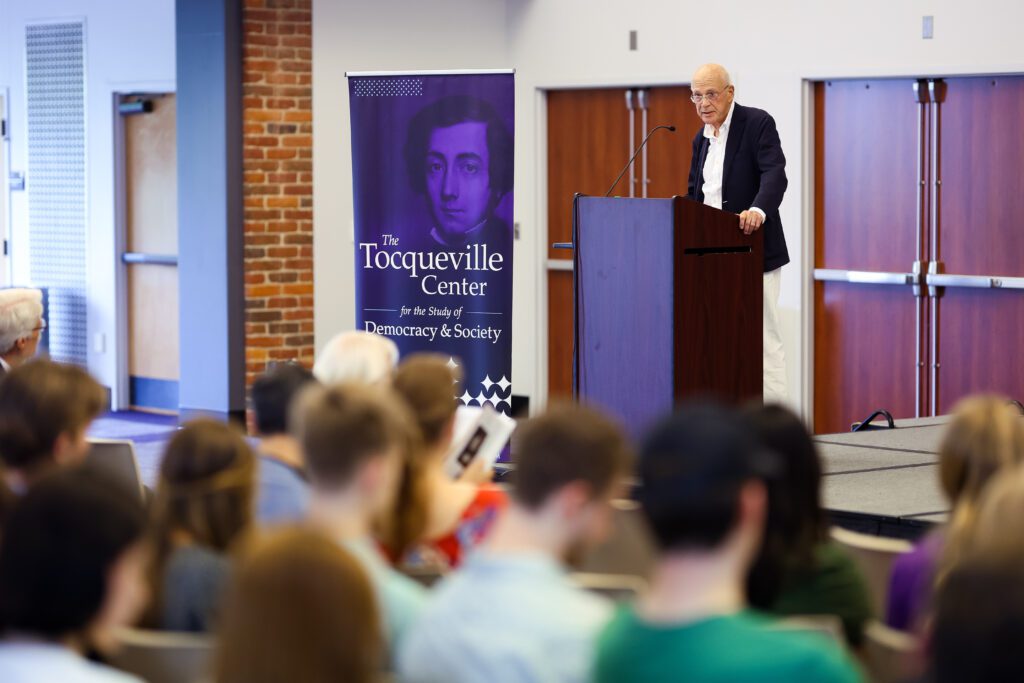
Olivier Zunz speaking on Alexis de Tocqueville for the Tocqueville Center
Olivier Zunz, James Madison Professor of History at the University of Virginia and an internationally recognized expert on the life and work of Alexis de Tocqueville, and Sarah Gustafson, Assistant Professor of Politics at The Catholic University of America, were featured speakers at this year’s installment of the Tocqueville Center’s Walters Memorial Lecture Series. The series honors Professor Ernest J. Walters, who joined Furman’s Political Science Department in 1962, and served as the department’s chair from 1979 to 1984. His daughter Amy attended the event.
The Tocqueville Center program was designed to showcase the center’s namesake, Alexis de Tocqueville, a 19th-century French author, statesman, and traveler who developed a “new science of politics” focused on the study of the modern democratic soul. Zunz and Gustafson presented original research that was equally theoretical and historical, exploring different but related concepts in American democracy as expressed in Tocqueville’s body of writings on American democracy and his political activities in France, as well as his account of the democratic welfare state (Gustafson) and his influence on French aristocrat and travel memoir author Astolphe de Custine (Zunz).
The result was an illuminating and expansive dialogue between the speakers, panelists, and audience that exposed and clarified aspects of Tocqueville’s life and thought not frequently discussed, and highlighted his continuing relevance to contemporary politics. Gustafson and Zunz exemplify a refreshingly Tocquevillian approach to political theory in their scholarship, where political theory consists of careful analysis of historical facts from which generalizations are induced, rather than a series of deductions derived from conditional, presupposed, and general hypotheses.
What did Alexis De Tocqueville say about American democracy and the welfare state? Sarah Gustafson’s response
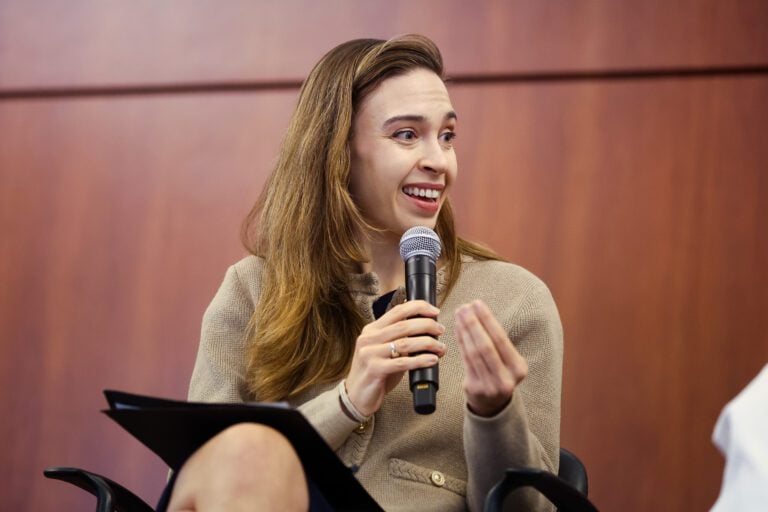
Sarah Gustafson speaking on Alexis de Tocqueville and the democratic welfare state
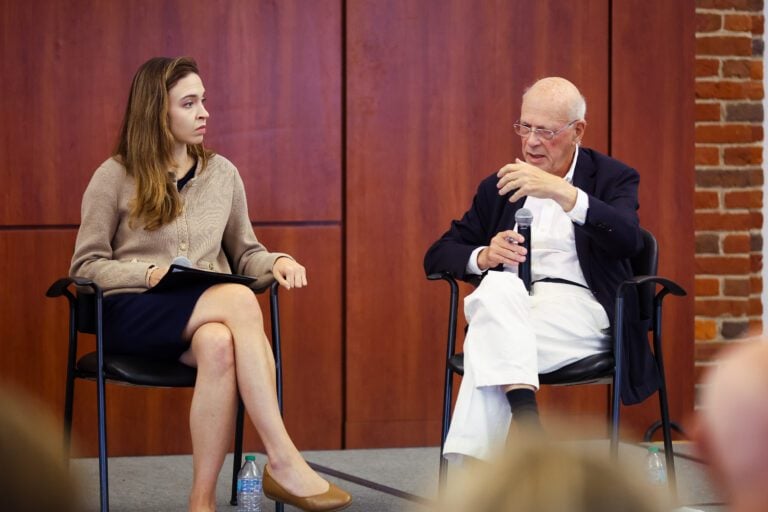
Sarah Gustafson kicked off the Tocqueville Center’s two-day event with a talk on “Democratic Well-being and Democratic Welfare: Tocqueville’s Complex Account of the Welfare State”. A Harvard PhD, Gustafson is a specialist in Alexis de Tocqueville and nineteenth-century political thought, with additional interests in Ancient and Medieval Political Philosophy, contemporary and normative political theory, virtue ethics, Catholic Social and Political Thought, and Ethics and Business. Her research examines Tocqueville’s concept of charity, especially its relationship to his accounts of self-interest rightly understood, associations, and welfare. Panel commentary was provided by Olivier Zunz, Robert L’Arrivee (Politics and International Affairs, Furman University), and Elizabeth L’Arrivee (Rosary College).
Gustafson began by identifying a puzzling aspect of Tocqueville’s thought. Tocqueville the political theorist had famously warned about the potential for American democracy to develop into a soft despotism, a kind of government where Americans willingly gave up their rights in exchange for benefits granted by an increasingly powerful state. At the same time, the historical record indicates that Tocqueville the politician advocated for aspects of what would become the European—and later the American—welfare state. Gustafson asked whether Tocqueville’s political theory contradicted his political action, by advocating in practice for the very thing that threatened his democratic ideals.
Fundamentally, Gustafson’s questions concerned Tocqueville’s accounts of soft despotism, the welfare state, human liberty, and the relations between them: “Is soft despotism the same as the welfare state? Is soft despotism inevitable? Is it possible to devise and structure a welfare state in such a way that upholds human liberty while also attending to the most vulnerable among us? Lastly, how do Tocqueville’s practical political writings on the social question — the question of mass poverty caused by industrialization – and the welfare state compare with his theoretical writings?”
Her answer illuminated an important feature of Tocqueville’s approach to political science, which Zunz picked up on in the panel commentary (and which the Tocqueville Center seeks to preserve). Rather than setting up an abstract theory of democratic welfare and then attempting to impose it on an imperfect reality that falls far short of the hypothesized ideal, Tocqueville began from real-world observations, which set the conditions within which he attempted to “instruct” and “guide” democracy. Tocqueville, Gustafson emphasized, is thus “not a perfectionist, and awareness of human imperfection set him against the radical idealism ‘characteristic’ of Tocqueville’s era – characteristic of Marx, Comte, and many others – that would ‘reduce’ the complexity and messiness of human life to ‘systematic theory’ and by so doing, try to perfect it.”
What did Alexis de Tocqueville observe on his visit to the United States?
Cautioning the Tocqueville Center audience against relying on a “bumper-sticker” account of familiar Tocaquevillian themes to solve the puzzle, Gustafson’s argument began with modified or novel interpretations of his key concepts of associations, self-interest rightly understood, and despotism. Tocqueville’s account of associations, she argued, despite having an echo in the works of Robert Putnam and others, is incompletely understood in the absence of Tocqueville’s historical context, namely, as his protest against the French government’s hostility towards associations. Self-interest rightly understood, better left in her view as the untranslated intérêt bien entendu, is “something like the animating spirit and virtue of association. It both is a product of and encourages a spirit of cooperation and mutual help towards shared ends, towards shared goods, in the realm of civil society”.
This moral though not completely other-regarding virtue, which has Christian characteristics, “educates and elevates one’s individual self-interest through active communion and participation with others in the open and free spaces of civil society and voluntary association.” The variety of associations Tocqueville saw arising naturally in American democracy indicated a distinctive diversity, where meaningful distinctions arranged various aspects of civil society, such as ‘charity’, ‘church’, ‘family’, etc., into hierarchies according to their varied importance. At the same time, the Americans’ love of equality predisposed them to have compassion for all those who were vulnerable to and impoverished by democracy’s constantly changing social conditions. Citizens in democracies will tend to approve, Gustafson observed, of the state taking over the care of the poor and vulnerable from private associations because of their compassionate feelings.
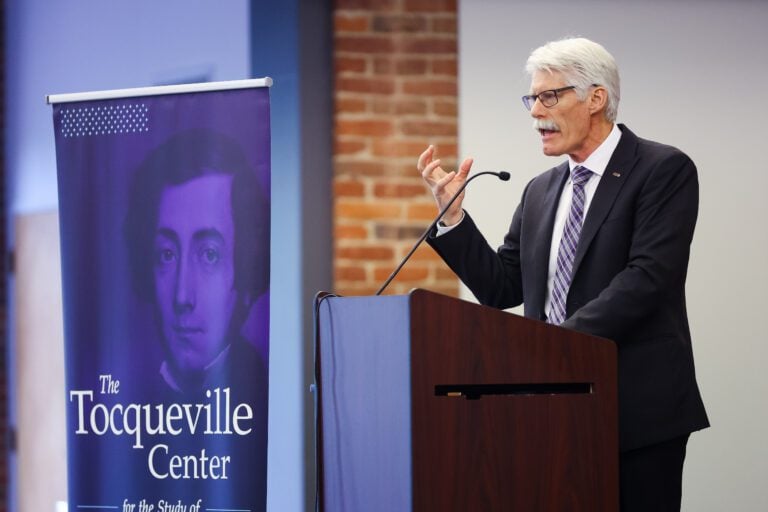
Tocqueville Center Director, Brent Nelsen (Politics and International Affairs, Furman)
What danger did Tocqueville see in the majority rule in the United States?
The state takeover of private welfare through associations brought on by democratic compassion is exacerbated, Gustafson continued, by the individualism democrats are susceptible to on account of their equality. If all are equal, the kinds of attachments that elevate someone or something over another are weakened. Moreover, the collective action problem, where potentially beneficial cooperation is undermined by competing self-interests, encourages the state to step in where others have not. The administrative state, so remarkably decentralized in American townships and associations, becomes centralized, thus replacing local politics and voluntary associations.
The resulting centralization of power in the hands of the government is antithetical to democracy, Gustafson pointed out, since it is an essential feature of exactly the soft despotism Tocqueville warned about. But unlike Marx, Tocqueville, while recognizing the problems of American democracy, never conceived of an endpoint to history, where the inequalities that lead to some having while others have-not are eradicated through a massive redistribution of wealth. Does that mean Tocqueville adopted a laissez-faire attitude or lacked compassion? Gustafson turned to Tocqueville’s life in France and his sojourn as a statesman to find out.

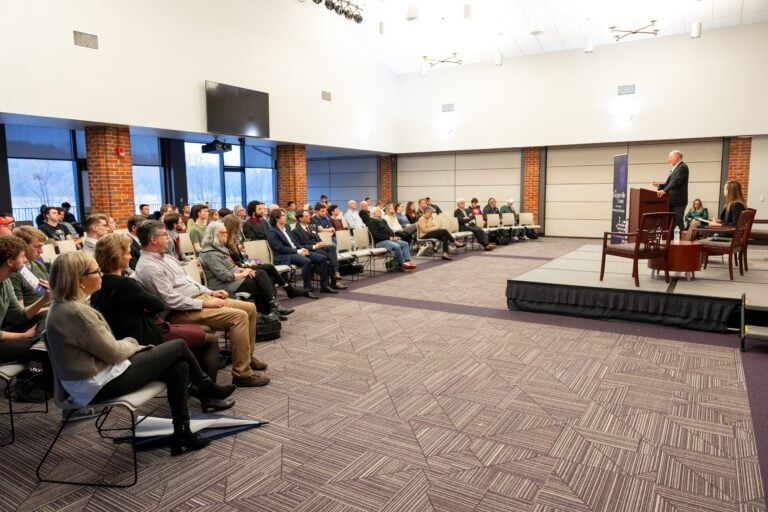
The panel takes questions from the audience for “Alexis de Tocqueville in America”
Through a historical analysis of pauperism in Europe during the time of the Industrial Revolution, Gustafson detailed an insightful account of Tocqueville’s statesmanship that bears important lessons for today. Tocqueville’s observation—likely enhanced by the fact that he was Catholic—from Europe’s experience of having replaced the private Catholic charities which had cared for society’s most vulnerable with state redistributionism via the “poor laws” was that well-intentioned and compassionate public policy had set up some perverse incentive frameworks and mores. The poor often became “path dependent” through government assistance, in that they were reduced to merely satisfying their most pressing, material needs, resulting in a “brutalization” of their humanity into the political category, “the poor”.
Gustafson’s takeaway was that amid the soft despotism of the welfare state today, we need to recognize the limits of public policy and acknowledge key distinctions between public and private charity. While some form of public charity is necessary, as it is more regular than spontaneous private charity, unmediated, face-to-face interactions through private associations providing help to society’s vulnerable are more humanizing and thus preserving of human liberty. She called for a renewal of that ambiguous yet important concept, self-interest rightly understood, or intérêt bien entendu, to cultivate habits that link self-interest to shared ends in civil society and resurrect the animating spirit of associations.
Is democracy dead? Should aristocracy prevail? Olivier Zunz on how a French aristocrat’s Russian travels brought him into agreement with Tocqueville on democracy’s superiority
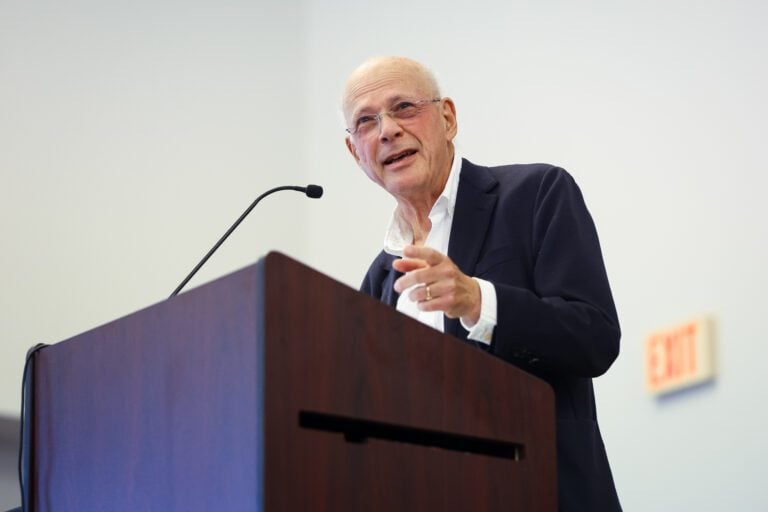
Olivier Zunz speaking on Custine’s debate with Tocqueville over the political fortunes of Russia versus America
Olivier Zunz continued the Tocqueville Center’s deep-dive into Tocqueville’s thought, life, and influence on the second day with his talk, “The Great Debate between Alexis de Tocqueville and Astolphe de Custine on the Political Fortunes of America and Russia”.
Zunz, who is the James Madison Professor Emeritus of History at the University of Virginia, has authored or edited 12 books, including The Changing Face of Inequality (1982); Making America Corporate, 1870-1920 (1990); and Why the American Century? (1998). His most recent book is The Man Who Understood Democracy: The Life of Alexis de Tocqueville (2022), but despite the book’s significance as a biography of Tocqueville that balances meticulous historical research with a sensitivity to Tocqueville’s ideas as he himself understood them, Zunz’s choice of topic for the day was purely a result of accident. A family member, Zunz recounted, had by chance offered a book by Marquis de Custine from his collection to Zunz. When Zunz read what turned out to be a 900-page record of Custine’s trip to Russia in 1839, he saw that Custine was carrying out a (mostly implicit) argument with Tocqueville over the relative merits of democracy and aristocracy. He thought his account of the Americans and the Russians, whom Tocqueville had called “two great peoples”, deserved greater attention.
Zunz recounts Custine’s travels in Russia
Custine was an anti-American, anti-democratic French aristocrat who went to Russia to find evidence that would vindicate aristocracy and affirm despotism over and against representative governments. His travels, which occurred under Nicholas I—who was infamous for fiercely oppressing all dissent—changed his mind. The resulting book, written under the guise of a series of letters, became a bestseller in 1843, much to the chagrin of Nicholas, who banned the book in Russia. Tocqueville’s pro-democracy, anti-aristocratic, and anti-despotic ideas thus became indirectly albeit immensely influential, as Custine’s account of the Russians and the perils of despotism influenced Western public policy in the 19th and 20th centuries.
Zunz began by identifying the similarities between Tocqueville and Custine. Both were French aristocrats by birth, whose families became victims of the Revolutionary Terror. Both had been mentored by Chateaubriand. And both had personal battles with their fellow aristocrats—Tocqueville over his pro-democratic views, and Custine over his choice to live as an openly gay man after his sexual orientation was made public through no choice of his own.
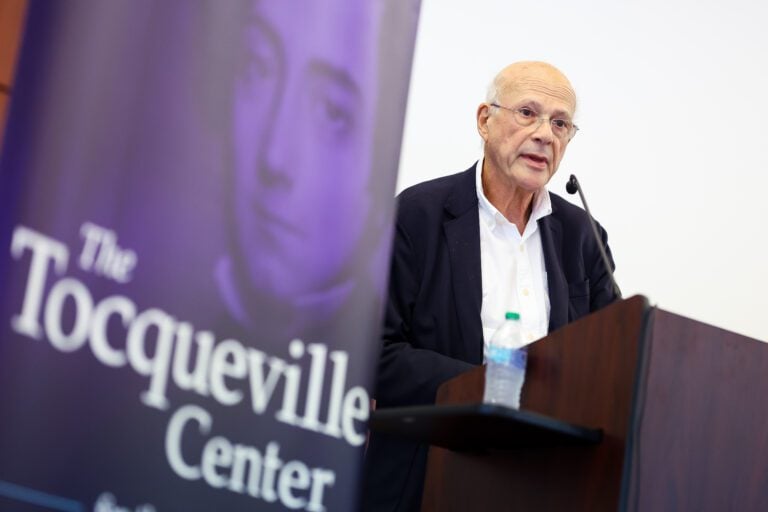
Despite their similarities, Custine, Zunz detailed, saw American democracy as an abstraction that had been improvised in a land without a memory. The Enlightenment philosophy of the 18th century was an encroachment on religion, and Custine was certain he could find his vindication of aristocracy and despotism in Russia, which was in many ways the antithesis of America. So, like Tocqueville, Custine embarked on a journey of observation. But what he found ended up convincing him that his debate with Tocqueville was without merit.
Seeking vindication, Custine finds defeat: Zunz illuminates the 19th c. debate over America’s and Russia’s political fortunes
In Russia, Zunz recounted, Custine found that the majority of the Russian princes and aristocracy were mediocre. Despite having contempt for the humorless Puritanism of the few Americans he had encountered in his travels, Zunz told the Tocqueville Center audience, Custine did not recognize human agency in the Russians. Instead, he saw a “nation of slaves”, whose human dignity had been destroyed under the atmosphere of fear that resulted from Nicholas’ intolerance of all dissenting opinions. Tyranny and despotism had the appearance of civilization, but it disguised a fundamental barbarism. Custine concluded that Russia was a “kingdom of fear and silence with no regard for human dignity”, where self-interest rightly understood was impossible. All were equally slaves in Russia, whereas in America, equality, far from excluding liberty, actually helped promote it.
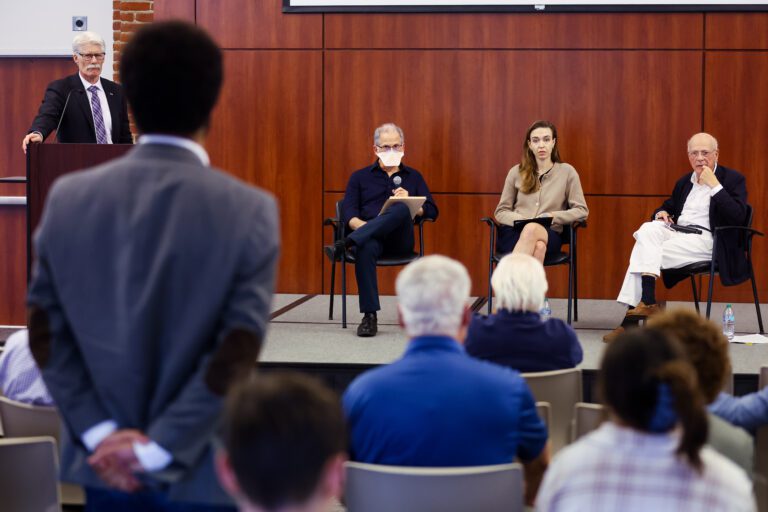
Mike Bressler (Politics and International Affairs) joins the panel on Alexis de Tocqueville
Zunz completed his talk at the Tocqueville Center by recounting the extraordinary influence of Custine’s book, and the question of whether America is or can still be the guarantor of liberty. Sarah Gustafson and Mike Bressler (Politics and International Affairs, Furman) provided helpful commentary. Bressler, a scholar of Russia, pointed out that Custine got certain aspects of Nicholas wrong. Nicholas, for example, enacted progressive policies that decentralized some of the czar’s powers. His repression of dissent was a somewhat justifiable reaction to his attempted overthrow. And Custine’s inability to find any voices of dissent in Russia was an oversight, as the first half of the 19th century, which has been called the Golden Age of Russian Poetry, included dissenters such as Pushkin. Zunz gratefully acknowledged Bressler’s points, but reiterated that Custine’s account, though incomplete and even inaccurate in places, nonetheless had remained extremely influential for over a century.
What is Tocqueville’s Polical Science? Olivier Zunz and Sarah Gustafson Exemplify a Tocquevillian Approach
Overall, the Tocqueville Center’s first lecture series of the year provided an opportunity to reflect on Tocqueville’s thought, life, and influence in light of detailed historical analysis. But perhaps more importantly, Zunz and Gustafson exemplify what it means to practice Tocquevillian political science, where “thought takes as given the imperfections of the world, the chasm between ideal theory and the study of politics, on the one hand, and the urgent necessity to implement and practice the best possible political science and public policy on the other” (Gustafson). The resulting moderation is surely one of Tocqueville’s most valuable legacies.
Be sure to keep an eye out for upcoming events, as the Tocqueville Center continues to explore the spirit of democracy in America!

Rob L’Arrivee (Politics and International Affairs, Furman) asks a question at the “Alexis de Tocqueville in America” event