Tocqueville Fellows Blog, by Karissa Horn: Can Non-Ideological Novels Rewrite Politics? What Mark Noll and Marilynne Robinson Reveal About Scripture in Public Life
Karissa Horn, from Simpsonville, South Carolina, is a senior majoring in Religion and English at Furman University with a minor in Medieval and Early Modern Studies.
Scripture, Politics, and the Problem of Ideological Use
Katelyn Schiess, Mark Noll, and other panelists at the October 7, 2025 lecture on Religion and the American Founding expressed strong skepticism about the ways Biblical passages have been used to support—or garnish—political arguments, both during the American Revolution and in recent years. The general consensus among the speakers was that scripture provides a backdrop of common stories and phrases that politicians have cherry-picked, bent, and attached to predetermined conclusions for centuries.
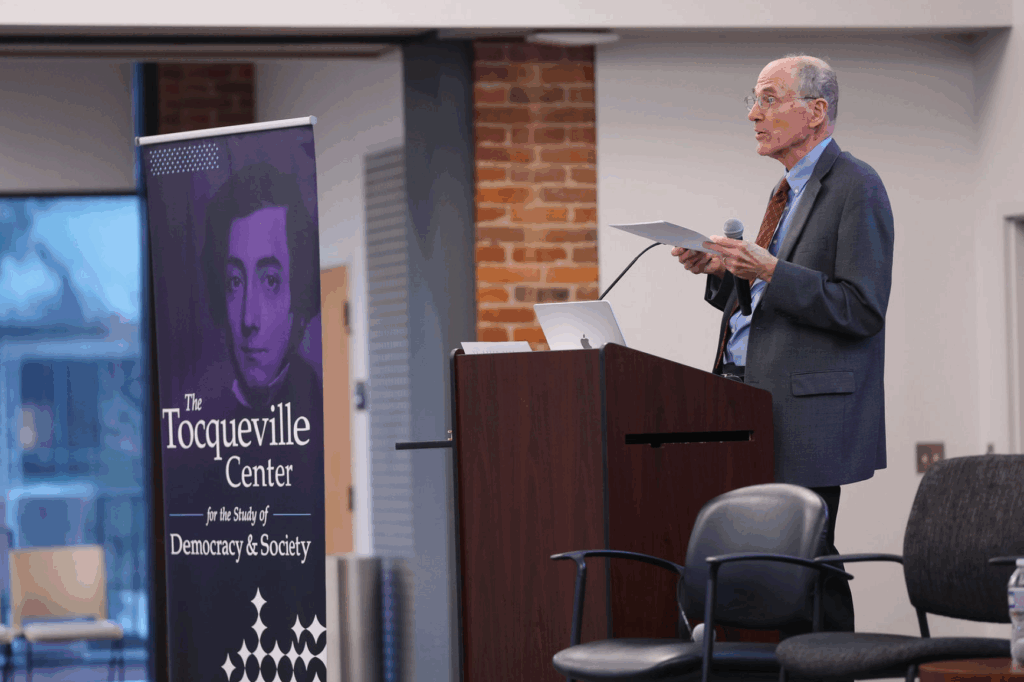
Tocqueville Center speaker, Mark Noll
Marilynne Robinson and the Possibility of “Authentic Scriptural Politics”
In light of this skepticism, Dr. Noll raised the possibility that “a non-political, even an apolitical, promotion of the scriptures might have a positive effect on public political life without trying to.” As an example, he cited the novels of Marilynne Robinson, especially Gilead, which follows a Congregationalist pastor and his family in rural Iowa.
Noll’s suggestion hints that novelists may be uniquely positioned to depict—and even create—what I call an “authentic scriptural politics” that informs readers’ public lives both consciously and unconsciously. “I would think someone who takes Gilead seriously is going to do the political thing differently,” Noll states. This rests on two ideas:
- novels with no explicit political content can still shape public political life, and
- the mores of a society can be strengthened by such works.

What Makes a Story “Non-Political”?
What does it mean for a story to be non-political or apolitical? Stories always depict “politics” in the sense that they portray communities, roles, laws, norms, and the presence (or absence) of peace. Any novel that depicts a functioning or dysfunctional community is, in some sense, speaking about politics.
However, there is a crucial distinction between politics—structures of authority—and ideology—a system of ideas held by a party or faction. Many novelists write about communities without referencing recognizable ideological positions. They may also restrict the narrative to local or familial politics without referencing national policy, leading readers to think they are consuming something “non-political.”
Gilead, as Noll notes, mentions the American Civil War but otherwise focuses on family and local life; it never names a president. It could not shape public political behavior if it were free of politics altogether, but it does appear free of partisan or ideological content.
Why Non-Ideological Fiction Might Influence Social Mores
Non-ideological novels might, as Noll suggests, be especially well-positioned to influence social mores. A major issue with the political use of scripture—identified by both Noll and Schiess—is that politicians often employ Biblical texts to bolster conclusions they already hold, even when the context of the passage does not support those conclusions.
Novelists are not immune to this temptation. Yet a non-ideological novel is free to use scripture as a starting point for imagining the mores and structures of authority in a fictional community. Novelists face none of the constraints of party lines, approval ratings, or electoral pressure. They can depict authentic scriptural politics using careful research and interpretation, unburdened by pragmatism.

Tocqueville Center speaker, Kaitlyn Scheiss
Fiction, Moral Worlds, and the Reader’s Imagination
The project of fiction is, broadly speaking, to illuminate the human experience. Children’s fairytales do this by showing the moral weight of particular behaviors—good behaviors are rewarded, bad behaviors are punished—thus establishing a moral world with rules. More “sophisticated” stories still do this, even if the rules are complex, ambiguous, or arbitrary.
Anecdotally, stories cause readers to feel what it’s like to live under a set of moral assumptions. Literature says, this is your life, and for the duration of the reading experience, it is. Readers are often motivated to continue living in a world whose moral logic they find compelling. This is even easier when the moral world is internally consistent and grounded in accessible realities—such as scripture.
The Promise and Limits of Scriptural Politics in Fiction
In conclusion, non-ideological novels offer an approachable vehicle for mores that foster authentic scriptural politics, especially at the local or communal level. Yet a novelist’s freedom from pragmatic constraints is both an advantage and a limitation. However coherent such politics may appear on the page, implementing them in real life remains a serious, even debilitating, challenge.