Lecture Summary, Religion in America: Mark Noll and Kaitlyn Schiess on the Bible, Politics, and the “City on a Hill”
Watch the recordings:
“A City on a Hill: The Bible and American Exceptionalism”- October 8
“It took a Frenchman to teach Americans what made them unique.”
With this remark, Director Brent Nelsen opened the second of two Tocqueville Center lectures on religion and the American founding. In 1831, Alexis de Tocqueville traveled across the United States to study its democratic experiment. What he found was not merely political institutions, but a society in which religion shaped civic imagination. Religion, he wrote, was “the first of their political institutions,” not because church and state were entwined, but because religious conviction offered a moral grammar that made self-government possible.
Today, that moral grammar is fraying. But biblical language remains a persistent, if often misunderstood, part of our public life. This October, the Tocqueville Center welcomed historian Mark Noll (University of Notre Dame) and political theologian Kaitlyn Schiess (Duke Divinity School) for two evenings examining how the Bible has shaped American political discourse—from the Revolution to the present.
Their lectures did not offer nostalgia for a “Christian nation.” Instead, they traced how Scripture has been used, contested, and reimagined, revealing the complex ways religion and democracy intertwine in the American story.

Tocqueville’s Question
In his opening remarks, Nelsen reminded the audience why Tocqueville remains such a fruitful lens. Tocqueville did not find a “biblical republic.” Instead, he found that Americans argued politically within a shared moral horizon. People disagreed fiercely—but they assumed a transcendent moral order existed and that Scripture, however variously interpreted, spoke to it. That assumption no longer holds in the same way.
The Tocqueville Center’s fall series is organized around this fact. What happens to democracy when its shared moral grammar weakens? What happens when biblical references remain, but their meanings fragment?
Night One: Mark Noll on the Bible in the American Revolution
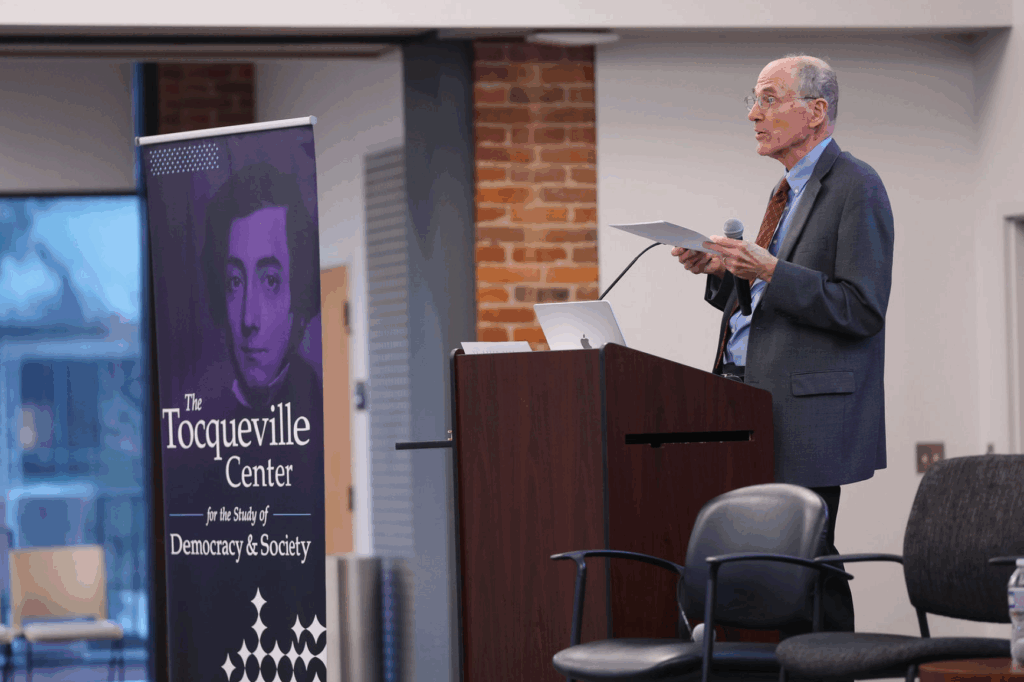
On Tuesday, Mark Noll (University of Notre Dame) delivered a lecture titled “The Powers That Be Are Ordained by God: The Bible as Weapon in the American Revolution.” Noll, one of the nation’s leading historians of religion, began with an unmistakable claim:
“It’s only a slight exaggeration to say that the Bible was everywhere.”
From pulpits to pamphlets, Scripture saturated revolutionary America. Patriot and loyalist clergy alike framed their arguments with verses that audiences knew well. Patriots leaned on texts like Galatians 5:1 (“For freedom Christ has set us free”) and the Exodus story as paradigms of liberation. Loyalists, in turn, cited Romans 13—Paul’s admonition to “be subject to the governing authorities”—as a divine prohibition against rebellion.
The Bible’s ubiquity, Noll emphasized, did not mean it offered clear political guidance. “The same text could be deployed to opposite ends,” he noted. “For every Exodus sermon, there was a Romans 13 sermon.”
Tom Paine famously invoked 1 Samuel 8 to denounce monarchy, portraying the demand for a king as a sin against God. Anglican clergy countered with Deuteronomy’s prescriptions for kings, suggesting monarchy could be righteous. Both sides reached for the same book—and found ammunition for their cause.
Noll’s core historical point cut through the noise:
“Serious historical study does not justify describing the founding of the United States as distinctly, singularly, or unequivocally Christian.”
The Revolution was steeped in Scripture but not governed by a single theological consensus. Biblical language functioned as a rhetorical and moral resource, not a blueprint. This reality complicates both secular and religious myths of the founding.
Panel Response: Scripture as Common Vocabulary—Then and Now
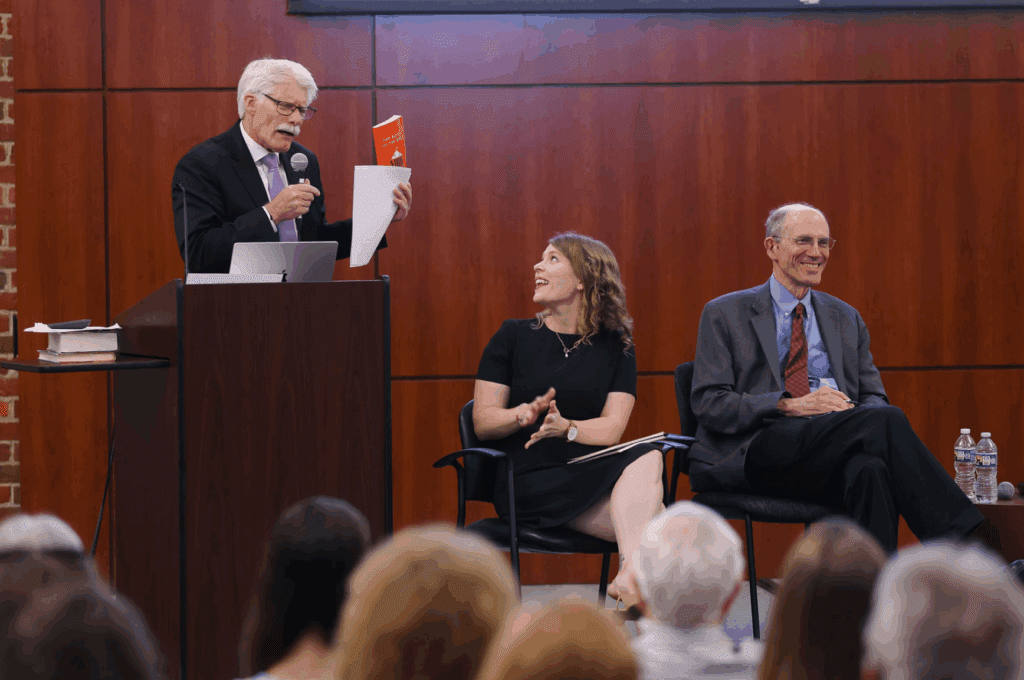
The evening’s panel featured Kaitlyn Schiess (Duke Divinity School), John Barrington (Furman University), and Grant Wacker (Duke Divinity School). Each highlighted different dimensions of Noll’s argument.
- Schiess argued that the Bible no longer functions as a shared cultural text in the way it did in the 18th century. Even then, its authority was contested, but at least it provided a common vocabulary for public debate. Today, in a pluralistic society with waning biblical literacy, that shared reference point is weaker. She suggested that Christians should respond not by demanding cultural dominance, but by reclaiming Scripture as the church’s book, modeling responsible use rather than wielding it as a blunt instrument.
- Barrington placed Noll’s claims in context by underscoring the deep anti-Catholic sentiment of the revolutionary era. Religious language was not simply moral—it was often polemical. The Quebec Act, for example, helped galvanize Protestant fears, and references to papal tyranny became potent political tools.
- Wacker drew attention to the difference between biblical language as backdrop and rhetoric that moves people. Scripture was everywhere, but “it’s not always what changed minds.” Paine’s line—“We have it in our power to make the world over again”—may have stirred hearts more than any single biblical quotation.
In short, Noll’s lecture and the panel together painted a nuanced picture: the Bible structured the language of the Revolution but did not dictate its outcomes.

Night Two: Kaitlyn Schiess on the “City on a Hill”
On Wednesday, Kaitlyn Schiess (Duke Divinity School) delivered the second lecture: “A City on a Hill: The Bible and American Exceptionalism.”
Schiess began with an observation: explicit biblical citation has largely disappeared from contemporary political rhetoric, replaced by vague nods to “faith” or cultural references familiar to certain audiences. But one phrase has endured almost uniquely—“a city on a hill.”
“The most American biblical habit might be this one: to quote something from the Bible to death until we don’t even remember it’s from the Bible.”
The line comes from Matthew 5:14, part of Jesus’s Sermon on the Mount: “You are the light of the world. A city set on a hill cannot be hidden.” Jesus was speaking to his followers about their visibility as a community of faith—not about national destiny.
In 1630, John Winthrop repurposed this image aboard the Arbella in his sermon A Model of Christian Charity. For Winthrop and his fellow Puritans, the phrase was a warning as much as a hope. If they failed to live up to their covenant with God, they would not shine—they would become a cautionary tale.
“For we must consider that we shall be as a city upon a hill,” Winthrop wrote. “The eyes of all people are upon us.”
For centuries, the line lay largely dormant in American public life. But in the Cold War era, it resurfaced as a way to frame America’s global role. John F. Kennedy used the image in 1961; Ronald Reagan made it famous in his 1989 farewell address. By then, the note of warning had been replaced by triumph. Winthrop’s trembling covenantal vision had become Reagan’s shining beacon of national exceptionalism.
Schiess’s central argument was not that this shift is simply good or bad—but that biblical language has been transformed through its political use. A theological image of Christian communal life became a civil religious slogan, detached from its original meaning.

Panel Response: From Civil Religion to Civic Literacy
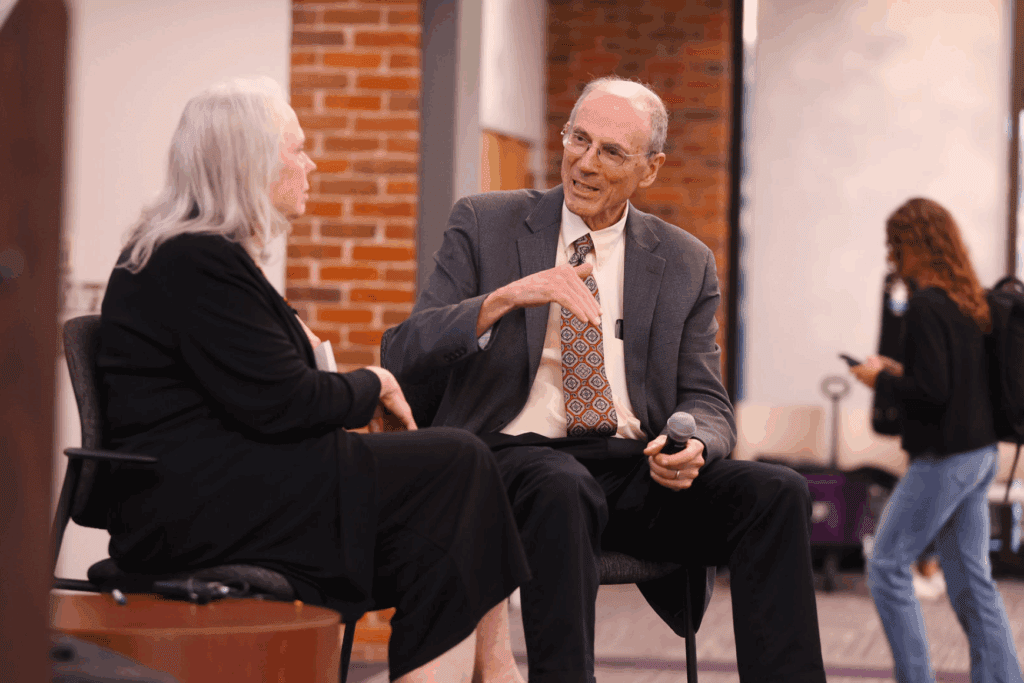
A response panel featuring Mark Noll (University of Notre Dame) and Helen Lee Turner (Furman University) brought the discussion back to Tocqueville’s themes.
Turner reflected on decades of teaching college students. “Even those who grew up in church,” she said, “know less Bible than they did forty years ago.” The erosion of biblical literacy matters—not because everyone must be Christian, but because fewer people can recognize or critically engage the religious language that still shapes political speech.
Noll raised a historical comparison: Winthrop’s original warning was echoed in many different American moments, including Jimmy Carter’s “malaise” speech—a rare modern instance of a president invoking moral responsibility rather than celebratory exceptionalism. Such appeals are fragile in today’s polarized environment.
Schiess responded by urging humility. Christians, she argued, should resist collapsing the distance between Scripture itself and their political interpretations of it. When politicians claim divine authority for their platforms, they narrow the space for real democratic deliberation. A healthier approach is to bring religious language into public life as a gift, recognizing that others bring their own languages too.
“Bible Haunted”: A Diagnosis of the Present
Perhaps the most memorable phrase of the night came when Schiess described America today as “Bible haunted.”
“We are a nation that is Bible haunted—filled with biblical language, images, and stories, but drained of much of their meaning.”
She explained that Americans still use phrases like “city on a hill,” “good Samaritan,” and “promised land,” but often without knowing their scriptural origins or theological significance. This leaves biblical language ripe for distortion. Politicians and movements can wield familiar words stripped of their moral depth.
Yet, for Schiess, the haunting is not only a problem—it’s an opening. These lingering biblical echoes point to a continuing longing for transcendence, a moral horizon that political language alone can’t supply. That longing is why these metaphors endure, even as their original meanings recede.
Tocqueville’s Insight, Revisited
Tocqueville saw religion as crucial to democratic life not because it imposed unity, but because it provided citizens with shared moral reference points that made disagreement meaningful. In the 18th century, Americans didn’t agree on what Scripture demanded—but they agreed it mattered. Today, that shared moral grammar is weaker.
The Tocqueville Center’s October lectures did not offer a program to restore it wholesale. Instead, they modeled what Tocqueville thought democracy needed: serious historical reflection, theological clarity, and open civic dialogue.
Noll reminded us that Scripture’s political role has always been complex, even in the founding era. Schiess showed how political use of the Bible transforms its meaning over time. Both emphasized that biblical language can illuminate, but also distort, public debate.

What Comes Next
The Tocqueville Center continues its fall series with Homecoming Events on October 23–24, featuring John Tomasi (Heterodox Academy), Ben Sasse (former U.S. Senator), and Elizabeth Davis (Furman University) on free speech and the crisis in American higher education.
As the nation approaches the 250th anniversary of its founding, these lectures raise pressing questions:
- Can a democratic people sustain meaningful public discourse without a shared moral language?
- How can religious communities model responsible engagement rather than culture-war slogans?
- What happens to democracy when its “Bible haunting” deepens—or fades?
Tocqueville believed that democracy required more than free institutions. It required citizens capable of grappling with ultimate questions. These two evenings suggested that the recovery of serious moral language—not its erasure—may be part of the work ahead.
To paraphrase Kaitlyn Schiess, if we no longer share a stable moral grammar, we need institutions—churches, schools, centers of inquiry—that teach people how to read before they rally: to interpret charitably, reason publicly, and act justly.
Join Us
Bring a friend. Bring your questions. Join the conversation as we continue to ask Tocqueville’s enduring questions.
— The Tocqueville Center for the Study of Democracy & Society