Tocqueville Fellows Blog, by Anna Lloyd: “Biblical Literacy: The Language of American Politics”
Anna Lloyd, from Summerville, South Carolina, is a senior majoring in Economics at Furman University with a minor in Data Analytics.
America as a “Bible-Haunted” Nation
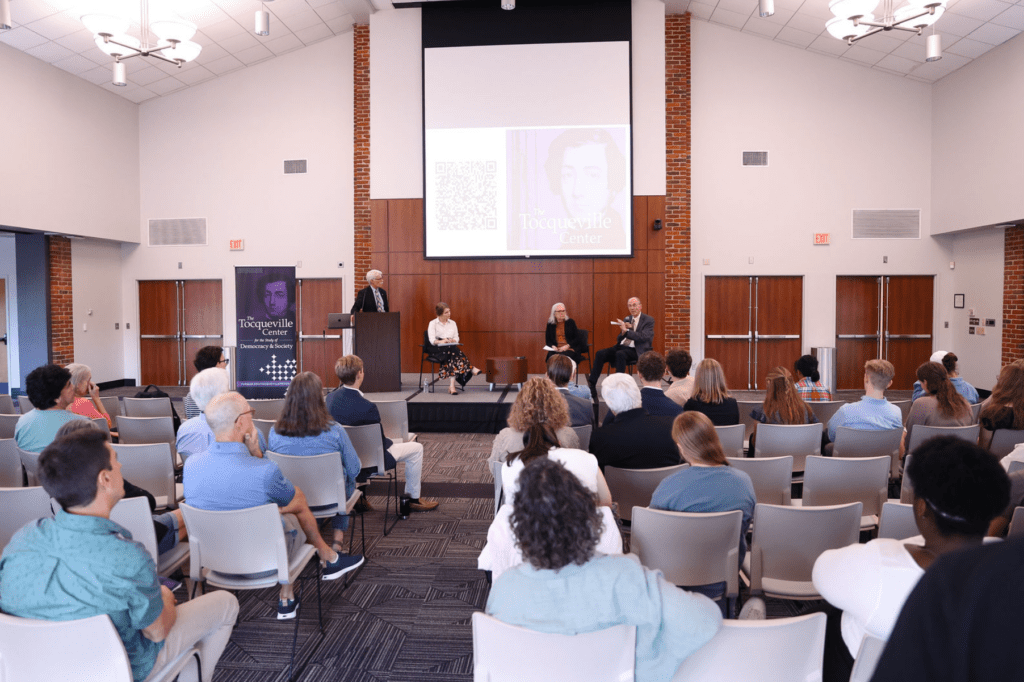
“We are a nation that is bible-haunted,” theologian Kaitlyn Schiess observed in her recent lecture on Religion and the American Founding. With this phrase, Schiess captured not America’s faith, but its speech. Our public language remains filled with biblical phrasing—from Lincoln’s “a house divided cannot stand” to the enduring vision of a “city on a hill.”
Yet these phrases are often detached from their biblical origins. They function less as arguments and more as moral ornaments. The Bible, once the moral foundation of political discourse, now lingers as an echo.

Scripture’s Role in the Founding Era
As historian Mark Noll discussed the night prior, this was not always the case. During the founding era, the Bible held a unique position in political life, serving both as a sacred text and as a shared moral language. Clergy played a fundamental role in shaping public opinion, weaving Scripture into both verbal and printed sermons.
Noll highlighted how ministers on both sides of the Revolution cited biblical passages to defend their positions. Baptist minister John Allen drew on Micah 7:3 to justify rebellion against the English monarchy, while others relied on Revelation 13:10 to condemn violence and urge anti-war attitudes. Even nonreligious Americans, such as Thomas Paine, employed biblical references to reach their religious audience.
Though the conclusions drawn from these passages differed, the Bible supplied a common linguistic and moral framework that allowed political arguments to root themselves in ancient moral reasoning.
A Shared Moral Language—But Not a Christian Nation
Noll’s research led him to a clear conclusion:
“Serious historical study does not justify describing the founding of the United States as distinctly, singularly, or unequivocally Christian.”
But it does reveal a nation that turned instinctively to Scripture for political meaning. The Bible shaped how Americans understood the foundations of politics and provided a vocabulary capable of expressing moral seriousness in public life.

From Biblical Meaning to Political Metaphor
Today, this common scriptural vocabulary remains—but in diluted form. Schiess’s characterization of modern America as “bible-haunted” captures the shift: a language once vibrant and substantive has been reduced to floating metaphors.
This change has two causes: intention and ignorance. Gone is the deep analysis of Scripture by clergy who once connected current events with biblical moral frameworks. Politicians today instead rely on cherry-picked phrases—“fight the good fight,” “the truth will set you free”—often unaware of their biblical source.
While these phrases still carry political weight, they lack the richer complexities of their scriptural contexts.
Few voters today would recognize “a city on a hill” as originating in Jesus’s Sermon on the Mount. Similarly, “fight the good fight,” now used in campaign rhetoric, is stripped of its theological meaning—perseverance in faith—and repurposed as a slogan for political combat.
This shift reveals a deeper transformation: The Bible once shaped the way Americans understood politics. Now it shapes only the way politicians sound.
Scripture, even stripped of meaning, still evokes emotion. That emotional charge is why it remains such a powerful political tool.
Schiess’s use of “bible-haunted” suggests not the absence of faith, but its distortion. Scripture remains present in our speech; its meaning, however, has faded.
Why Biblical Literacy Declined
This lingering presence shows how deeply Scripture is embedded in our national identity. These phrases circulate widely, but the population capable of recognizing or interpreting them has declined.
Schiess notes the role of Sunday school as a community-based introduction to Scripture—a way of giving children early exposure to the Bible. But for many Americans, scriptural education ends there. Adults rarely continue the study they began in childhood.
This lack of ongoing engagement has led to a steep decline in biblical literacy. Scripture becomes increasingly opaque just when the mind is most capable of grappling with its complexity. Adults are no longer challenged by Scripture, and if confronted with the intense political sermons of someone like John Allen, many would miss the argument entirely.
Recovering Our Scriptural Vocabulary
Just as Noll argues that America was not founded as a Christian nation, recovering the depth of our scriptural language does not require making America Christian again. What it requires is literacy—the ability to read, recognize, and understand the language that shaped our political imagination.
The Bible’s greatest influence on American life was not through doctrine, but through dialogue. It provided a shared moral vocabulary through which Americans could debate civic questions.
Without that shared literacy, the words remain, but their meaning dissolves.
If we hope to recover the richness of our political language—and the depth of our public life—it begins with reading and understanding the Scriptures we continue to quote.