Interview with Sergey Radchenko: Shades of Grey On Russia and China, and the Need for Intellectual Freedom
A Tocqueville Center interview with Cold War historian Sergey Radchenko

Sergey Radchenko is the Wilson E. Schmidt Distinguished Professor at the Johns Hopkins School of Advanced International Studies and one of the world’s leading historians of the Cold War, Russian foreign policy, and nuclear diplomacy. His research spans Soviet and Chinese archives, and his work has reshaped how scholars and policymakers understand 20th-century geopolitics.
Dr. Radchenko is the author of several books, including To Run the World: The Kremlin’s Cold War Bid for Global Power (2024), and has published widely in Foreign Affairs, The New York Times, and other leading outlets. His work bridges scholarship and public engagement, offering critical insights into global power dynamics.
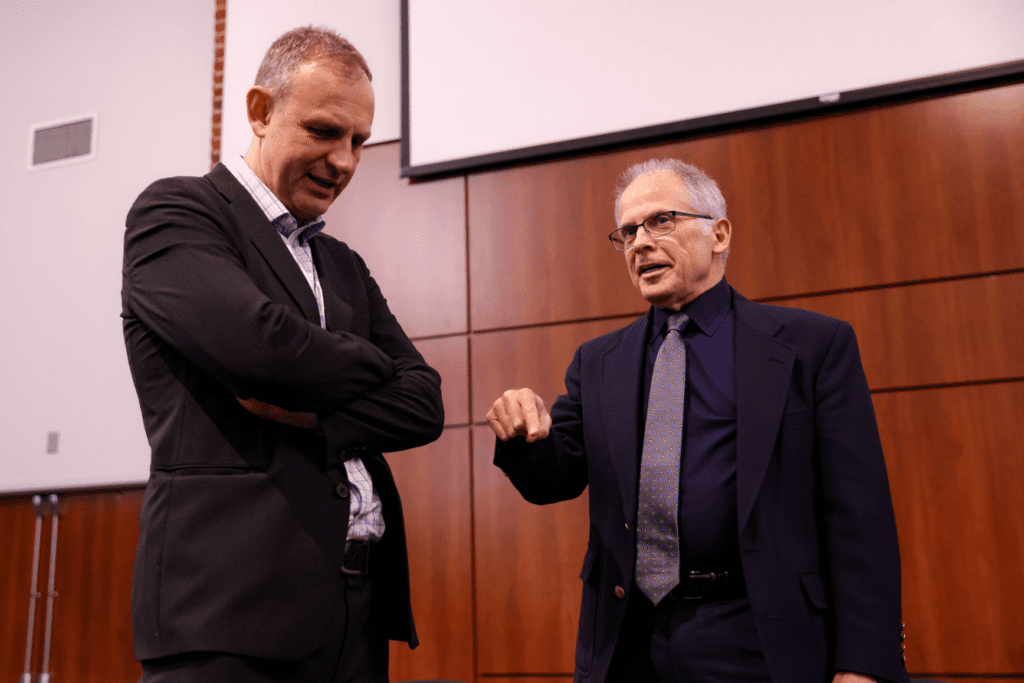
In March 2025, he visited the Tocqueville Center at Furman University to deliver a lecture titled “The Russia Problem—with an Eye to China”, where he spoke on the legacy of Cold War diplomacy, the logic of Russian strategy, and the challenges of open discourse in a polarized academic and policy environment.
American Students and the View from a Distance
Tocqueville Center: Is there anything you’d want to say to a college-age audience? Something about how Russia—or China—is understood here?
Sergey Radchenko: Well, you know, students here obviously don’t have direct experience of China or Russia in the same way we do in Europe. I mean, China is somewhat of an issue, but it’s not really the same. Russia is much more immediate for us. Since the invasion of Ukraine, for example, we’ve had Ukrainian refugees arriving in large numbers. So students over there, they have a better hands-on view of what’s going on.
Here, you’re basically on the other side of the world. Russia and China—they’re abstract concepts. They exist out there.
“They are abstract concepts that exist out there.”
And that’s part of why this idea of isolationism—or some return to it—sells well here. Because these places feel far away, and what happens there seems like it has no bearing on what happens here. This notion of interconnectedness—it just doesn’t always connect for a lot of people.
That said, I do notice a lot of curiosity. Students here, they have opinions. They want to know what happened, who was at fault. And there’s real interest in engaging with people like me, who are from that part of the world and have a perspective on how things are developing.

The Problem of Echo Chambers
Tocqueville Center: Outside of the student context—what’s missing in the broader public conversation? What do you find frustrating?
Sergey Radchenko: What I’m mainly concerned about are echo chambers. Echo chambers when it comes to our understanding of policy questions—Russia, China. There’s a tendency for people to self-censor. If they feel that what they say might not be accepted by their peers, or might hurt their careers, they hold back.
“There is a tendency for people to self-censor if they feel that if they say something… that will be detrimental to their careers.”
I’ve seen that with China, especially. For years—and things are starting to change now—but for years, if you were in Washington, you had to be a China hawk. That was the consensus. There was very little space for people who said, “Maybe we should try to avoid confrontation.” Those people were dismissed as naïve, or as “panda huggers.”
That kind of environment doesn’t help us think clearly about the China problem.
And on top of that, a lot of the people who weigh in on these issues—they’re not China experts. Maybe they don’t speak Chinese, maybe they’ve never even been to China. And look, I’m not saying we should exclude them—they sometimes have interesting things to say. But if too many people in the room are like that, and there aren’t enough actual experts, that’s a problem.
The same applies to Russia.
What You Can’t Say Anymore
In Europe, after Russia invaded Ukraine, there were just certain things you knew not to say. So that created this echo chamber effect. And once that’s in place, even when people are faced with new evidence—evidence that contradicts the dominant view—they’ll reject it. Or they just ignore it.
Tocqueville Center: Can you give an example?
Sergey Radchenko: Sure. One example is Mearsheimer—John Mearsheimer. He’s got this theory that Putin invaded Ukraine because he was worried about NATO enlargement, and that’s the only reason.
Now, he doesn’t speak Russian. He’s not a regional expert. But this theory—it’s become very popular in some circles. And he’s very insistent that he’s right. I personally think it’s bonkers. But I’d never try to suppress that. It’s good that it’s out there. We should be discussing it.
“I personally think [Mearsheimer’s view is] bonkers, but I would never try to suppress that.”
The bigger problem is when people insist, with absolute certainty, that Russia has no grounds to claim there’s been any discrimination against Russian speakers in Ukraine. And then they label anyone who raises that point as a Putin apologist, or a useful idiot. And I just think, come on—look at what’s actually happening.
It’s not about being stupid—it’s just that people get sucked into these narratives and feel they can’t say certain things, even if they’re true.
The Istanbul Talks and the Backlash
I had a very interesting experience with this. I co-wrote an article with Sam Charap of RAND—we looked at the Istanbul negotiations between Russia and Ukraine. The article ended up being one of the best of 2024 in Foreign Affairs. But we got attacked like crazy. Absolute mob attacks. Angry emails.
“We got attacked like crazy after publishing this article.”
People claimed we were justifying Putin, or that we falsely claimed he wanted to negotiate. And I said, “Well, here’s my evidence. Where’s yours?” But they didn’t have any. They just didn’t want that narrative to be challenged.
Later, I saw something similar at a conference in Estonia. Sam gave a talk and got into a very intense exchange with a Ukrainian participant. It was just a really hostile atmosphere. And I thought, I get it—we’re talking about war, and people are emotional—but still, you can’t shut down views that don’t match your own.
Because then we’re just talking to ourselves. And we miss obvious things.
Trying to Stay in the Middle
In my work—whether it’s Russia, China, or something else—I try to steer toward the center. To the extent that the center even exists. I try to look at different perspectives and put them side by side and ask: is it really black and white? Or is it some shade of gray?
“I try to steer… toward the center… Is it really black and white? Or is it some shade of gray?”
And I know a lot of people don’t like that. They see it as morally weak. When I say, “It’s not so simple,” they think I’m justifying something terrible. But of course I’m not. It’s just… it’s not so simple.
Academic Culture and Ideological Policing
Tocqueville Center: That reflects something broader in academia—the tendency to begin with doctrine and exclude anything that doesn’t align with it.
Sergey Radchenko: Exactly. Instead of starting with a question and evaluating evidence, we start with a conclusion. And then anything that doesn’t line up gets pushed aside.
I’ve seen this in so many areas—in academia more broadly. Whether it’s colonialism, gender, DEI, Israel–Palestine. Everything is so polarized.
What really worries me is that there are people actively looking for opportunities to take their colleagues down. They’ll use something someone said—maybe years ago—and try to ruin them with it. I find that outrageous.
“That reminds me of the kind of Soviet system of denunciations and backstabbing.”
And I think part of why it affects me so much is that I grew up in the USSR. That culture of denunciation—it reminds me of that. It’s really disturbing.
Literature, History, and the Russian Mind
Tocqueville Center: If a student wanted to understand Russia—not just the politics, but the deeper culture—what should they read?
Sergey Radchenko: There’s a guy at Georgetown, Charles King, who once wrote that we shouldn’t read 19th-century Russian novels to understand the “Russian soul”—just like reading Mark Twain won’t necessarily explain America.
Maybe he’s right. But I still think it’s important to read Russian literature. Not just to understand Russia, but to ask the fundamental questions we all face as human beings.
“I feel enriched by doing that. I always draw my students’ attention to the richness of Russian literature.”
I’ve read volumes and volumes—Dostoevsky, Tolstoy, all of them. Students today often don’t want to read something that’s 1,000 pages long, but I think that deep engagement matters. Not just with Russian literature—with any literature.
And then there’s history. We’re all rooted in history. If you want to understand where Russia or China is headed today, you have to read their histories. That helps you see how things have been interpreted, how experiences have been passed down. It doesn’t tell you everything—but it opens your mind.
Historians to Read
Tocqueville Center: Are there historians of Russia you’d recommend?
Sergey Radchenko: Sure. I love Simon Sebag Montefiore. He’s written biographies of Stalin, the Romanovs, Catherine the Great. He’s a fantastic storyteller—his books are for the general public. You can find them in airport bookstores all over Europe.
If you want something serious and scholarly, Stephen Kotkin is the way to go. His Stalin biographies are incredible—very deep, very rigorous. You have to work through them, but it’s worth it.
Orlando Figes is another one—he’s written about Russian cultural history, the Crimean War. Also very readable. I think students would enjoy his books because they’re light, but still informative.