Lecture Summary, Sergey Radchenko: “The Russia Problem with an Eye to China”
“To attain their aims, the former [America] relies on personal interest and gives free scope to the unguided strength and common sense of individuals.
The latter [Russia] in a sense concentrates the whole power of society in one man.
One has freedom as the principal means of action; the other has servitude.
Their point of departure is different and their paths diverse; nevertheless, each seems called by some secret design of Providence one day to hold in its hands the destinies of half the world” (Democracy in America, p. 413).
Cold War Echoes, Modern Stakes: Russia, China, and the Future of Global Power
Sergey Radchenko gave an illuminating talk at our March event last week on the topic of “America’s Role in the World.” Radchenko is the Wilson E. Schmidt Distinguished Professor at the Johns Hopkins School of Advanced International Studies. He is a native of Sakhalin Island, Russia, and was educated in the US, Hong Kong, and the UK, where he received his PhD at the London School of Economics.
Before he joined the Hopkins School of Advanced International Studies (SAIS), Radchenko worked and lived in Mongolia, China, and Wales. He has written extensively on the Cold War, nuclear history, and on Russian and Chinese foreign and security policies. He has served as a Global Fellow and a Public Policy Fellow at the Woodrow Wilson Center and as the Zi Jiang Distinguished Professor at East China Normal University (Shanghai).
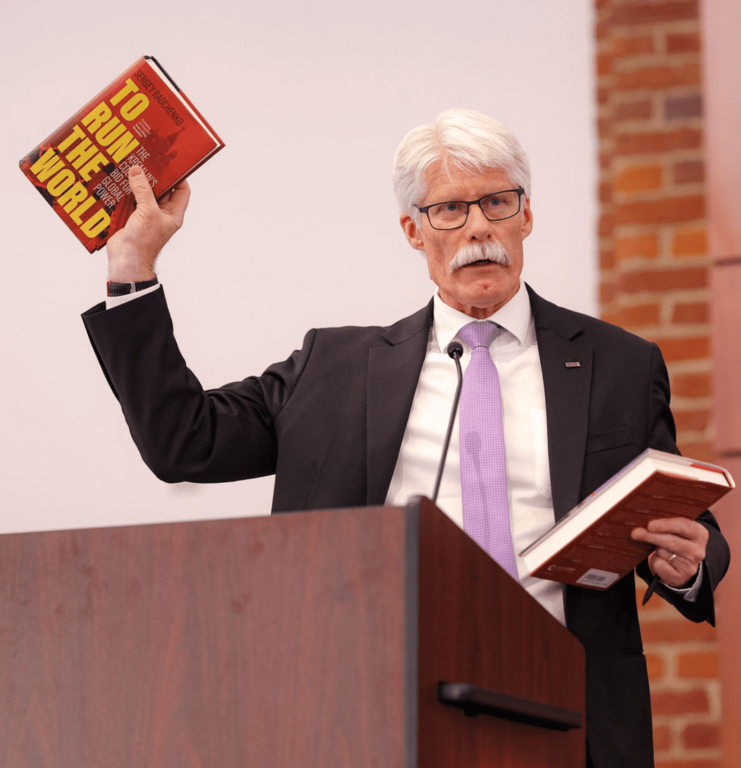
Radchenko’s books include Two Suns in the Heavens: The Sino-Soviet Struggle for Supremacy, 1962–1967 (2009) and Unwanted Visionaries: The Soviet Failure in Asia at the End of the Cold War (2013). His most recent book, To Run the World: The Kremlin’s Cold War Bid for Global Power, won the 2025 Lionel Gelber prize.
Watch the video of Radchenko’s lecture:
Russia’s Global Role: Cold War Legacy and Modern Foreign Policy
Dr. Sergey Radchenko offered deep historical insight into Russia’s Cold War diplomacy, post-Soviet transitions, and the trajectory of Vladimir Putin’s foreign policy.
“Many things that happen today—you can find echoes of them in history.”
Radchenko opened with a surprising 1988 moment: President Ronald Reagan strolling through Red Square with Mikhail Gorbachev. Though the Soviet Union still maintained a vast empire and nuclear arsenal, Reagan famously remarked, “It was another time, another era,” signaling the symbolic end of Cold War hostilities.
This anecdote served as a springboard for a detailed overview of U.S.–Soviet tensions, including the invasion of Afghanistan, martial law in Poland, and the 1983 downing of a Korean airliner. These flashpoints, Radchenko noted, brought the world close to the brink of a “Second Cold War.”
Soviet Collapse and the Rise of Putin’s Russia
Radchenko detailed how the Soviet Union’s internal collapse—due to economic stagnation, loss of political control, and nationalist movements—created power vacuums throughout Eastern Europe and Central Asia. He offered both a personal and scholarly perspective, describing his own childhood in Sakhalin Island, where shortages were so severe “we used newspapers instead of toilet paper.”
“Gorbachev loosened the screws of political control, permitting raw, destructive freedom.”
The geopolitical aftermath was complicated. President George H. W. Bush’s 1991 “Chicken Kiev” speech warned against “suicidal nationalism.” Meanwhile, Chinese leaders quietly sided with Soviet continuity, fearing that if the USSR disintegrated, China’s own fragile system might follow.
China and Russia: From Communist Rivalry to Strategic Alignment
Radchenko then explored the long, uneasy history of Sino–Soviet relations, from early communist camaraderie to ideological rupture in the 1950s and ’60s. Mao Zedong resented Soviet condescension, famously ridiculing proposals for joint naval command as imperial overreach.
“The Russians to you are superior while the Chinese are inferior… Shall we hand over our coastline too?” —Mao
This resentment escalated into border conflicts, culminating in a near-nuclear confrontation in 1969. By the 1970s, strategic concerns prompted China to pivot toward the U.S., and Russia began to reframe China as a potential rival. Despite past hostility, both sides eventually found common ground in opposing American unipolar dominance.
Strategic Realignment: The New Russia–China Partnership
The 1990s saw improved Russia–China relations, marked by mutual pragmatism. Leaders like Boris Yeltsin and Jiang Zemin downplayed ideological friction in favor of strategic cooperation. A central motivation, Radchenko argued, was the shared perception of American hegemony.
“China needed a strong Russia to counterbalance the U.S. — and vice versa.”
By the late 2010s, this had evolved into what Chinese diplomats called a “comprehensive strategic partnership,” though they have since distanced themselves from the phrase “partnership without limits,” especially after Russia’s invasion of Ukraine.
NATO Expansion and Russia’s Security Anxiety
Radchenko acknowledged the complex issue of NATO enlargement, often cited by Putin as a justification for aggression in Ukraine. He recalled a revealing moment from Gorbachev’s adviser Anatoly Chernyaev, who argued in 1990 that even if NATO moved eastward, Russia would remain secure due to its nuclear deterrent.
“It wouldn’t matter if Poland joined NATO. We have nuclear weapons.” —Chernyaev
Nonetheless, Radchenko noted how Russia’s sense of humiliation post-Cold War fed a revanchist mindset. Putin’s early promise to “lift Russia from its knees” tapped into this deep reservoir of resentment, ultimately fueling the invasion of Ukraine.
The U.S., China, and Russia: A Strategic Triangle in Flux
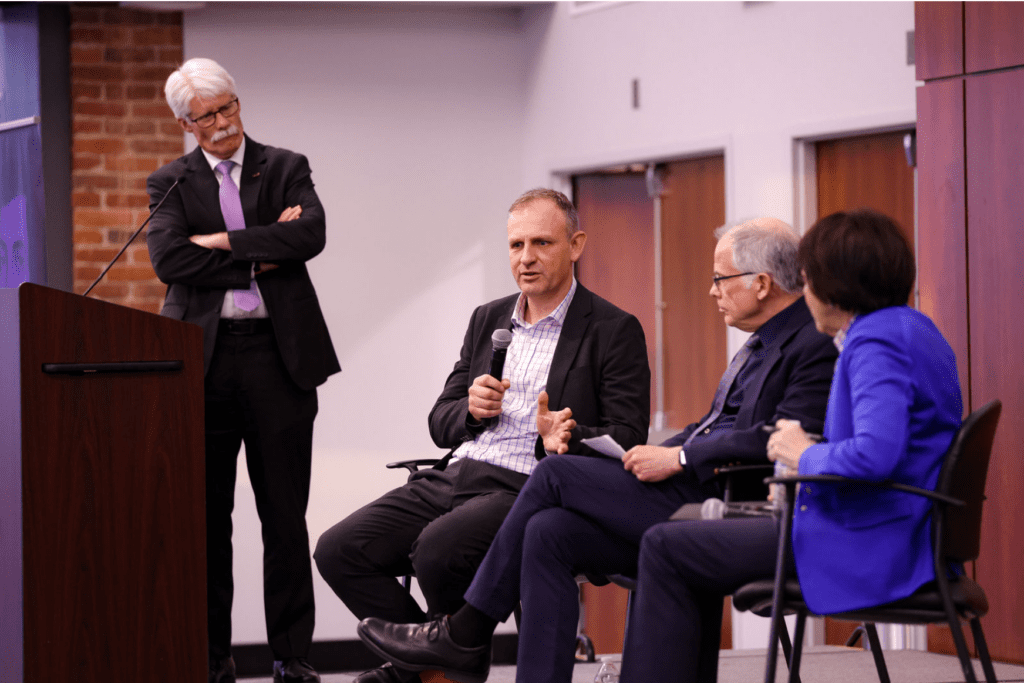
In the discussion panel following Radchenko’s lecture, Professor Susan Shirk (UC San Diego) and Professor Michael Buehler (Furman) provided expert commentary. Shirk emphasized the role of personal leadership in international relations, noting that Xi Jinping sees Putin as a more trustworthy partner than Western leaders.
“The subversion Xi fears now comes from the West—not Moscow.”
Buehler praised Radchenko’s focus on leadership psychology, arguing that political science needs to pay closer attention to individual agency, not just structural forces. He also drew historical parallels to post-World War I Germany, cautioning against humiliating a fallen power.
“I wonder sometimes if the U.S. had been a little more modest in its victory, things might have turned out differently.”
Key Takeaways on Russia, China, and Global Power Competition
- Russia’s Cold War legacy continues to shape its foreign policy worldview, particularly toward NATO and the West.
- Sino–Russian relations have evolved from bitter rivals to strategic partners aligned against American dominance.
- Personal leadership—Putin, Xi, Trump—plays a defining role in geopolitical alignment.
- Shared grievances about U.S. influence have brought Russia and China closer, though their partnership remains one of convenience.
The Tocqueville Center’s ongoing lecture series continues to shed light on these pressing questions, blending historical depth with contemporary insight as the world navigates a new age of great power politics.