Blog
Building Heat Resilience: How the Shi Institute and Bluffton Are Leading the Way
Extreme heat is one of the deadliest extreme weather events in South Carolina, and it’s getting worse. Residents already experience about 15 days each year with temperatures above 95°F, and that number is expected to increase in the coming decades. Yet, despite the growing danger, heat resilience often remains a low priority across the Southeast. Communities, and especially those most vulnerable, cannot afford to wait.
The Shi Institute for Sustainable Communities at Furman University is working to change that. By equipping at-risk communities with tools, knowledge and partnerships, the Shi Institute is helping local communities identify priority actions to prepare for extreme heat.
A Regional Network for Resilience
As South Carolina’s partner in the Southeast Navigator Network, a program launched in 2023 by the Geos Institute with support from the Walmart Foundation, the Shi Institute plays a critical role in advancing climate resilience. This network spans and supports South Carolina, North Carolina, Georgia and Florida, focusing on FEMA-designated Community Disaster Resilience Zones. Through this initiative, the Shi Institute collaborates with ten local governments, including Summerville, Goose Creek, North Charleston and Bluffton, to help communities understand their challenges and explore solutions.
Adelaide Bates, climate resilience manager at the Shi Institute and South Carolina’s navigator within the Southeast Navigator Network, connects communities with resources, funding and technical assistance so communities can build resilience. The South Carolina Office of Resilience defines resilience as “the ability of communities, economies, and ecosystems to anticipate, absorb, recover, and thrive when presented with environmental change and natural hazards.” The Shi Institute works with communities to transform community challenges like extreme heat into opportunities for resilience and long-term thriving.
Why Heat Resilience Matters
Extreme heat poses serious health risks from chronic heat stress and heat stroke to adverse pregnancy outcomes, mental health challenges, and cardiovascular and respiratory illnesses. The health impacts of extreme heat are not distributed equally among community members, a trend that will be amplified by worsening natural hazards and changing conditions. Vulnerable populations, including seniors, young children and people with pre-existing conditions, face the greatest danger from extreme heat.
In the Southeast, communities are already grappling with health disparities stemming from historic inequities, causing many historically marginalized communities to face compounding risks from disproportionate heat exposure, chronic disease and limited healthcare access.
Combatting Extreme Heat with University Resources
The Shi Institute has a large network of experts and resources to aid communities as they fight extreme heat. In the spring of 2024, the Shi Institute partnered with the Town of Bluffton through the Carolinas Climate Adaptation Partnership to conduct an extreme heat vulnerability mapping assessment, at no cost to Bluffton, to help the town identify priority areas for climate resilience.
Unlike traditional heat maps that rely solely on satellite data to show hot spots, the Shi Institute’s Applied Research Team also pinpointed the locations of those vulnerable to extreme heat to determine the areas where heat risk and community need intersect. This is a critical realization, as not all community members manage the impacts of extreme heat the same way.
Adelaide added, “The Shi Institute understands that not everybody has the same capacity to manage heat. Some people are particularly vulnerable, so we wanted to know where these people are, how we can identify them and how we can direct resources to them.”
Adelaide’s work in the community made this deeper analysis possible, paving the way for the Shi Institute’s Applied Research Team and later Furman students and faculty to contribute in ways that amplify impact and advance the university’s educational mission.
Where Heat and Community Needs Meet
The Town of Bluffton is using these insights to prioritize mitigation strategies by providing shade and decreasing the impact of the urban heat effect through various strategies, such as bolstering its tree canopy and placing shelters on priority bus stops.
The partnership also sparked student-led projects at Furman. In the fall of 2024, results from the extreme heat vulnerability assessment guided students in a Visioning Sustainable Futures course to create different scenarios for the Town of Bluffton under varying levels of extreme heat action. The resulting report, titled A Sustainable Vision for Bluffton, showed various scenarios illustrating possible futures for Bluffton based on various mitigation strategies.
Aruzhan Sakhariyanova, a student in the Visioning Sustainable Futures course who later became a heat adaptation fellow at the Shi Institute, continued the work beyond the classroom. Through this fellowship, she led community outreach and engagement in Bluffton by surveying residents and interviewing municipal staff to assess residents’ needs and interests related to heat adaptation projects, such as cooling centers and community solar initiatives. According to the results from her surveys, 80% of Bluffton respondents indicated heat was an important issue in their community to varying degrees. Her work helped guide Bluffton in their future efforts.
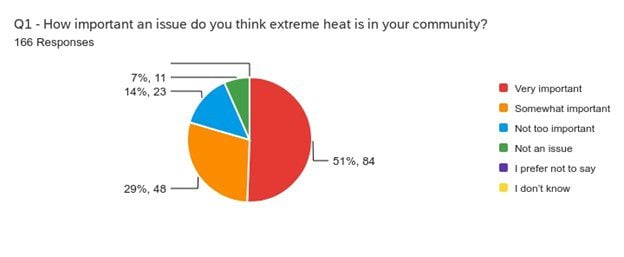
Results from community survey.
Adelaide understands the impact that Aruzhan’s research will have on the community, as she explained, “She’s not just creating a pretend project or working on a community that does not exist. She’s working on a real-world example, and she’s truly providing a big benefit to this community.”
Not only did the community benefit from her work, but Aruzhan also saw an impact. She shared, “My experience as a Heat Adaptation Fellow strengthened my foundation for future work in public-sector sustainability. It helped me develop organizational and collaborative skills, especially cross-sector collaboration.”
Furman students in the Sustainability Science Practicum expanded on the research in Bluffton to explore, scope and recommend potential strategies for Bluffton and local organizations. Students visited the town to connect with local government leaders, understand the town’s unique needs and develop recommendations for reducing extreme heat vulnerabilities and improving community heat resilience. Next year, the Shi Institute will support the town in pursuing next steps.
Looking Ahead
As extreme heat intensifies across the region, communities need trusted partners who can help them navigate complex challenges. The Shi Institute’s approach of combining research, education and deep community engagement demonstrates that climate adaptation is most effective when it’s collaborative and community driven. The choices made today will shape who thrives tomorrow, and Bluffton’s story shows what’s possible when preparation meets partnership.