Blog
Data for a Greener FUture
Working on Furman’s Greenhouse Gas Report has helped me understand how small actions can make big impacts. Something as small as swapping a lightbulb can save enough energy to power a home! At a scale as large as Furman, these seemingly tiny actions will be pivotal to achieving our goal of being carbon neutral by 2040.
My name is Kate Buckley, and I am the Sustainability Assessment Fellow this year at the Shi Institute. As a senior sustainability science student and aspiring sustainability specialist, this fellowship has allowed me to see a side of real-world sustainability that I couldn’t see in my classrooms. 
From the hours spent communicating with stakeholders gathering data to the hours spent analyzing and reporting data, I have faced many challenges in compiling Furman’s annual greenhouse gas report. Ensuring our data is accurate and precise is essential for generating an accurate greenhouse gas report. We have to make lots of assumptions about some of our data because it is imperfect or incomplete. These problems created amazing learning opportunities for me to help with improving our reporting practices.
One piece of difficult data was our Study Away Travel. I received this piece of data with minimal information – just the number of participants on each program and what cities they flew to. From this, I found the flight miles of each trip; our first assumption was that all participants flew on the same plane. We know this is most likely not 100% true as many times students must purchase their own flights, but it is the best assumption we could make to ensure we didn’t over or under report the emissions. Next, I had to reach out to the help desk of our reporting platform, SIMAP, to double check what exactly we were supposed to report, flight miles or passenger miles. I discovered that I needed to multiply the flight miles I calculated for each program by the number of participants to report the passenger miles accurately. This correction has improved this year’s report, and the knowledge gained will improve future reports. Being able to contribute to Furman’s sustainability commitments this year has been so meaningful, even in a small way, fixing one reporting strategy.
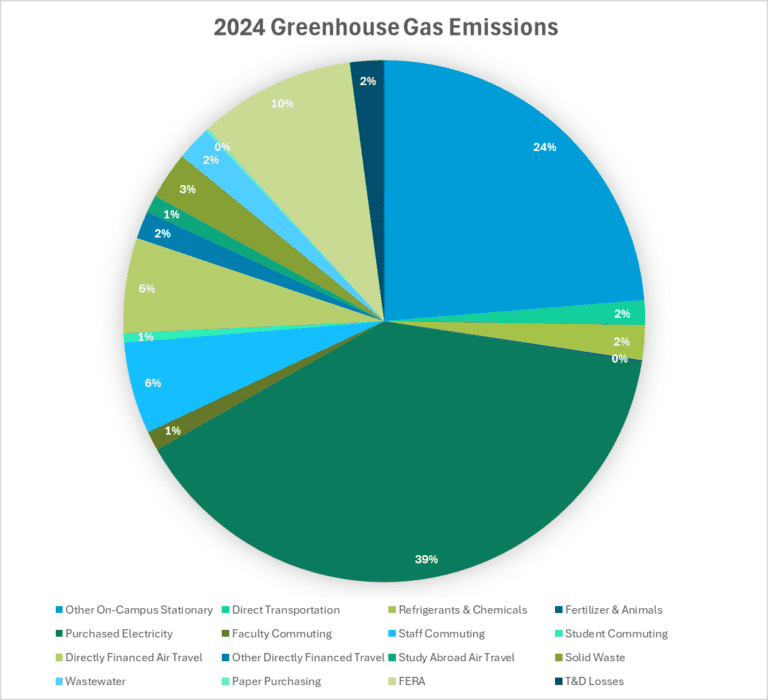
Furman’s emissions by category in FY 2024. Electricity is almost 40% of our total carbon footprint. Making small swaps, like more efficient lights, has helped us reduce our consumption and emissions.