News from campus and beyond
NSF program increases access to science, careers for Furman students
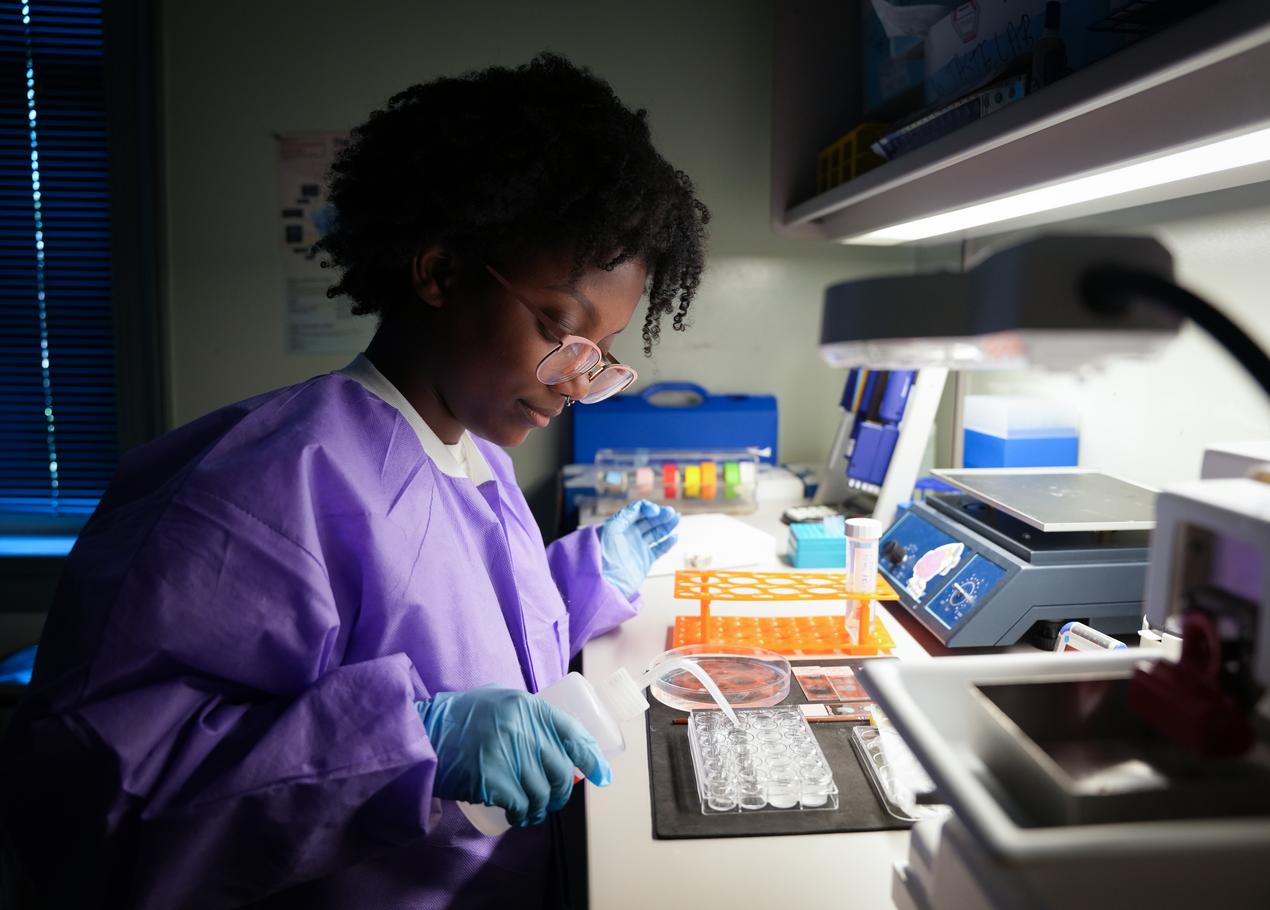
Dallas Shuman ’25 works in Veronica Flores’s lab in this photo from July 12, 2023. Photo by Nathan Gray, Furman University.
Dallas Shuman ’25 has always been close to her grandmother. When Nana was diagnosed with Alzheimer’s a few years ago, it was troubling.
“Her personality hasn’t changed, it’s just a memory thing for her,” Shuman said. Nana, who lives in Savannah, couldn’t remember when her granddaughter was going to graduate, so she would ask over and over, forgetting after each time. And she began to wander. “She was always a busy body. She still is, but now she’ll leave and not come back,” Shuman said.
Shuman also felt the fear of the disease’s uncertainty. Would Nana forget her granddaughter. Would her mother be diagnosed one day. Would Shuman?
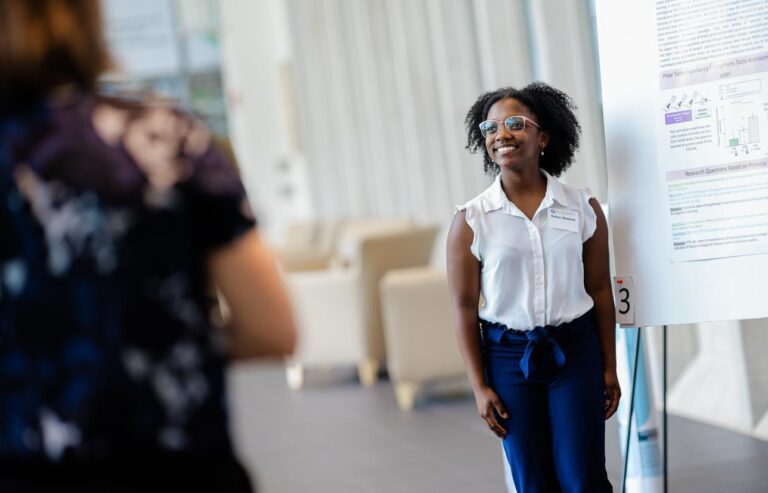
Dallas Shuman ’25 presented her work at the 2022 Neuroscience and Psychology Research Conference on campus. File photo.
There’s a good chance that Shuman, an undergraduate researcher, might answer these types of questions herself one day. She came to Furman in part because of the university’s success receiving funding from the National Science Foundation’s Scholarships in Science, Technology, Engineering and Math, or S-STEM. The program provides grants to universities specifically for students who demonstrate high academic ability and talent, but who have financial needs. Furman has been awarded $3.6 million since 2012.
“Social mobility for low-income students with academic potential is even more crucial than for students (who) enjoy other economic support structures,” according to the NSF.
“Our goal is to improve and broaden the STEM base for all areas of science and math,” said Furman’s John Wheeler, associate provost for integrative science and principal investigator of the S-STEM grant. “The best way to do that is to make sure we’re not missing undergraduates who aren’t able to pursue those interests because they don’t have sufficient funding to complete their education.”
S-STEM fits within The Furman Advantage ethos: offering a personalized four-year pathway with high-impact learning opportunities so students can be their best.
After she graduates in May with a degree in neuroscience, Shuman hopes to spend a post-baccalaureate year studying more neuroscience at the National Institutes of Health before pursuing a doctoral degree in – wait for it: neuroscience – and studying neurodegenerative diseases, like Alzheimer’s.
Furman’s success in S-STEM
Furman first competed for and received S-STEM funding in 2012. The $600,000 grant supported 23 students, from their first year through graduation and into STEM fields. The next time the university was eligible to apply, in 2020, it received $1 million and supported 27 students, including Shuman.
Furman competed this past fall for a new award and will receive $2 million in funding to support about 30 students beginning in Fall 2025, Wheeler said.
To be eligible for the upcoming program, high school students must demonstrate high aptitude and an interest in studying chemistry, biology, neuroscience, math or computer science. They must be eligible for federal Pell grants and have additional unmet financial need, said John Kaup, director of science education and the program manager for Furman’s S-STEM awards.
“With an increased maximum award of $15,000 per year, we look forward to making Furman an accessible option for the next cohort of future scientists” Kaup said.
S-STEM universities are required to offer best-practice programs and to study the results. During the current award, Furman created a program called Start an Amazing Furman Experience (SAFE) Passage, in which they brought S-STEM scholars to campus for a week during the summer before they enrolled. Students met faculty, attended mock classes, shadowed STEM research groups and participated in social activities. During their first year the scholars were co-enrolled in an introductory chemistry course with peer mentors, taught by Beth Anderson, and a first-year writing seminar, taught by Ruth Aronoff. S-STEM students also had their own cohort in Furman’s Pathways Program, a two-year course where students learn about themselves, how to succeed academically and how to prepare for careers.
S-STEM Students Succeeding
“The impact on our S-STEM scholars’ retention, participation in experiential learning activities and academic performance has been extraordinary,” Wheeler said. For example, 68% of S-STEM students completed research after their first year, compared with about 15% of the overall STEM student population. Twenty-three percent of them have completed three years of summer research with a year and a half remaining in the program. Grades in STEM courses have averaged half a point higher than reference groups with similar interest in STEM majors over the first two academic years.
Furman’s S-STEM program has also measured participants’ sense of belonging, including if they feel like they are part of a larger scientific community.
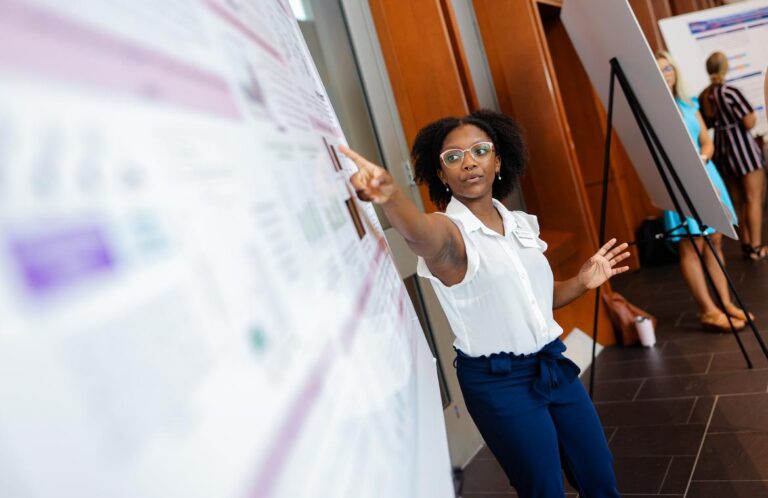
Dallas Shuman ’25 presented her work at the 2022 Neuroscience and Psychology Research Conference on campus. File photo.
“Scholars self-report feeling like they belong in the field of science and have a stronger STEM identity versus matched reference groups, data highly encouraging, statistically significant,” Wheeler said. Based on scholar reflections, much of this results from SAFE Passage, the friendships created during first-year cohort engagements and early research experiences.
Shuman, who has done psychology research with Veronica Flores, said she’s still friends with her SAFE Passage cohort, and the grant “meant an easier start at Furman because I had to worry less about the financial aspect.”
Another program goal helps scholars travel to scientific meetings to present their work and meet other scientists.
Shuman has presented her work at three national conferences. At the Annual Biomedical Research Conference for Minority Students she received a best-presentation award in neuroscience.
Shuman said she’s always liked science classes best. “I always asked 10 million questions,” she said. At Furman, she realized, “Oh, there’s a career where I can ask questions and answer them.”
Making that discovery answers the first big question in the life of Shuman the scientist.