News from campus and beyond
Medical-legal MayX offers perspective on poverty

Kirby Mitchell ’90, legal director of Upstate Medical Legal Partnership at South Carolina Legal Services, speaks with students in the Medical Legal Partnership MayX outside of the Greenville County Courthouse on June 2.
Kirby Mitchell prescribed his Furman University class a healthy dose of perspective during this year’s summer May Experience term.
“Poverty, Medicine and the Law: Greenville’s Medical-Legal Partnership” challenges students to consider how low-income people navigate court without a lawyer or access healthcare without insurance. They don’t just ruminate on these questions in a classroom, but visit the courtroom and emergency room to find out for themselves.
The three-week MayX term offers students engaging, experiential learning opportunities on campus, or study-away programs throughout the world.
“I pitch it to my class as a foreign study in Greenville, because so many Furman students have no experience with the legal or health care systems,” said Mitchell, legal director of the Upstate Medical Legal Partnership (MLP) and adjunct professor.
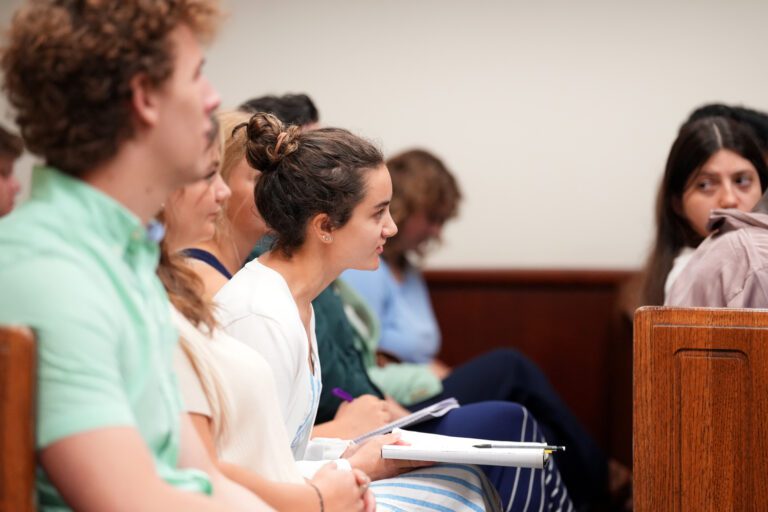
Jessica Clover ’26, middle, asks a question to Judge Edward Miller, not shown, during a visit to the Greenville County Courthouse as part of the Medical Legal Partnership MayX course on June 2.
Students met judges, bailiffs and attorneys, emergency room doctors and people who have navigated complex medical situations. Mitchell took them to tour Greenville’s family and circuit courts and visit Prisma Health to help ground their ideas for social change in the real-world challenges people face.
“These are systems people have to navigate every day. Seeing it ourselves was extremely helpful in understanding the roles people play and the impact an emergency room doctor or a bailiff can have on someone’s life,” said psychology major Matt Zubryd ’25.
Catherine Sikes ’25, a biology and German studies double major, said she’s interested in health public policy and how it affects incarcerated people. She interned at Prisma Health her junior year, but she gleaned new insights from Mitchell’s class. There are more people struggling to make sense of these systems and get the services they need than she and other students initially realized.
“It’s one thing to sit in a classroom and talk about these things, but it’s another to run a poverty simulation or go into the hospital and court room to see it ourselves,” she said.
The relationships between crime, poverty and health outcomes was well-trod territory at circuit court. Many defendants face mental health struggles or substance use disorders, said 13th Circuit Public Defender Mindy Lipinski. There’s often overlap among economic, medical and legal hardships for her clients.
“Crime tends to follow poverty, and it’s well-known that unemployment and housing insecurity drive crime,” she said. “We have plenty of people sitting in jail because they can’t afford a $500 bond.”

From left: Libby Adams ’27, Vivianna Gutierrez ’27 and Landon Sutton ’26, participate in a poverty simulation in the Watkins Room of the Trone Student Center as part of their Medical Legal Partnership MayX course on May 27.
The Upstate MLP – started in 2016 as the first of its kind in South Carolina – connects Furman, Prisma Health Upstate and South Carolina Legal Services to improve health outcomes for people throughout the Upstate. The partners help coordinate access to non-medical assistance when a medical issue is exacerbated by a social or legal problem.
“You have to retain the ability to have an individualized approach,” Mitchell said. “You have to treat every patient and every defendant independently.”
That’s what he hoped to show his class: As they explore possible careers and find ways to help people in need, they should keep a critical eye on the systems they help others navigate. Many of his students are considering law or medical school, where critical thinking will serve them well.
“What’s fair to people involves more than just what happens in a courtroom,” Mitchell said. “The different lenses you can look through – constitutionality, practicality, morality – all ask different questions. If you want to be an effective lawyer, it’s helpful to be able to shift through those different arenas.”