News from campus and beyond
Furman’s IACH helps map hunger throughout the state

Sean Rusnak ’18, an employee of Openfields, talks with members of the Food Security Coalition during a meeting at LiveWell Greenville’s office space at the Rupert Huse Veteran Center on Tuesday, Feb. 11, 2025.
How can a community fight food insecurity if they don’t know what’s causing it?
Furman University’s Institute for the Advancement of Community Health (IACH) has partnered with Food is Medicine South Carolina (FiMSC) and Openfields to map food insecurity risk throughout the state. This data tool was developed with funding from S.C. SNAP-Ed and enables community stakeholders to compare food insecurity risk with relevant health outcomes, demographics and community resource data.
You may have heard the term “food deserts” – areas that lack access to nutritionally adequate foods. But “access alone does not solve the problem,” said IACH Director of Community Action Melissa Fair ’10.
“Poverty is the leading indicator for why people don’t have access to healthy food,” she said.
The researchers involved in this project developed the South Carolina Food Insecurity Risk Index, which measures multiple economic and social vulnerabilities people face at the census tract level. This serves as an indicator of how likely people in each area are to experience food insecurity. The publicly available map visualizes the risks, giving anyone access to community data to help shape programs and policies around local needs.
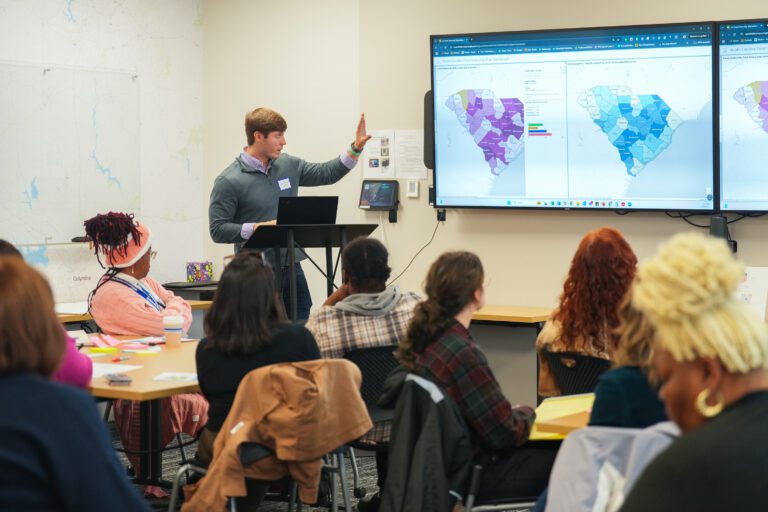
The South Carolina Food Insecurity Risk Dashboard, developed in a partnership that includes Furman’s Institute for the Advancement of Community Health, visualizes food insecurity risk, high-risk demographics and health outcomes for communities statewide.
“Some of these risk factors include a person’s economic status, their mobility and access to food resources, their household structure and vulnerabilities that can limit a household’s income potential,” said Sean Rusnak ’18, with Greenville consulting firm Openfields. “Food insecurity is the center of a problem that has all these upstream factors.”
The map is a tool to help communities throughout South Carolina tackle these issues, providing an even footing for local organizations to make data-driven decisions in their own backyards. Rusnak said it can answer questions like how food insecurity data overlaps with coronary heart disease rates or give insight into how poverty rates and demographic data affect access to healthy food.
“It’s not a one-size-fits-all approach,” Fair said. Having census tract-level data allows tailor-made approaches to tackling food insecurity at the local level. Fair said this map can inform where resources like food pantries, soup kitchens and nutrition education programs are deployed.
“We were able to cast a vision for a data resource that gives policy makers and community leaders a tool to engage their stakeholders at the state and local level,” Rusnak said.
IACH has history with this kind of work, since Fair previously helped develop a similar food insecurity map for Greenville County in partnership with Furman’s Shi Institute for Sustainable Communities the nonprofit coalition LiveWell Greenville. When developing that map, Fair said IACH partnered directly with community organizations running programs delivering food directly to communities in need. These organizations needed a tool to understand how to target their services, and IACH and LiveWell Greenville developed technical guides and training to teach partner organizations how to use the map’s data.
“We’re continuing to develop that index map and look at things like walkability, access to parks and green spaces, youth obesity rates and disparities by race and ethnicity,” Fair said.