News and Events
A Riley Diversity Leaders Initiative group puts little libraries in salon, barber shop
IACH Executive Director Dr. Kerry Sease is part of a team that helped to set up cozy reading spaces for children as part of the Diversity Leaders Initiative (DLI) program of the Riley Institute at Furman University.
By Damian Dominguez, Senior Writer
Photos by Owen Withycombe
Tucked away from the snipping of scissors and the hum of hair dryers, children lounge in plush chairs, books in hand. They have their own cozy libraries where they can read in private, or where parents can sit with their children and flip through books they pick off the shelves.
The Beautiful U salon in Mauldin and GroomGod barbershop in Greenville have these libraries now thanks to a group in the Diversity Leaders Initiative (DLI) program of Furman University’s Riley Institute. The stories families can enjoy range from picture books that let kids exercise their imaginations to chapter books that immerse them in adventure.
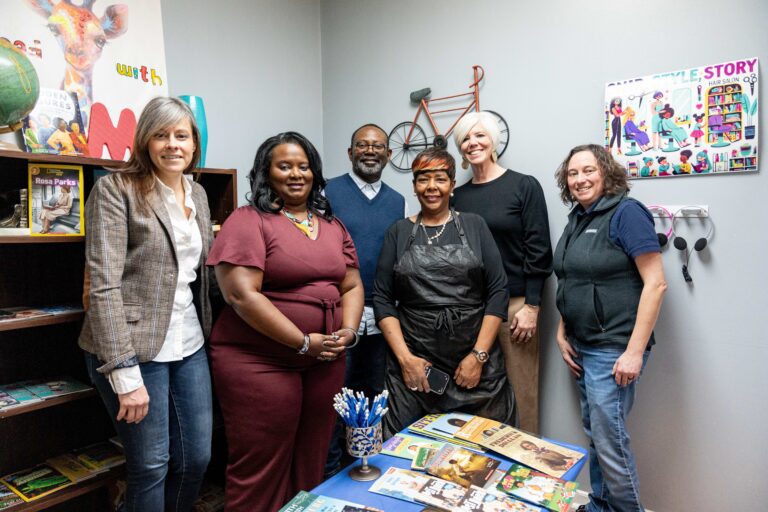 “Our team loved the idea of increasing literacy using regular downtime activities children have in their world, and the idea of reading and literacy has a transformative role in creating opportunities and opening doors for an investment in stronger, more equitable communities,” said Kerry Sease, one of the group’s members and the executive director of Furman’s Institute for the Advancement of Community Health.
Sease and the other group members — Michael Burgess, Yolanda Crittendon-Jones, Kristin Isgett, Jeannine Rogers, Tor Bennstrom and Jason Wolf — wanted to expand on a previous project that put family appropriate books in laundromats to another cornerstone of many communities: salons and barbershops. Crittendon-Jones, community advocate and government affairs coordinator at Public Education Partners, helped identify the two locations.
Braiding hair can be a time-consuming process that creates a long-lasting style, Crittendon-Jones said, and instead of handing children a device to play games or scroll on, she said they wanted to offer books. This project equips these community spaces with books that some parents might not have, and that they might not feel comfortable asking for at their children’s schools.
Organizers hope the libraries will encourage children to read and give parents a place to read to their children outside the home. Photo by Owen Withycombe, Furman University.
“Some of our best opportunities to improve literacy involve meeting young families where they are,” said Bryan Boroughs, Riley Institute executive director. “Improving literacy is about making books, reading and storytelling part of a young family’s daily life, which can only be done through those deep community partnerships.”
Stylists and barbers often develop close, long-term relationships with clients making their businesses key institutions in their communities. Salons have long been a front line for community health professionals to educate women about health disparities. The DLI group saw them as ideal spaces for promoting literacy. And literacy is a critical driver of health, said Sease, a primary care physician with more than 20 years in academic medicine.
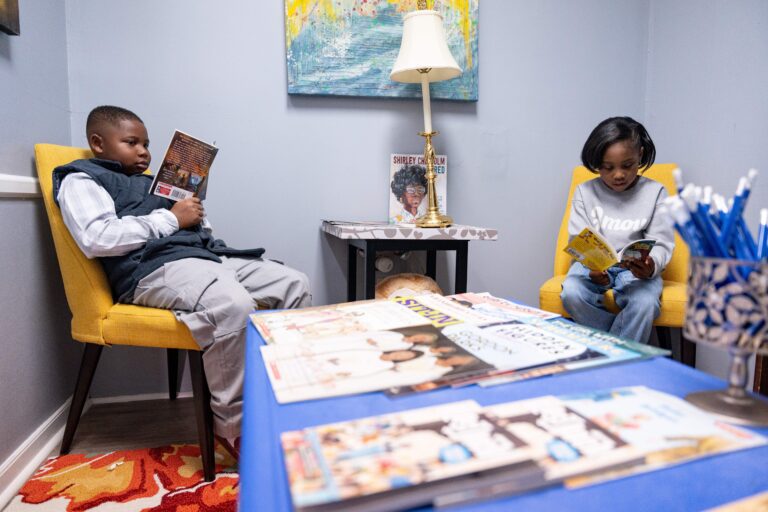 “It shapes an individual’s ability to access, understand and use information that promotes health and well-being,” she said. “Low literacy is closely linked to poverty, which is a major driver of health.”
And it’s something Andrea Walker has seen firsthand at Beautiful U Salon, which she has owned and operated for a decade. When children get excited about a new book, their parents see the thrill of learning and realize it’s important to their child. While books provide valuable lessons to the children, Walker said they also help show parents what matters most to their own children.
“A lot of children are getting pushed through schools and can’t even read. I’ve had clients tell me that even about their own grandkids,” she said. “We’re taking things back to the books and off the computers and phones. Put something in their hands that lets them learn.”
The DLI program, established in 2003, equips leaders from all sectors of South Carolina to “leverage diversity as a way to improve organizational outcomes and drive social and economic progress.” More than 2,800 Riley Fellows have graduated from the program, having organized more than 350 community action projects that provide models of real-world solutions for social equity issues.