Tocqueville Fellows Blog, Featuring Lane Lytle: “The American Family: A Reflection on Faith, Marriage, and Society”

Lane Lytle, SPARTANBURG, SC | CLASS OF 2027 | POLITICS AND INTERNATIONAL AFFAIRS, RELIGION, ANCIENT GREEK AND ROMAN STUDIES MINOR
Why the American Family Matters to Me
The American Family is a concept that is very close to my heart, especially as a young man hoping to start a family in the next five years. The discussions held by the Tocqueville Institute shed light on empirical data that truly illustrates the state of our unions.
Insights from Brad Wilcox and Melissa S. Kearney
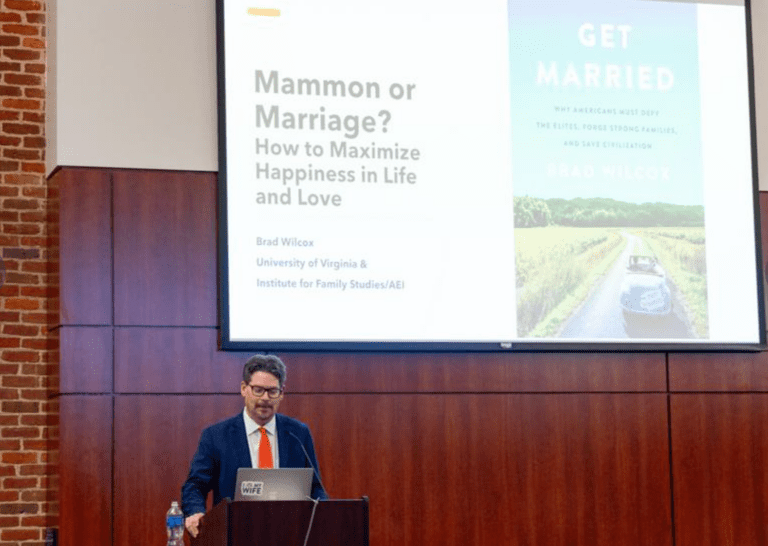
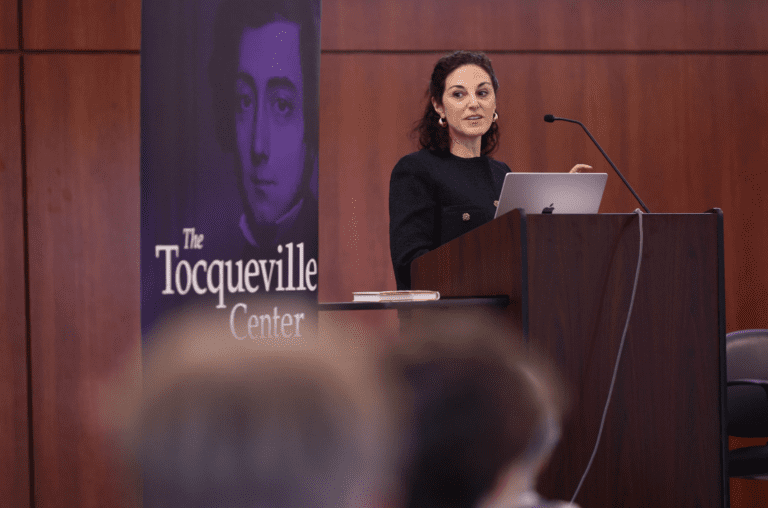
As part of this lecture series, Brad Wilcox and Melissa S. Kearney were invited to speak. Dr. Wilcox is the author of Get Married: Why Americans Must Defy the Elites, Forge Strong Families, and Save Civilization, while Dr. Kearney wrote The Two-Parent Privilege.
Upon hearing these titles, I was immediately intrigued. How would the lectures unfold? Would they reflect the political polarity between Democrats and Republicans, or would they serve as self-help guides for marriage? I was happy to discover that they were neither. Instead, Dr. Wilcox and Dr. Kearney delivered complementary lectures that shed light on marriage in the United States.
The Link Between Marriage and Happiness
Dr. Wilcox stated that people who report being in a good marriage are 545% happier than their single counterparts. Upon hearing this, I wasn’t shocked. As a Christian, I believe I am called to dwell in community with others, and what is marriage if not a community?
“Man by nature is a social animal.” — Aristotle
Similarly, the Bible states in Ecclesiastes 4:9, “Two are better than one because they can help each other up,” and in Colossians 3:14, “Love binds everything together in perfect harmony.” With both early social scientists and Scripture affirming the connection between happiness and human relationships, one must ask: Why have marriage rates declined since the 1960s?
The Decline of Marriage and the Faith Factor
While many explanations can be proposed, I argue that the decline is due to the absence of the Faith Factor. Dr. Wilcox supports this idea in his discussion of those he calls the “Faithful.” He states:
“Their ties to their local religious communities and their faith endow their marriages and family lives with deep spiritual significance… providing practical, social, emotional, and even financial support when it comes to handling the ups and downs of modern family life.” (Wilcox, p. 27)

The Impact of Secularization on Modern Life
Dr. Kearney, on the other hand, focuses on the upbringing of children, a topic somewhat disconnected from the Faith Factor, yet not entirely foreign to it. Federal policies have shifted away from religious influence, and as a result, faith has become less interwoven within American society. The absence of religion in schools contributes to this growing disconnect.
In agreement with Dr. Wilcox, I believe that future generations of Americans must return to faith. The societal rebellion of the 1960s ushered in an individualistic culture, and as this individualism grew, marriage rates declined.
“If America loses its religious roots, will we not lose our other institutions as well?”
Church attendance and religious affiliation have also fallen in the United States. Given the rise of individualistic culture, I believe the answer is yes.

Restoring Faith for a Stronger Society
The decline in marriage rates, fertility rates, and overall happiness since the 1960s indicates that we are missing a vital element of our society. The preservation and promotion of faith in American society must be restored.
For the sake of our nation’s future, we must return to the foundation of our unity. The state of our unions can only be restored and strengthened through a reunion with faith.
“To be in community with one another, we must first be in community with the Divine.”