Tocqueville Fellows Blog, Featuring Kai Springer: “Reevaluating Marriage: Insights from Brad Wilcox at the Tocqueville Center”

Kai Springer, CAMBRIDGE, MD | CLASS OF 2027 | POLITICS & INTERNATIONAL AFFAIRS
Challenging Cultural Narratives on Marriage and Happiness
On February 12, the Tocqueville Center invited UVA sociologist Brad Wilcox to present the thesis of his book, Get Married, as a CLP lecture. At Furman, he offered a provocative counterpoint to prevailing cultural narratives about relationships, happiness, and life priorities.
As someone who attended both his lecture in Watkin’s and a dinner discussion at Soby’s, I found myself visibly nodding in agreement while also preparing counterarguments to his exploration of modern marriage.
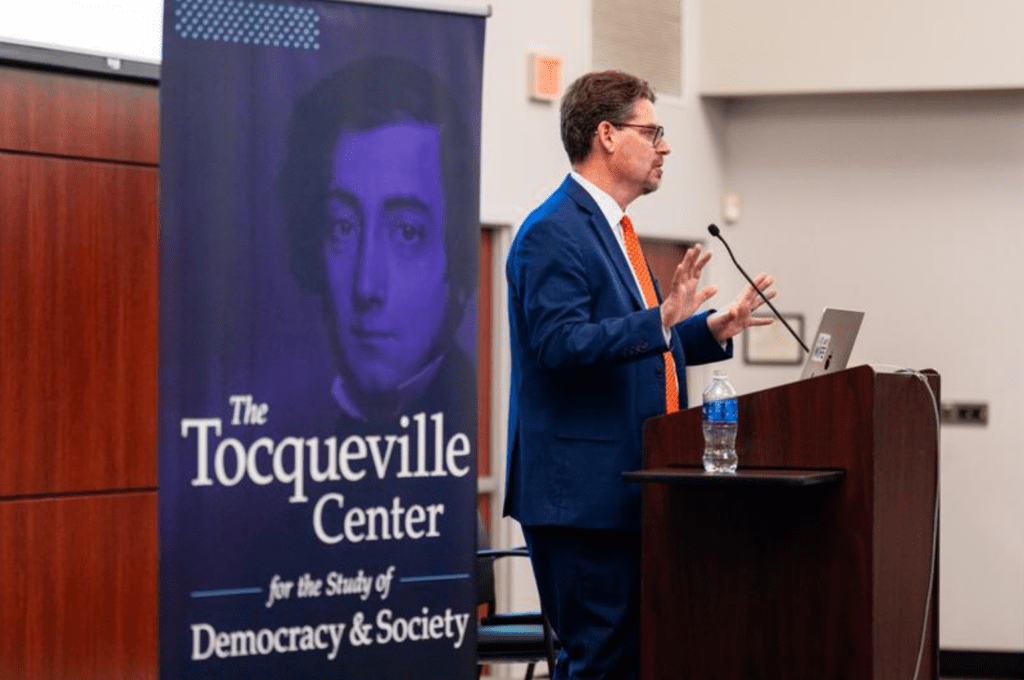
Brad Wilcox presenting at the Tocqueville Center event on “The American Family”
The Midas Mindset vs. the Family-First Approach
Wilcox frames contemporary America as caught between two competing visions:
- The “Midas mindset” – characterized by materialism, workism, and individualism
- The family-first approach – which he advocates as a path to greater happiness and fulfillment
According to Wilcox, elite voices from both liberal circles and the “red pill” right share a surprising consensus: marriage is a high-stakes gamble, often seen as a dead-end leading to disappointment and dissolution.

Does Marriage Predict Happiness Better Than Wealth?
Wilcox’s core argument is straightforward yet bold: Marriage predicts happiness better than wealth.
Drawing on Aristotle’s observation that “man is by nature a social animal,” Wilcox critiques what he calls the “Midas curse”—where material prosperity is increasing, yet fewer people are experiencing high-quality marriages.
“One-third of adults today will never marry, trapped in hookup culture or unstable alternative arrangements.”
The Five Pillars of a “Family-First” Marriage
Wilcox outlines five key pillars of what he terms “family-first” marriage:
- Communion – A deep emotional and spiritual bond between partners
- Children – The role of parenting in building a lasting relationship
- Commitment – Unwavering dedication to the partnership
- Cash – The financial stability that supports a strong marriage
- Community – Support networks that reinforce the relationship
He also argues against prenuptial agreements and separate financial accounts, suggesting that these practices create psychological barriers to full commitment.
Perhaps most controversially, he positions faith as a foundation for marital flourishing, rejecting the idea that religion imposes restrictive purity standards.

Why Do So Many Americans Struggle to Find a Partner?
Despite 87% of Americans expressing a desire for marriage, many find it increasingly difficult to secure a suitable partner in today’s fragmented dating landscape.
Wilcox attributes this to several factors:
- The rise of individualism and career-first priorities
- A decline in religious community involvement
- The influence of secular dating norms and short-term relationships
- Unrealistic expectations of a “perfect” partner
Pushback: Is Wilcox’s Traditional Model Realistic?
While Wilcox’s arguments are thought-provoking and well-researched, there are several counterpoints worth considering.
- The rush into marriage – Some people, particularly in religious communities, marry too quickly, without proper family planning.
- Gendered asymmetry – Research suggests that men benefit more from marriage than women, with many women sacrificing careers for motherhood.
- Economic barriers – Most American families require dual incomes, making Wilcox’s traditional model unrealistic for many.
- High expectations – Modern marriage is portrayed as both essential for happiness yet unattainable due to shrinking dating pools.
“The matching process is particularly challenging for educated women seeking partners with comparable economic, educational, and emotional development.”
The Dating Crisis: A Culture of Mistrust and Isolation
The dinner discussion following the lecture offered valuable personal context for Wilcox’s perspectives.
Having been raised by a single mother, he has firsthand experience with the challenges of modern family structures. His observations on dating culture were particularly insightful:
- Serial monogamy and polygamous mindsets create deep mistrust.
- Women increasingly remove themselves from dating, fearing exploitation.
- Men, in turn, become isolated and resentful, accelerating gender polarization.
The result? A society where men and women view each other as competitors rather than companions.

The Perfectionism Paradox: Why Many Never Marry
Wilcox’s characterization of Americans as “risk-averse and isolated” struck a chord.
In the age of social media and virtual relationships, many believe the “perfect partner” is just around the corner. Yet, this mindset ensures that many never marry at all.
“Perhaps we should ‘take the 80%’—finding someone eager to grow alongside us rather than waiting for an idealized match who may never materialize.” — Dr. Franklin

Should Marriage Be a Cornerstone or a Capstone?
One of Wilcox’s most intriguing insights is his challenge to conventional wisdom about when marriage should occur.
He argues that instead of seeing marriage as a capstone achievement—something pursued only after career and financial stability—we should return to an older vision of marriage as a cornerstone for building a fulfilling life.
This perspective doesn’t mean settling for an unsuitable partner. Rather, it acknowledges that life rarely unfolds according to perfect plans. True commitment and happiness develop organically through shared growth and mutual dedication.
Final Thoughts: Why Wilcox’s Work Matters
While some may disagree with aspects of Wilcox’s analysis, his approach provides a valuable counterweight to purely ideological discussions.
In an increasingly polarized culture, his work reminds us that strong relationships remain essential for both personal happiness and societal flourishing.
“The health of our intimate relationships is fundamental to both personal happiness and the strength of our communities.”