Tocqueville Fellows Blog, by Michaela Valentine: And the Solution to Populism Is… Immigration? Reflections on a Conversation with Dr. Eric Kauffman
By Michaela Valentine
Michaela is from Boone, NC. She is a member of the Class of 2026, studying Politics and International Affairs and Spanish.
Populism and Immigration: A Cultural, Not Economic, Phenomenon
“Without the immigration issue, we wouldn’t have anything like the populism that has arisen in the West today.” This is the argument Dr. Eric Kauffman of Buckingham University put forth in the Tocqueville Center’s 2025 Spring lecture series: Populism in America.
Like Dr. Pippa Norris, another panelist at the event, Kauffman believes the rising tide of populism sweeping through Europe and the Americas is fundamentally driven not by economic reasons, as previously supposed, but rather by cultural issues. His comprehensive research finds that, beginning in 2014, increasing levels of immigration have resulted in statistical trends indicating that whites are quickly losing their status as the historic majority in these areas. Dr. Jan-Werner Müller, also speaking in the lecture, tells us that populism is a movement grounded in an us-versus-them mentality. Thus, sensing demographic change in their societies and feeling unrepresented by the elites in government, whites have begun to look outside the system to populist leaders, drawn to their charismatic personalities and promises to represent the common man.

Dr. Eric Kaufmann and Dr. Pippa Norris speak on the cultural roots of populism during the Tocqueville Center’s 2025 lecture series at Furman University.
Voting Patterns and the Salience of Immigration
To demonstrate his point, Kauffman presented data describing how the tendency to vote for populist leaders in both Europe and the United States has little to do with one’s income, and everything to do with the salience, or importance, of immigration. Interestingly, Kauffman points to individual psychology as an important factor in determining salience. Depending on genetics and personal history, some people are more likely, in Kauffman’s words, to view “change as loss and difference as disorder.” In order to neutralize the effects of populism, Kauffman believes that this issue in particular should be treated less like a moral principle and more as a policy preference, something that can be increased or reduced depending on voter needs.
Reducing Immigration to Reduce Populism?
When listening to Kauffman’s lecture, I was impressed by the scope of his research and fascinated by the trends it indicates. Nevertheless, some of his conclusions surprised me. Particularly, I was struck by his claim that one key way to control populism is to reduce immigration. This suggestion concerned me for two reasons. I initially questioned whether, given the intense polarization in American society, implementing–let alone speaking about–these policies would even be feasible.
Additionally, Kauffman reiterated throughout his lecture that minority groups care about these demographic shifts just as much as whites, something he terms ethno-traditional nationalism. However, he also argues for equal representation of majority interest in the government, meaning the main drivers in immigration policy would most likely be whites. This has been the main criticism of his work, which is derided by the left as promoting white identity politics. Indeed, when I first came across this idea in his book Whiteshift, I was reminded of the classic description of the bully who, after being denied what he wants, throws a fit until eventually appeased. It seemed to me that by embracing populism, the white majority, now denied its original status in society, is throwing a fit until it gets the representation and the policies it wants. With this in mind, I was skeptical of ensuring all voices are being heard without appearing to cater to the “bully” that might become the white majority.
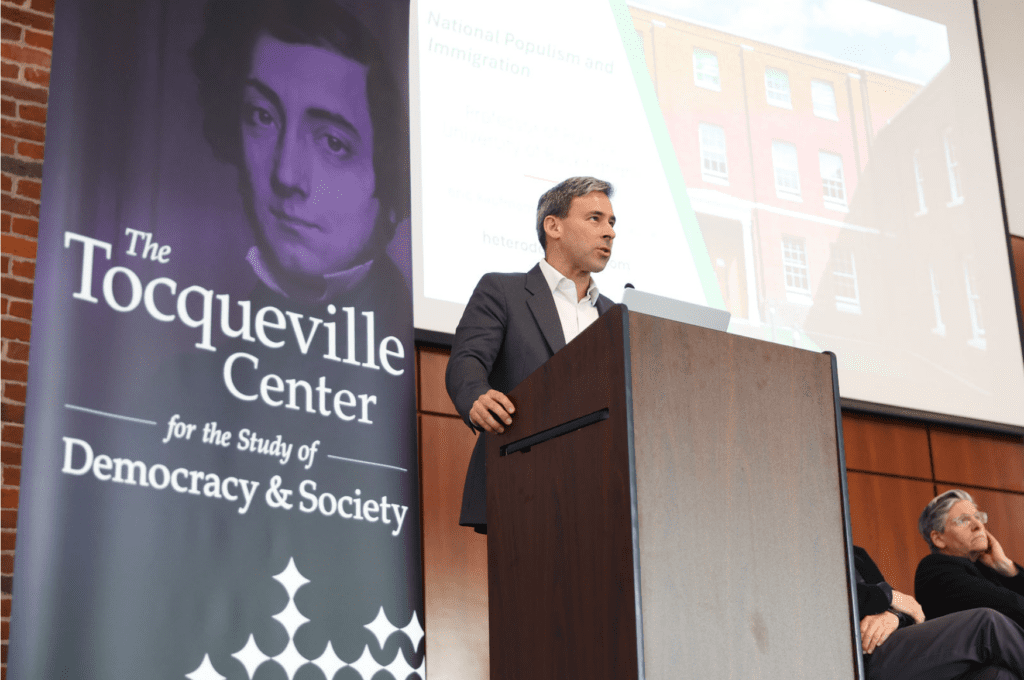
Dr. Eric Kaufmann presents his research on demographic change and white identity politics at the Tocqueville Center’s populism event.
Can the Immigration Debate Be Reopened?
In an effort to better understand this issue, I spoke with Dr. Kauffman several weeks following his lecture at Furman. Below is a summary of our conversation.
Regarding the controversial nature of immigration policy, I began by asking what a realistic policy solution might look like. How, I wondered, when even an offhand comment about race or immigration can leave one ostracized, would we ever be able to successfully, and peacefully, reduce it? Kauffman immediately agreed that addressing this issue is difficult. When it comes to immigration, he said, “There is no spectrum. We make it black and white.” That is, the dominance of liberal progressivism in our society dictates that anyone who does not staunchly support immigration is portrayed as racist, undemocratic, or promoting white nationalism.
Because of this, Kauffman proposed that the ability to have a successful debate about immigration starts, like so many other things, with the elites. Already, he has seen indications that they are beginning to address the populist issue. For example, as the elites come to realize that this movement is not just a blip on the radar, there has been a reduction in DEI initiatives and a more comprehensive focus on social cohesion. To clarify, Kauffman emphasizes that, “we still need norms against racism, but they need to be properly scoped. There is a need for both pressures in the system…and we shouldn’t weaponize these charges [concerning immigration] to shut down debates.” Nevertheless, cultural changes like these don’t happen overnight, and he admits it will take time before the country is able to have productive discourse over immigration.
Appeasing Populism Without Embracing White Identity Politics
As to my second question, whether it is possible to appease white voters without promoting white identity politics, Kauffman had less to say and addressed the issue first in terms of privilege. “Generally, there is a cultural minority privilege and an economic majority privilege,” he explained. Whites, as the majority, enjoy privilege when it comes to jobs and education. However, minorities have a cultural privilege that whites are excluded from. For instance, it is not culturally acceptable for whites to celebrate their heritage or promote their values in the same way that other ethnic groups can. Kauffman made clear he is not arguing for a white state, or ethnonationalism, as some critics suggest. But he does believe that the rights of the majority are just as important as the rights of the minority, saying that “Those who are worried [about immigration] are concerned about decline and against change; their identity is based in place and nation. We need to respect that as well; this asymmetry is not sustainable.” In other words, he fears that if minority interests are repeatedly promoted over those of the majority, whites will continue to look outside the establishment to populist leaders whose authoritarian tendencies could have grave consequences for the future of democracy in the US.

Students and guests engage in discussion on immigration, populism, and the future of democracy.
Beyond the Data: Reconciling with History
As a white American, I obviously want my voice to have a place in how my country is run. But the dangers of populism are real and complex, and after listening to Kauffman, I think there are certain cultural trends that his data overlooks. The influence of the white majority in the United States is deeply tainted, and when it comes to the question of immigration, race, and identity in American politics, our history often carries more weight than the numbers, the examination of which does not reveal the impact of polarization or how deeply our society is divided. For Kauffman’s ideas to have leverage, it seems to me that the country will need more time to reconcile with its past. Nevertheless, if populism continues to rise unchecked, the clock may already be ticking.
References
Chotiner, Isaac. 2019. “A Political Scientist Defends White Identity Politics.” The New Yorker.
https://www.newyorker.com/news/q-and-a/a-political-scientist-defends-white-identity-politics-eric-kaufmann-whiteshift-book
Kauffman, Eric. 2019. Whiteshift: Populism, Immigration, and the Future of White Majorities. New York: Abrahams Press.