Lecture Summary, Populism in America: Jan-Werner Müller, Pippa Norris, and Eric Kaufmann, April 8, 2025
Watch the recording: Populism in America – April 8
On April 24, the Tocqueville Center welcomed three leading scholars of populism—Jan-Werner Müller, Pippa Norris, and Eric Kaufmann—for a major conversation on Populism in America. The event brought together students, faculty, and members of the community to explore the global and national forces reshaping democratic societies today.
Following Director Brent Nelsen’s welcome, the evening’s speakers offered definitions of populism, analyses of its causes, and reflections on how democracies should respond.
Jan-Werner Müller: Populism and Anti-Pluralism

Jan-Werner Müller explains the anti-pluralist roots of populism
Jan-Werner Müller, Roger Williams Straus Professor of Social Sciences at Princeton University, began by cautioning against the overuse of the word populism.
“We’re not doing ourselves a favor if we label policies like protectionism or democratic socialism as populist,” he said.
Rather than defining populism as mere anti-elitism, Müller emphasized that true populism is fundamentally anti-pluralist.
“Populists claim that they, and only they, represent the real people. This excludes some citizens from the body politic and damages democracy itself.”
Müller warned that populists, once in power, consistently undermine democratic institutions:
“All populists in power, when they have enough time and resources, take their countries in an authoritarian direction.”
Pippa Norris: Authoritarian Populism as a Global Phenomenon

Pippa Norris discusses authoritarian populism and global democratic backsliding
Pippa Norris, Paul F. McGuire Lecturer in Comparative Politics at Harvard University, expanded the conversation beyond the American context.
“America is, in some ways, following Europe rather than leading it when it comes to populism,” she observed.
Norris distinguished between populism as a rhetorical style and authoritarian populism as a political reality. She emphasized that authoritarian populism combines anti-elite appeals with loyalty to a strongman figure, often resulting in democratic backsliding.
Drawing on her research, Norris outlined three broad explanations for the rise of authoritarian populism:
-
Economic grievances among those left behind by globalization
-
Ethnic and racial backlash against immigration and diversity
-
Cultural backlash against progressive social change since the 1960s
Of these, Norris argued that cultural factors are most significant:
“It’s a cultural backlash more than an economic backlash which is at the cause of many of these phenomena.”
Eric Kaufmann: Immigration and Populist Realignment
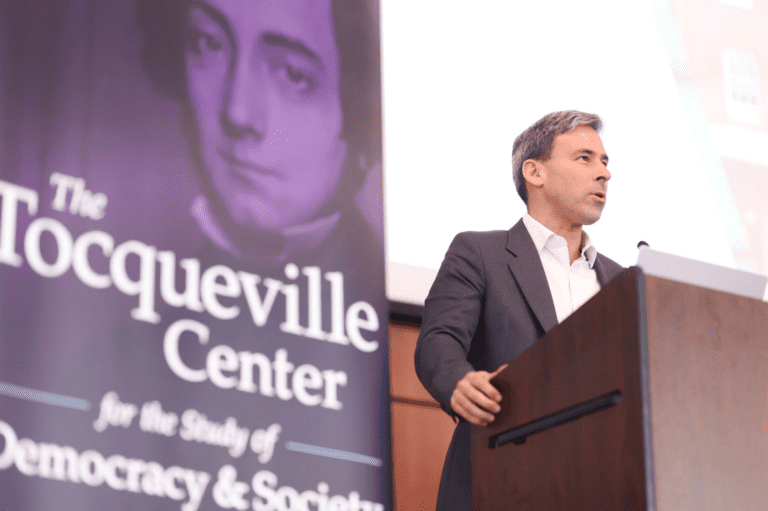
Eric Kaufmann analyzes immigration and the populist realignment
Eric Kaufmann, Professor of Politics at the University of Buckingham and Director of the Center for Heterodox Social Science, focused his remarks on the role of immigration in fueling right-wing populism.
“Without the immigration issue, we would not have anything like the populism on the right that we see in the West today,” Kaufmann stated.
Using extensive survey data, Kaufmann demonstrated that concerns over immigration consistently outweigh economic factors in predicting populist support in both Europe and the United States.
“Among white Americans who say immigration should be reduced a lot, over eight in ten voted for Trump. Income level made almost no difference.”
Kaufmann emphasized that immigration is not merely a material concern, but reflects deeper psychological divides:
“Diversity splits people by psychological makeup—those who see change as loss move toward populism.”
He noted that immigration concerns are not limited to white voters:
“You can actually get what I call ethno-traditional nationalism—where even minorities who identify with a traditional image of the country react to rapid demographic change.”

Brent Nelsen and Jim Guth join Jan-Werner Müller, Pippa Norris, and Eric Kaufmann for a panel discussion on populism
Panel Discussion: Causes and Responses to Populism
During the panel discussion, moderator Dr. James Guth asked the speakers to respond to one another’s presentations and address how democracies should engage with populist movements.
Müller reiterated the need to distinguish populism from related but distinct phenomena:
“We must not conflate anti-immigration sentiment with populism itself. Populism is fundamentally about anti-pluralism.”
Norris argued that while immigration is a powerful symbol, it taps into broader cultural anxieties:
“Immigrants symbolize perceived threats to traditional values more than to economic security.”
Kaufmann responded that political elites’ failure to address immigration concerns has fueled populist backlash:
“There has been an attempt to restrict debate. If you bring up immigration, you’re accused of being a racist. That forces voters toward populists.”
The panelists discussed the risks and trade-offs of “cordon sanitaire” strategies (excluding populist parties from political participation) versus engagement. Müller cautioned against normalization without critique:
“Total exclusion is bad, but uncritical inclusion is worse.”

Closing Reflections
The evening concluded with audience questions on generational change, the sources of anti-immigration sentiment, and the prospects for democratic resilience.
Reflecting on the Tocquevillean spirit of the event, Müller reminded the audience:
“Democracy is about conflict and disagreement—but without the recognition that not all opponents are enemies, democracy erodes.”
The Tocqueville Center thanks all participants, fellows, and supporters for their engagement throughout the 2024–2025 academic year.
To learn more about upcoming events, join our mailing list or visit our website.