Tocqueville Fellows Blog, by Jack Buss: “Globalization, Europe, and TAN: Why Most Grievances Are At Least a Little Economic”
Jack Buss (’27) is a Tocqueville Fellow at Furman University from Plymouth, Michigan, studying Politics and International Affairs and Economics with a minor in Ancient Greek and Roman Studies.
Globalization and the Economic Roots of Political Discontent
The Tocqueville Center recently hosted Dr. Gary Marks, Dr. Elizabeth Hooge, and Dr. Matthias Matthijs for discussions about Europe and America. Dr. Marks and Dr. Hooge spoke about the changing focus of the various right-wing (“TAN”) parties of Europe in their lecture titled “The Rise of the Radical Right and the Future of Europe,” and Dr. Matthjis spoke about how Trump has affected European Integration in his lecture titled “The Transatlantic Trump Trap.” Both cited European identity, trust in the national vs. EU government, and social issues in their analysis of why European politics exists in its current state, and I would be foolish to disagree. However, I spent long enough in a “Politics of the Global Economy” class, taught by the Furman Tocqueville Society’s very own Dr. Brent Nelson, that I must add a short explanation of economic factors to the equation, factors which the speakers both implicitly and explicitly mentioned. Specifically, Globalization is the hidden, invisible mastermind behind many of the grievances both Trump and European “TAN” parties raise, which is why it is imperative to understand Globalization as a whole to understand how it has impacted Europe.
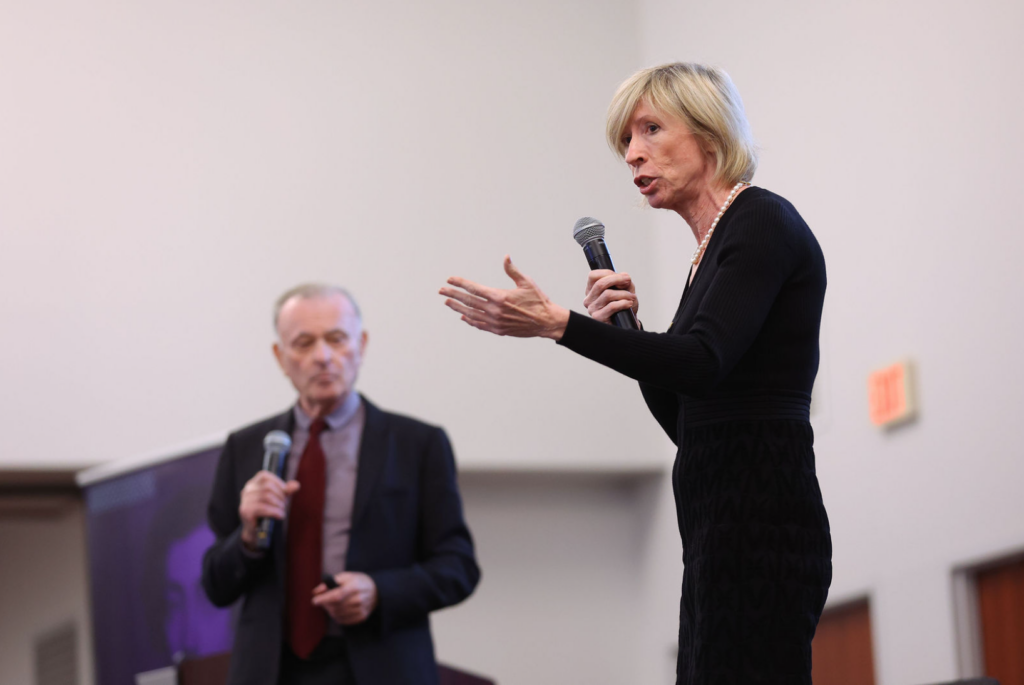
Gary Marks and Liesbet Hooghe address students and faculty at a Tocqueville Center event on the future of Europe and the rise of the radical right.
To give a bit of background, we defined “Globalization” in Dr. Nelson’s class as “the process of creating a single global economic, political, and cultural system through the exchange of people, goods, and ideas across national borders.” By that definition, Globalization has been around for a few hundred years during the development of the market economy, but it is the degree of interconnectedness and interdependence that separates Globalization’s current form from antiquity. Since World War II, the cost of communication and transportation has dramatically decreased due to innovation and technology advances ranging from iPhones to shipping containers, so countries are now more willing to trade with other countries for the goods they cannot produce as well as another country, rather than struggle to produce them at home. This has caused goods, information, and people to be on the move at levels that history has never seen, which in turn has formed economic, cultural, and political ties between all countries that are impossible to break.
Winners, Losers, and the Rise of TAN Politics
However, this movement of goods does not benefit everyone equally. Sometimes this Globalization results in tremendous good, as it has for the billions of people who it has lifted out of abject poverty around the world through a greater prevalence of jobs and goods. However, sometimes Globalization can also devastate communities, as the millions of American manufacturers have felt as they watched their livelihoods get offshored to a cheaper labor market. This dichotomy was a key part of Dr. Nelson’s class: that in a market economy, there are people who benefit from the economy (“winners”), and there are people who are hurt by it (“losers”), and sometimes that is just because of market incentives.
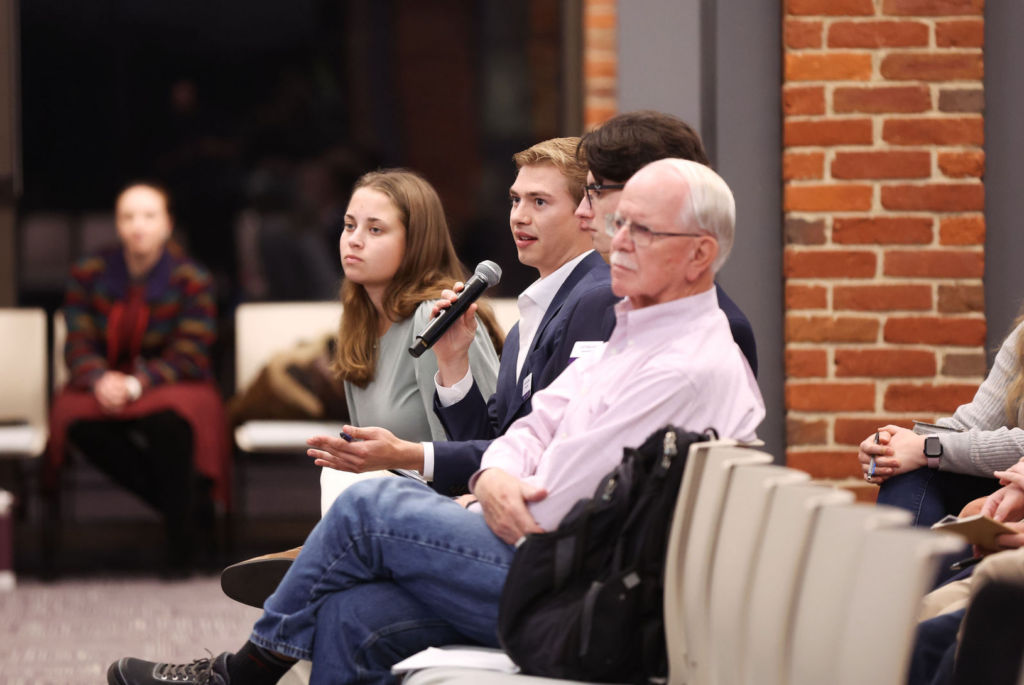
Tocqueville Fellow Zach Lacombe engages Gary Marks and Liesbet Hooghe during the question-and-answer session following their Tocqueville Center lecture.
Other times, however, the government can dictate winners and losers by setting policy goals for a country. It is the promise to use this power to fix the situation of the people Globalization has made “losers” that is so salient to many of the TAN parties in Europe and to Trump’s supporters in the U.S. In fact, Dr. Hooge and Dr. Marks seem to have created the “TAN” acronym in reference to these promises, since each letter describes a different part of the promise that the right-wing parties in question often give their constituents. Those promises might be phrased as solutions to social or cultural issues, but the real grievance behind many of those social and cultural issues can be traced back to the alienation caused by “winning” or “losing” in a new kind of market.
Nationalism and the Future of European Politics
For the people who have deep community ties to auto or steel manufacturing, or for the people who have a long family history of textile making, Globalization can seem like an economically destabilizing force, destroying the livelihood of thousands of communities. Even more so, Globalization can also seem like a culturally and morally destabilizing force, since losing a long-held tradition or cultural practice can be demoralizing and alienating. Dr. Marks and Dr. Hooge, then, were right to add the “Traditional” label to TAN parties, since the chance to return to a semblance of a time or occupation that is familiar or “traditional” seems like it would return the losers to their formerly winning status. Of course, the “Authoritarian” part of the TAN moniker can swiftly follow that promise when it includes scapegoating either fellow losers or new winners or creating an idealized fiction of history, but that was outside the scope of Dr. Marks and Hooge’s lecture at Furman.
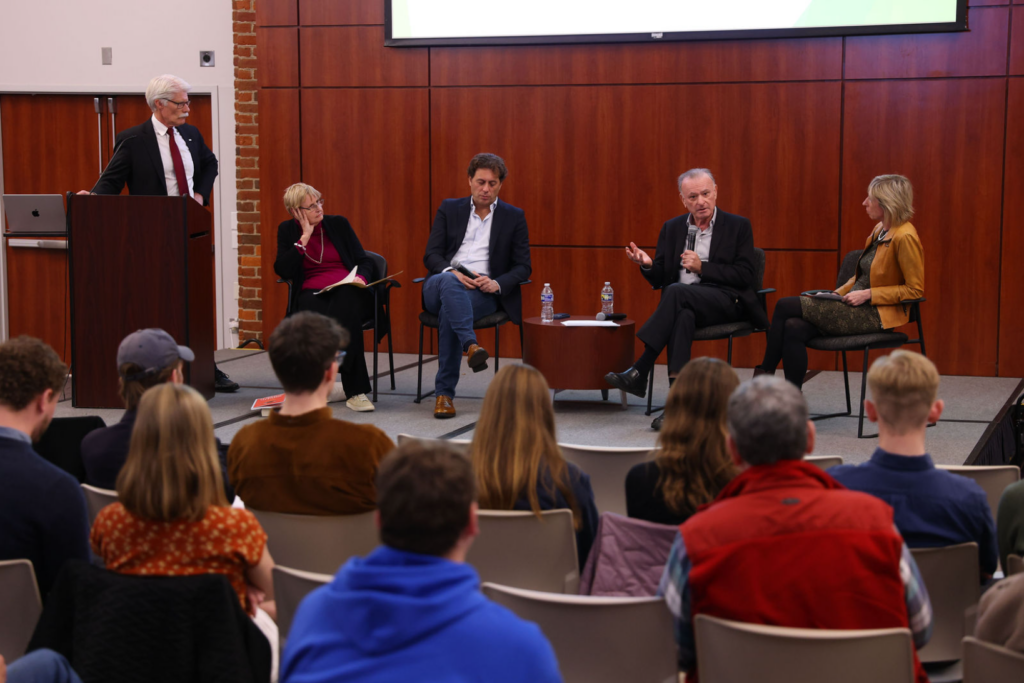
Brent Nelson, Marian Strobl, Liesbet Hooghe, Gary Marks, and Matthias Matthijs discuss Europe, democracy, and the transatlantic relationship during a Tocqueville Center event at Furman University.
The final letter of TAN, the “N” for “National,” is, ironically enough, the most internationally focused solution to the winners-losers issue that TAN parties promise to fix. As Globalization seems to dissolve both physical and cultural borders, nationalism appears to offer safety and security by drawing harder lines to separate one country from the others, making people who feel like they are losing their identity think that their country’s culture and identity are protected from the threat of Globalization. As we have already seen, though, much of what is scapegoated as an invading culture or a flood of immigrants is often a global restructuring of the labor and production markets to where they are most efficient. That restructuring creates real grievances through loss of livelihood, and the nationalism of TAN parties reframes that economic loss as a threat to national sovereignty.
After Dr. Marks, Dr. Hooge, and Dr. Matthijs’ lecture, I am even more intrigued by how European TAN parties will use nationalism to interact with both the economic grievances of Europeans and the economic threat from the United States. In the U.S., smoothing over economic grievances with nationalism seems a bit more cut and dry: Trump blames other countries for “ripping off” the U.S., and then he takes that out on the world through tariffs. In Europe, however, there seems to be a more complex tension between national identity and European identity, and that tension can muddy the waters as to whom TAN nationalism is really aimed at. The fragmented European defense system, with every country having its own distinct army, seems to indicate Europeans are still scared of each other to some degree, but that system creates too many inefficiencies to adequately stand up to non-European rivals like Russia, China, and now the U.S., making Europe as a whole suffer. With all the different interests battling for ideological control in Europe, it seems we are back to square one: who will Europe choose to be its winners, and who will it choose to be its losers?