Tocqueville Fellows Blog, by Vivian Claire: “Self-Censorship, Fear, and Free Speech on College Campuses”
Reflections from the Tocqueville Center’s American Higher Education Series by Vivian Claire. Vivian, a senior from Washington, DC, is a Biology and Religion major and a Tocqueville Fellow whose work explores free speech, higher education, and the conditions necessary for genuine intellectual inquiry in the college classroom.
What Does It Mean to Self-Censor in the Classroom?
Free speech is a hot-button issue on college campuses today, and rightly so. Between outcries from the right against cancel culture of visiting speakers and outrage from the left against the Trump administration’s crackdown on funding, it feels like American universities are caught in the crossfire.
In the recent Tocqueville series on American higher education, John Tomasi engaged with the idea of free speech by presenting self-censorship as a potentially useful measure of its health. He explained that Heterodox Academy, the organization he directs—founded on open inquiry, viewpoint diversity, and constructive disagreement—conducts a national survey of faculty and students that consistently finds “that students report self-censoring—that they don’t say what they really think in their classrooms.” He goes on to say that “something like 74% of undergraduates in the U.S. claim that they report that they self-censor.”
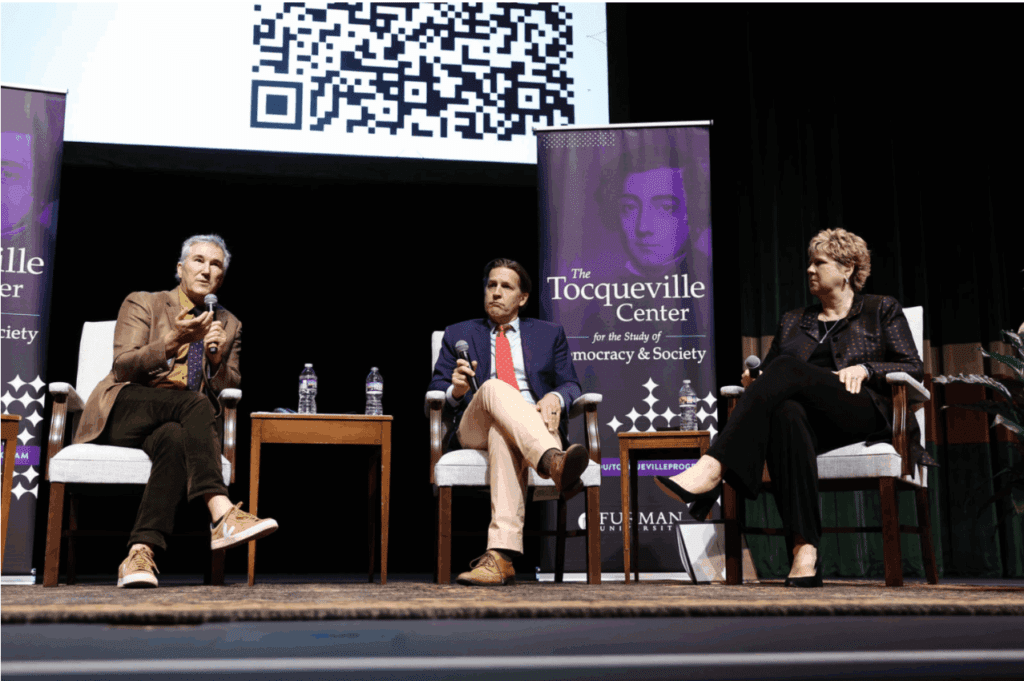
John Tomasi, Ben Sasse, and Elizabeth Davis at “The Crisis in Higher Education”
While self-censorship can signal poor health of campus free speech, I argue it is an imperfect proxy because the motives for it are not always clear. In a culture of fear, practical steps in the classroom can make a substantial difference.
Tomasi provides an interesting definition of self-censorship: “not saying what you really think,” or, in other words, holding back the ideas you could have said but didn’t. What makes a college student self-censor?
Self-Censorship as Prudence and Self-Restraint
First, self-censoring can sometimes be a prudent act of self-restraint. Yelling “fire” in a crowded classroom is not a good idea if there isn’t a fire; and the classic idiom “think before you speak” might be more applicable in college classes today than one might hope. Generously, self-censorship in the classroom could look like a student pausing, processing, realizing a comment isn’t productive, and wisely choosing to keep her thoughts to herself for the sake of a more productive class dialogue. This kind of self-censorship is a virtue—rarely praised precisely because it’s hard to celebrate what someone chose not to say.
This kind of productive self-censorship is obviously not a useful proxy for understanding the climate of free speech on a campus.

Fear of Peer Retaliation and Social Media Consequences
Rather, we can turn to a second reason students might self-censor. Tomasi went on to explain that the reason for student hesitancy to speak in class is “because they’re afraid of what their fellow students are going to say about them, especially on social media.” This kind of self-censorship, driven by fear, is certainly not productive to the education of students. If the college classroom is a place so restricting in speech that the vast majority of students have been afraid to speak at some point, then are universities truly the ideal place for learning to happen?
It seems that one of the best ways to learn is through conversation—actively contributing, questioning, and dialoguing with those who disagree with you. College students are missing out if they are afraid to speak for fear of retribution from their peers.
Power Dynamics and Fear of the Professor
Tied to this is self-censoring out of fear of the professor. While Tomasi indicated that this is less common in comparison to fear of classmates, it can have a disproportionate effect on a classroom environment, often because of the power dynamic at play. Fear of receiving a low grade because of disagreeing with the professor’s beliefs is certainly a reality. Further, not only do professors hand out grades, they can also seek to convert students to their ideology. Professors can use their class as a pulpit for their beliefs, and a student might self-censor so as not to have to defend their beliefs against a professor who would likely beat them in a debate because of years of experience—even if the professor were wrong.

Is Self-Censorship Always a Problem?
In all three of these scenarios, students self-censor for legitimate reasons. If a student is worried that what they have to say might harm someone, cause ostracization from peers, elicit a failing grade from a professor, or cause a change of core beliefs, then self-censoring acts as a vital protection mechanism. However, even if self-censorship isn’t inherently a problem, being afraid to speak because of retribution from peers or professors remains a signal of an unhealthy campus culture.
Can Classroom Design Lower the Cost of Bravery?
To this, Tomasi asked, “Is bravery the antidote to self-censoring?” In classrooms where students have underestimated the charity of their peers, one student’s bravery can start a chain reaction and open up space for a diversity of voices. For the first student, however, it is still a substantial risk—one that can lead to great harm to their well-being and future.
In order to lower the cost of bravery in the classroom, professors can pitch in—even in small ways.
For example, professors can conduct class activities that help reveal the differing beliefs of students in the room anonymously. As one exercise, students could write down their reflections on a contentious topic chosen by the professor, anonymously swap the cards, and then explain their new card—representing a classmate’s belief—to the rest of the class.
In discussion contexts, professors can also support bravery by practicing steel-manning beliefs that they do not hold themselves. This practice teaches students to be better critical thinkers and encourages them to see other sides of issues humanely.
Finally, professors should have clear rubrics for assignments that emphasize evidence and the presentation of counterarguments.
While these are just examples, professors should feel the freedom to workshop ideas with their students to produce a more open classroom environment. With thoughtful classroom design, professors can enable bravery to take root.