Interview with Susan Shirk, on Studying China, Political Education, and Public Service
Follow Your Curiosity: Susan Shirk on Studying China and Public Service
A Tocqueville Center conversation with China scholar and former State Department official Susan Shirk.

Susan L. Shirk is a leading expert on Chinese politics and U.S.–China relations. She is Chair of the 21st Century China Center and Research Professor at the University of California, San Diego. From 1997 to 2000, she served as Deputy Assistant Secretary of State in the U.S. Department of State, where she handled China policy.
Dr. Shirk is the author of several influential books, including China: Fragile Superpower and Overreach: How China Derailed Its Peaceful Rise. Her work bridges scholarship and public service, offering deep insights into China’s political system and its global ambitions.
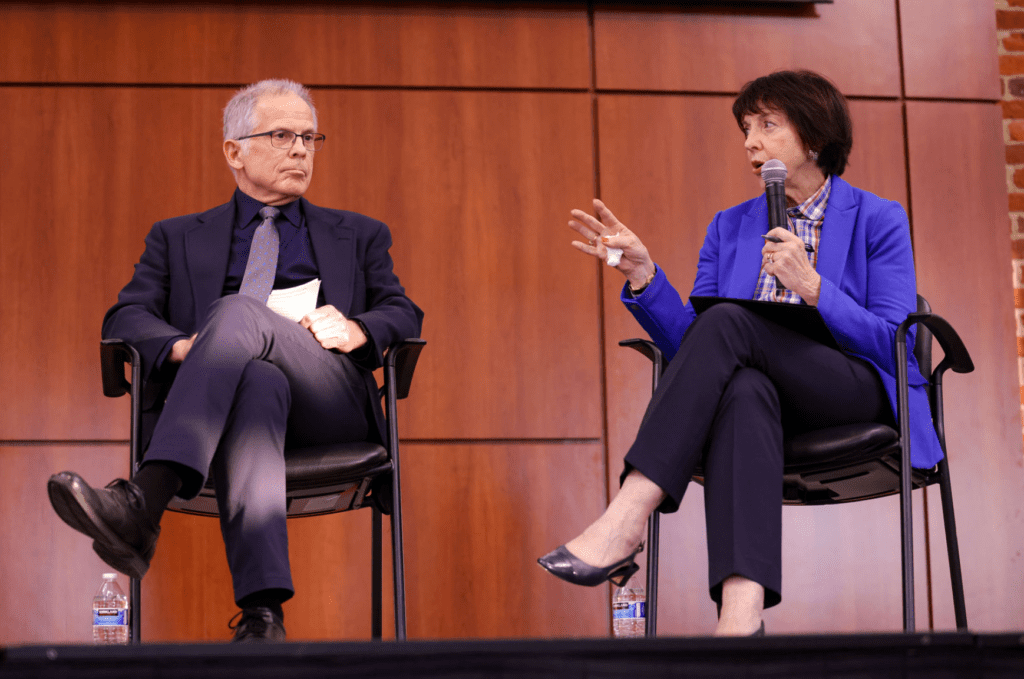
In March 2025, Dr. Shirk visited the Tocqueville Center to deliver a lecture on “Global Politics and the Rise of China,” sharing reflections on her career and the future of U.S.–China relations.
How to Build a Career in Global Affairs
Tocqueville Center: What would you say to students—especially those just starting out—who want to pursue a career like yours?
Susan Shirk: Don’t try to plan out your life like you know exactly what each step will be. Follow your curiosity. There’s always a lot of luck involved—serendipity. Things just happen.
“There’s always a lot of luck involved—serendipity. Things just happen.”
Tocqueville Center: How did your own path into studying China begin?
Susan Shirk: When I started, Americans couldn’t even go to China. It might’ve seemed like a strange choice, but I learned Chinese and did my dissertation in Hong Kong. I interviewed refugees who had swum from the mainland to escape. That gave me a view into grassroots society under Mao.
I focused on secondary school students and how people were promoted for ideological loyalty—what I came to call virtuocracy. That became the basis of my book Competitive Comrades, about how Maoist ideology shaped both school life and workplace dynamics.
Studying China During the Opening Era
Tocqueville Center: Did you eventually get to visit China?
Susan Shirk: Yes. I was still in Hong Kong when, in 1971, Mao invited the U.S. ping pong team to China. A group of us—American PhD students—applied, and we became the second group of Americans allowed in.
“China opened up just as I was doing dissertation research.”
After that, I had more opportunities to do fieldwork as China moved from Mao’s totalitarianism to Deng Xiaoping’s reforms. I later joined the faculty at UC San Diego and became director of the Institute on Global Conflict and Cooperation.
Tocqueville Center: And that eventually led you into government?
Susan Shirk: Yes. My husband, Sam Popkin, worked on presidential campaigns, including Clinton’s. Through that, I was asked to join the Clinton administration as Deputy Assistant Secretary of State for China. None of it was planned. I never imagined those opportunities would come.
Discovering Asia: A Personal Journey
Tocqueville Center: What sparked your original interest in Asia?
Susan Shirk: I spent a summer in Japan before college, living with a shopkeeper’s family. It felt like something out of Shōgun. I went in thinking Western civilization was superior, and came away understanding Asia had a civilization just as rich.
Then in college, my Asian history professor got a letter about a Carnegie-funded program to study critical languages—Chinese, Japanese, Arabic, Russian—at Princeton. She asked if I wanted to go. I said yes right away.
“I spent my junior year as a broad ‘abroad’—at Princeton—as one of just 12 women on campus at the time.”
This was the mid-60s, when the Ivy League was still all-male. I had chosen a women’s college to find the academic rigor I wanted, which the Ivies weren’t offering to women yet.
Education and Ideology in China Today
Tocqueville Center: You studied education under Mao. How do you see it changing under Xi Jinping?
Susan Shirk: Sadly, it’s becoming more like it was under Mao. Education is still strong in math and language, but there’s little room for creativity. Political ideology is once again emphasized.
Students advance through exams, but political performance matters too—especially if you’re in the Communist Youth League. Under Xi, the expectations are rising. Students have to attend meetings, volunteer for labor, sometimes even help with harvests.
“Under Mao, education was completely state-controlled. And depressingly, it’s kind of returning to that.”
China’s Historical Meritocracy and Its Decline
Historically, China recruited government officials through a rigorous examination system rooted in Confucian classics. It was a remarkable model of early meritocracy, demanding both literacy and philosophical grounding. This is why people talk about China as a meritocracy—very advanced for a traditional system.
These exams didn’t just measure knowledge; they signaled moral depth and leadership potential. But with the founding of the People’s Republic of China in 1949, the system ended.
“In 1949 those kind of examinations stopped.”
Today, China retains exams for lower-level roles, but political advancement is based more on party loyalty than merit.
Who Rises in Modern China?
In contemporary China, elite leadership is driven less by education or expertise and more by political credentials.
“The people who move up to be the leaders of China are not moving up because of their professional merit so much as their political.”
This creates a system where high-ranking officials function more like party loyalists than technocrats or scholars.
Why Liberal Arts Still Matter
Tocqueville Center: Given all that, how do you view liberal education in the U.S.?
Susan Shirk: I place a high value on intellectual freedom—the ability to question dogma, to speak freely, and to think independently. Liberal arts education gives you exposure to the great ideas from many civilizations—not just Western—and the freedom to develop your own thinking.
“Liberal arts education gives you access to the wisdom of the ages—and the freedom to develop your own thinking.”
Before 1949, Chinese educators were interested in thinkers like John Dewey. That spirit still survives in some private schools, especially among parents who want to avoid the rigid public system and the stress of the Gaokao, China’s university entrance exam.
Advice for the Next Generation
Tocqueville Center: Many students today worry about academic careers. What would you tell them?
Susan Shirk: People will warn you it’s hard to get an academic job, that you might not end up where you want to live. But if you really love what you’re doing, and you’re intellectually curious—just keep going. It’ll work out somehow.
“If you love what you’re doing and you’re intellectually curious, just keep going. It’ll work out somehow.”
Even if it doesn’t lead to a tenure-track job, there are many meaningful ways to use what you’ve learned. Stay open, stay curious, and take the opportunities that come your way—even the unexpected ones.