Interview: Sarah Gustafson (Catholic University of America) “Tocqueville and the Formation of Democratic Virtues”
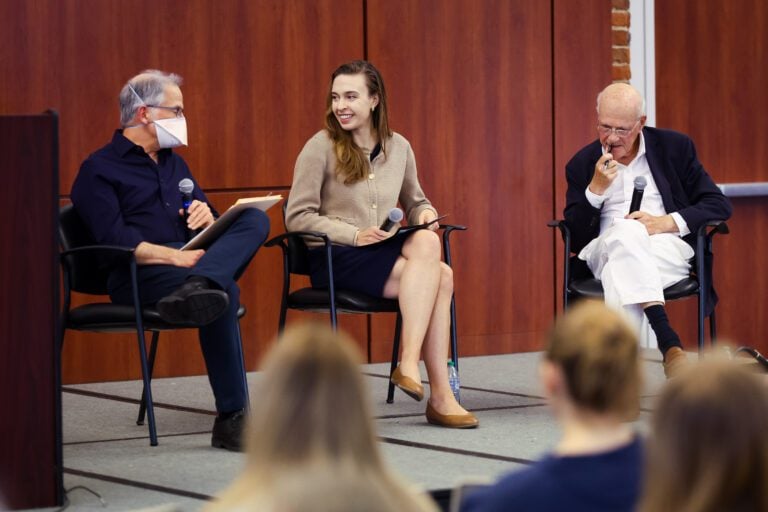
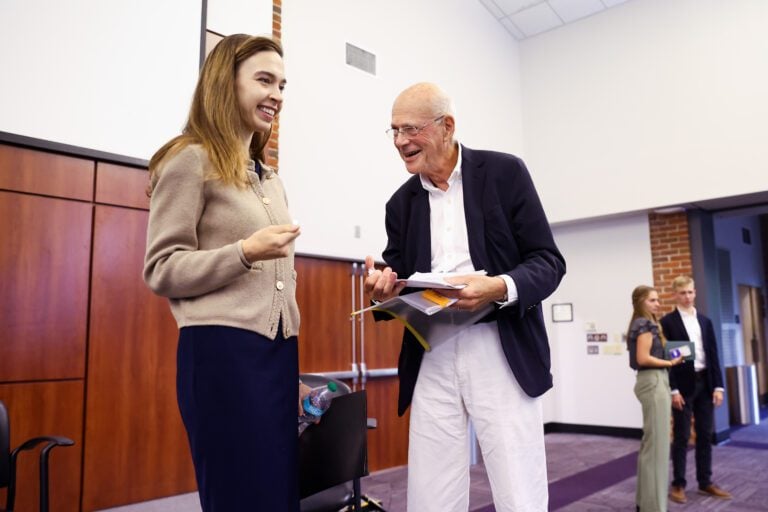
Sarah Gustafson (Catholic University of America) visited the Tocqueville Center earlier this fall to present “Democratic Well-being and Democratic Welfare: Tocqueville’s Complex Account of the Welfare State”. We asked her to expand on Tocqueville’s account of the democratic virtues, and whether they are at risk from the soft despotism that characterizes America today.
Sarah Gustafson is an Assistant Professor of Politics at The Catholic University of America. She earned her BA from Davidson College, MA from University College of London, and her PhD in Political Theory from the Department of Government, Harvard University. Her research focus is Alexis de Tocqueville and nineteenth-century political thought, with additional interests in Ancient and Medieval Political Philosophy, contemporary and normative political theory, virtue ethics, Catholic Social and Political Thought, and Ethics and Business. Her dissertation examines Tocqueville’s concept of charity, especially its relationship to his accounts of self-interest rightly understood, associations, and welfare. Gustafson is no stranger to Furman. In January 2024, she accompanied Dr. Robert Putnam to the Tocqueville platform where they presented their paper “Two Voyages of Discovery: How the 1831 Journeys of Darwin and Tocqueville Changed our Understanding of the World.”
How Americans embody democratic virtues and Tocquevillian concepts such as civil association
Tocqueville Center:
Could you elaborate on your idea that some of Tocqueville’s ideas on the habits of democratic citizens and how American democratic virtues can be better experienced than explained?
Sarah Gustafson:
A lot of concepts in Tocqueville are almost so self-explanatory to our experience of being American that it can become very difficult to explain them conceptually. So I think something like civil association is one of these kinds of things, which is why I think it’s really valuable to actually point out real people’s lived experiences of these phenomena.
So yesterday in the lecture, I made reference to the experience of applying to colleges. This is something that Furman students are familiar with. It’s a kind of rite of passage for many Americans.
And so what do you do when you’re in high school? You fill your extracurriculars up with a variety of different kinds of things. Maybe you have sports, maybe you have an Honor Society, maybe you’re volunteering for the Humane Society, or something like this. And maybe some of these activities are not ones that you’re initially excited to do. Your mom or your dad encouraged it or your friend brought you into it because they said it would be good for your college application. And so there’s a kind of initial reluctance.
But I think what often inevitably happens is, well, maybe you end up being transformed in some way. Your loves end up being transformed. Your habits end up being transformed by volunteering for the Humane Society, by volunteering for an environmental organization. Maybe you begin to learn why you should not litter or something like that, something very basic.
…”maybe you end up being transformed in some way. Your loves end up being transformed. Your habits end up being transformed by volunteering for the Humane Society, by volunteering for an environmental organization. Maybe you begin to learn why you should not litter or something like that, something very basic.”
And so it ends up that you increasingly care about this element of the common good that you’re contributing to, but then you also become habituated in your actions in your private life to mirror this greater kind of good that you’re aiming at.
And so there’s a manner in which something like self-interest rightly understood, while it’s somewhat vague and conceptual and rather hard to pin down in some ways—Is it, is it moral? Is it political? Is it, is it economic even in some way?—we all have a kind of experience of being habituated to love and care about something that might be political, but it doesn’t have to be political. But that contributes still to a kind of greater common good.
On self-interest rightly understood, and the daily habits that are needed to form democratic virtues
Tocqueville Center:
What is the importance of face-to-face interactions in cultivating the kinds of democratic habits, such as self-interest rightly understood, that Tocqueville describes?
Sarah Gustafson:
Tocqueville is kind of an ancient and kind of a modern. So he recognizes on the one hand that we’re social creatures that were political by nature. He says the Township arises spontaneously. Families are natural, there all kinds of associations that are that are natural.
But he’s also enough of a modern and enough of a liberal and attentive enough to the phenomena that are released by the democratic equality of conditions to know that people in democratic ages can be very selfish, right? They can have a temptation to close in on themselves and focus on their own interests.

And again, I think the collective action problem is a really way, another really good way of understanding this right, that if everyone is equal, if everyone is more or less responsible for taking care of the same park, the same plot of land. Why should I myself go out of my way to clean it up when it’s littered with cans of soda or something like this? Each person is equally responsible.
And so unless you have an ethic of care and responsibility that actually gets lived out right, you fall into this trap of no one actually does anything to care for any of the things that are that are shared. And so why I emphasize the kind of personal face-to-face encounter is that Tocqueville makes a quite a big deal of the fact. There is this wonderful line. I quote it quite often because I think it’s important:
“Sentiments and ideas renew themselves, the heart is enlarged, and the human mind is developed only by the reciprocal action of men upon one another” (Democracy in America).
As a practical matter, we’re social because one man by himself can’t make his own shoes and make his own house. We need to live in community in part because we need each other in the most basic material sense, but we also need each other in this higher sense of flourishing that our hearts expand, that our capacity for virtue expands by rubbing off the rough edges of our personality by working together to achieve things, to do things together. And that only happens in face-to-face interactions.
What’s kind of remarkable about something such as such as l’intérêt personnel est bien compris (self-interest rightly understood) is there’s an end that you’re aiming at. You want to clean up the park. You want to prevent the park from being littered. But there’s also a kind of instrument, there’s a kind of intrinsic good to the activity that is you’re bonding with your fellow citizens, you’re making friends, you’re working towards an end together. And again, that can only happen in this important way, in a face-to-face kind of encounter.

He’s much more skeptical of the market that I think a lot of libertarian readers of Tocqueville want to make him out to be. He’s enough of an aristocrat to have these sort of anti-bourgeois market liberalism moments peppered throughout his political theory. But when you get this administrative centralization, industrialization, soft despotism, a lot of these systems that increasingly draw the sphere of activity away from ordinary people and ordinary face-to-face encounters, that has political effects and economic effects, but also has moral effects.
We literally don’t have to engage with one another. When you go to the grocery store and use a self-checkout, you literally don’t have to get some of the raw parts of your personality worked off through the mundane interaction between the cashier and yourself, right?
And so, while Tocqueville’s a sociologist, he’s a political theorist. He also has this distinctive sense of how these broader forces actually can shape the conditions for our virtue. And therefore we should have to think through what we do in the wake of that, right?
Like, how do we try to cultivate a virtuous character when we know that maybe some of the conditions in the spaces for cultivating that virtuous character under different kinds of political regimes, those spaces may be greater or lesser?
“…we also need each other in this higher sense of flourishing that our hearts expand, that our capacity for virtue expands by rubbing off the rough edges of our personality by working together to achieve things, to do things together. And that only happens in face-to-face interactions.”
The democratic virtues are threatened today by America’s soft despotism
Tocqueville Center:
Do you think the soft despotism of the centralized administrative state has enough benefits to offset the loss of democratic virtues among the citizenry?
Sarah Gustafson:
So on the one hand, he wants to have a kind of impartiality as regards aristocratic and democratic regimes. He wants to be able to—and I think he does this quite well, which is why he’s such a wonderful person to use as a way of thinking to teach people how to think about political theory.
Aristocracy has its virtues and its vices. Democracy has its virtues and its vices. The problem is that we are now in a democratic age. There’s no going back. There might be a going forward into democratic despotism. In which case a lot of the the virtuous elements of democracy get exaggerated and provoked to an excess where all of a sudden they become bad for human flourishing.
There is a sense in which you would not want a world where people are starving, poor, unable to pay their bills or something like this because we think well, we’re going to leave them free to the market or something like this. In reality, that’s not what Tocqueville’s talking about because he sees that if you leave space that is non-governmental, people will naturally fill that space.
There’s a wonderful line of Pope Benedict the 16th from an address he gave to social scientist, which kind of captures this principle really nicely. Benedict read Tocqueville. He wasn’t a Tocquevillian, so to speak. But I think he really captures it, which is that when social scientists and politicians and legislators are thinking about subsidiarity, they affirm the principle of subsidiarity, and in so doing leave room for freedom, but they also leave room for love. They should leave room for the flourishing of other kinds of virtues. To step up, step in and exercise a positive liberty, an exercise of the virtues.
So is the trade off worth it? Well, Tocqueville, I think, is willing to make that trade-off to the degree that it provides a net for people who would be caught in a transition, such as between one kind of economic and political system and another. Because that’s really what he’s talking about is people who are caught in the transition.
If we think about economic history, we think about the kind of economic transition that the United States has been through in the last 75 years where a lot of our manufacturing disappeared and went offshore, right? There are lots of people who are caught in the transition. What do we do for those communities? Do we have some kind of obligation of justice to help support those communities and get them back on their feet? When the market took those jobs elsewhere? I think Tocqueville would say we do, right? But it shouldn’t be in such a way as to deprive anyone of a sense of their human liberty, of their freedom. And he really understands liberty in this way, not just in a political way, but in a spiritual way, in a manner that they can grow and thrive and develop their capacities as human beings.
This is where his language of brutalization becomes rather uncomfortable, but also really important, in that he sees human beings as both material and spiritual. And so to treat them only as these material persons is to do an injustice to them. So, we should help people in transition, but also continue to provide that space for them to actually pursue their fullest human flourishing, which is going to include an exercise of their spiritual capacities.
“when social scientists and politicians and legislators are thinking about subsidiarity, they affirm the principle of subsidiarity, and in so doing leave room for freedom, but they also leave room for love. They should leave room for the flourishing of other kinds of virtues. To step up, step in and exercise a positive liberty, an exercise of the virtues.”