Posts
On Discourse Democracy Themed Teaching Series
As part of a special series, On Discourse will sponsor educational programs designed to help students, and the campus community, deepen their understanding of democracy in the United States. Where divergent schools of thought exist, multiple perspectives will be presented fairly and thoughtfully.
Spring Semester:
| Date and Time | Lecture |
|---|---|
| Jan. 21
5-6pm
|
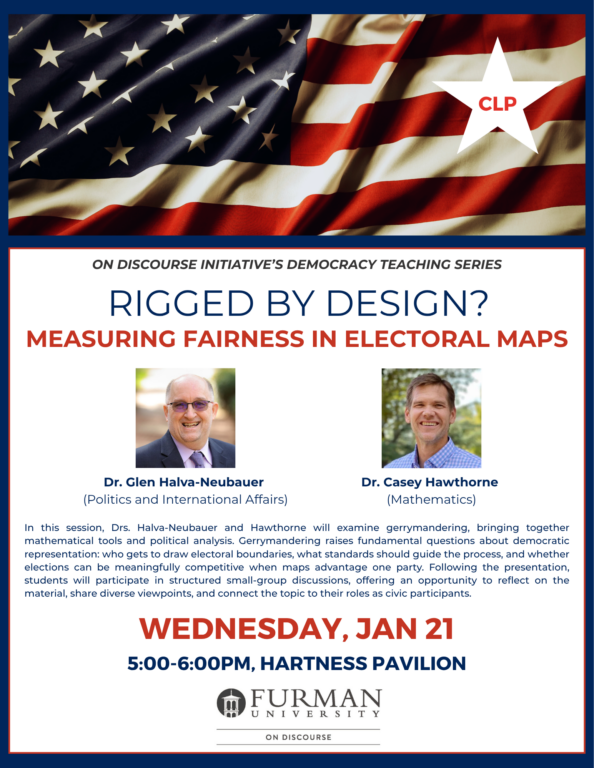
Rigged by Design? Measuring Fairness in Electoral Maps
In this session, Drs. Halva-Neubauer and Hawthorne will examine gerrymandering, bringing together mathematical tools and political analysis. Gerrymandering raises fundamental questions about democratic representation: who gets to draw electoral boundaries, what standards should guide the process, and whether elections can be meaningfully competitive when maps advantage one party. Following the presentation, students will participate in structured small-group discussions, offering an opportunity to reflect on the material, share diverse viewpoints, and connect the topic to their roles as civic participants. |
| Feb. 18
5-6:15pm
|
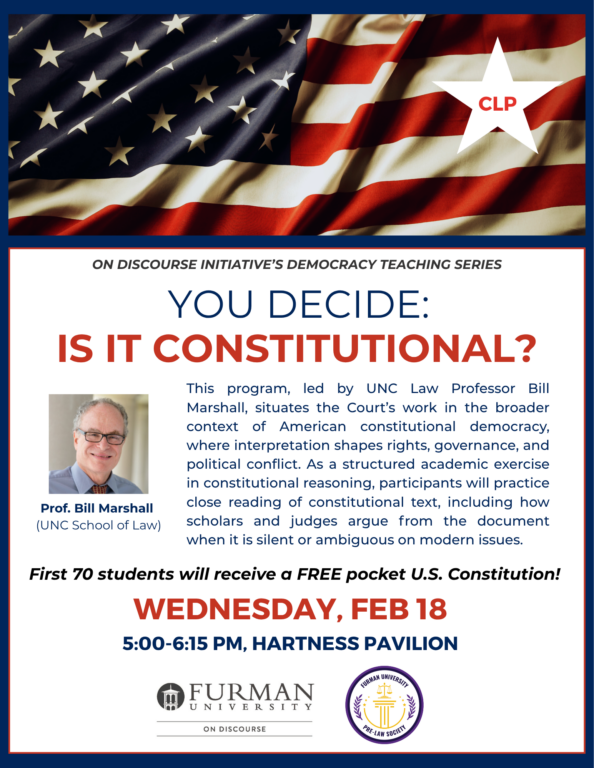
You Decide: Is it Constitutional?
This program, led by UNC Law Professor Bill Marshall, situates the Court’s work in the broader context of American constitutional democracy, where interpretation shapes rights, governance, and political conflict. As a structured academic exercise in constitutional reasoning, participants will practice close reading of constitutional text, including how scholars and judges argue from the document when it is silent or ambiguous on modern issues. |
| Mar. 12
5-6pm
|
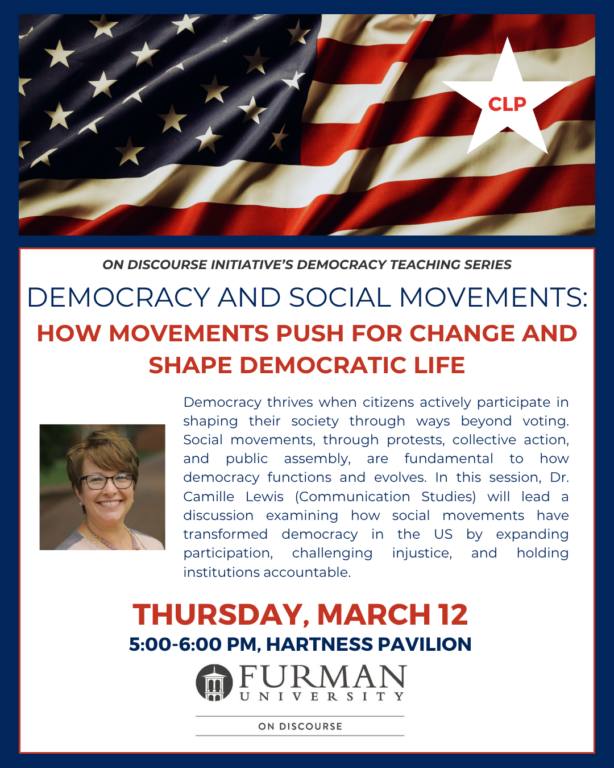
Democracy and Social Movements: How Movements Push for Change and Shape Democratic Life
Democracy thrives when citizens actively participate in shaping their society through ways beyond voting. Social movements, through protests, collective action, and public assembly, are fundamental to how democracy functions and evolves. In this session, Dr. Camille Lewis (Communication Studies) will lead a discussion examining how social movements have transformed democracy in the US by expanding participation, challenging injustice, and holding institutions accountable. |
| Mar. 16
5-6pm
|
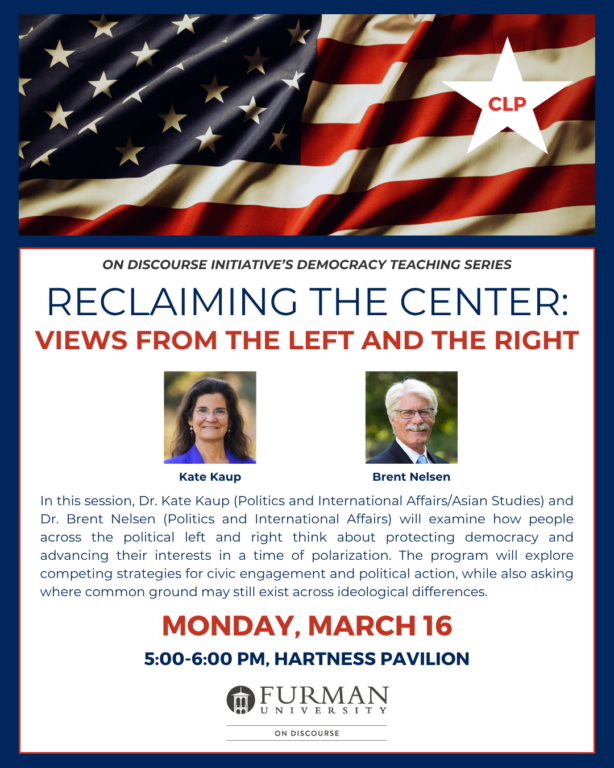
Reclaiming the Center: Views from the Left and the Right
In this session, Dr. Kate Kaup (Politics and International Affairs/Asian Studies) and Dr. Brent Nelsen (Politics and International Affairs) will examine how people across the political left and right think about protecting democracy and advancing their interests in a time of polarization. The program will explore competing strategies for civic engagement and political action, while also asking where common ground may still exist across ideological differences. |
| Mar. 17
5-6pm
|
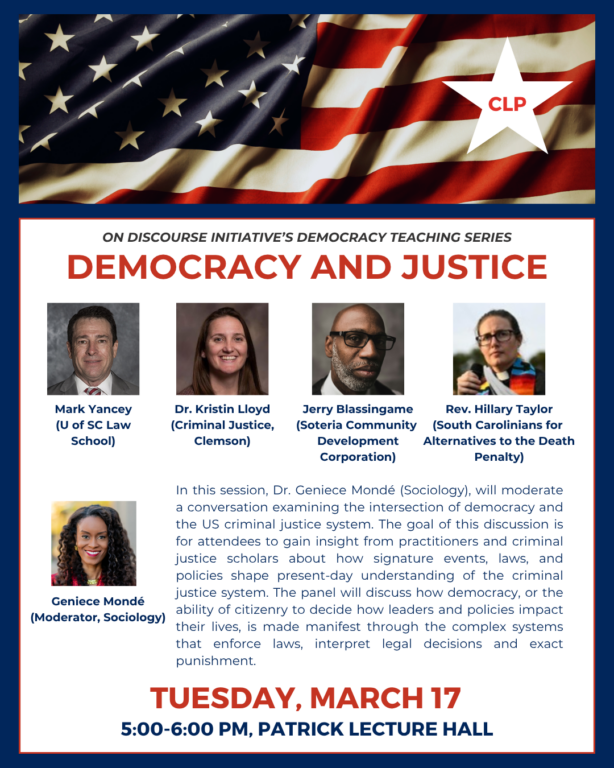
Democracy and Justice
In this session, Dr. Geniece Mondé (Sociology), will moderate a conversation examining the intersection of democracy and the US criminal justice system. The goal of this discussion is for attendees to gain insight from practitioners and criminal justice scholars about how signature events, laws, and policies shape present-day understanding of the criminal justice system. The panel will discuss how democracy, or the ability of citizenry to decide how leaders and policies impact their lives, is made manifest through the complex systems that enforce laws, interpret legal decisions and exact punishment. |
| Apr. 20
5-6pm
|
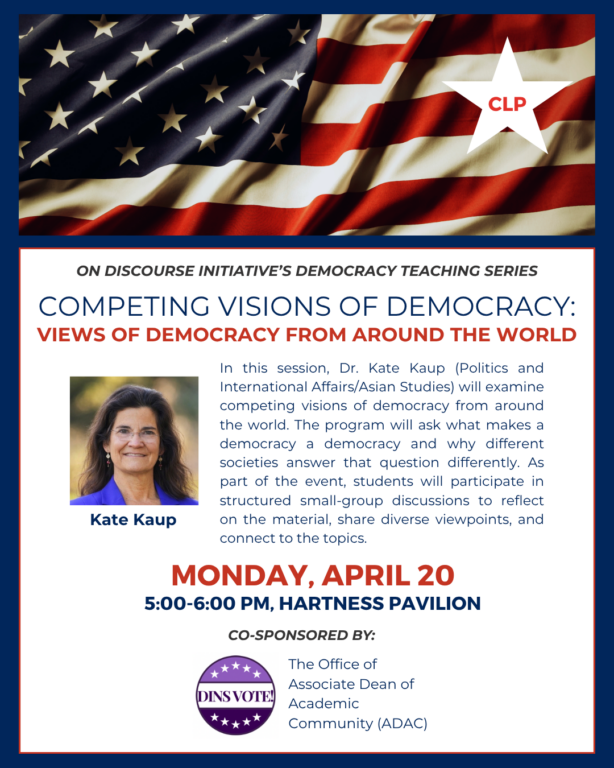
Competing Visions of Democracy: Views of Democracy from Around the World
In this session, Dr. Kate Kaup (Politics and International Affairs/Asian Studies) will examine competing visions of democracy from around the world. The program will ask what makes a democracy a democracy and why different societies answer that question differently. As part of the event, students will participate in structured small-group discussions to reflect on the material, share diverse viewpoints, and connect to the topics. |
| New
5-6pm
|
New Content goes here
New content goes here |
Fall Semester:
| Date and Time | Lecture |
|---|---|
| Sep. 10
5-6pm
|
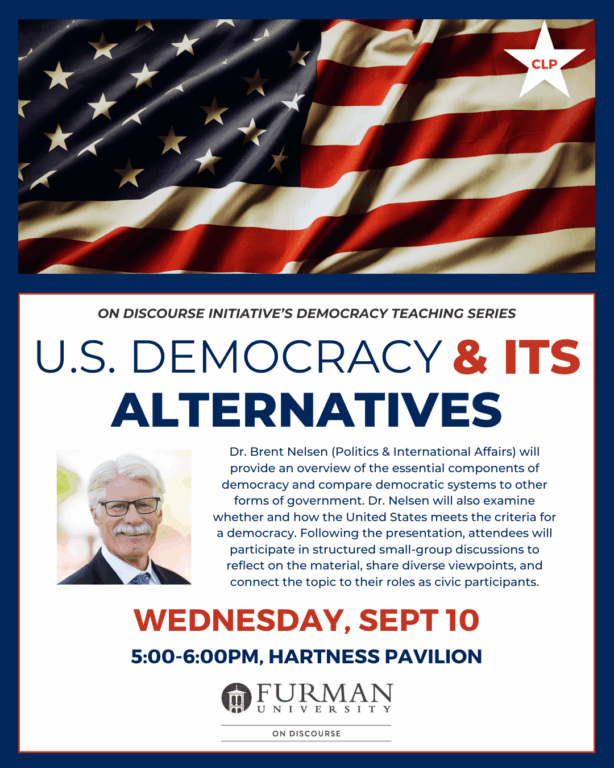
Democracy and Its Alternatives
In this session, Dr. Brent Nelsen will provide an overview of the essential components of democracy and compare democratic systems to other forms of government. He will also examine whether and how the United States meets the criteria for a democracy, highlighting areas of ongoing debate. Following his presentation, students will participate in structured small-group discussions, offering an opportunity to reflect on the material, share diverse viewpoints, and connect the topic to their roles as civic participants. |
| Oct. 6
12:30-1:30
|
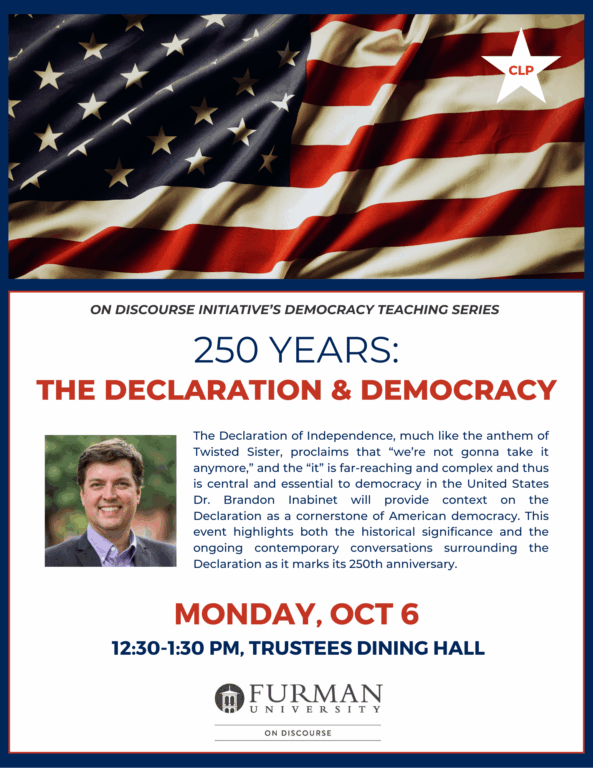
250 Years: The Declaration & Democracy
On October 6, we’re looking at The Declaration of Independence after 250 years. Dr. Brandon Inabinet will present his recent work: “Borrowing Trouble? The Declaration’s Threshold of Suffering and Care” (published as Chapter 15 in Mary Stuckey’s recently released title: Used, Abused, and Sidelined: Debating the Declaration (2025). The Declaration of Independence, like Twisted Sister, tells us that “we’re not gonna take it anymore,” and the “it” is expansive. This end of toleration spans not just the couple of dozen listed slights against King George III. The text goes further to imagine the breaking of a universal standard, of Anglo-American “natural rights.” And further, as explored in this analysis, the text indicts the lack of compassion for colonists’ suffering. Boundaries of acceptable suffering are a key aspect of revolutionary political texts. These thresholds can be real, but quite often they may be borrowed from other marginalized or maligned communities. |
| Oct. 6
5-6pm
|
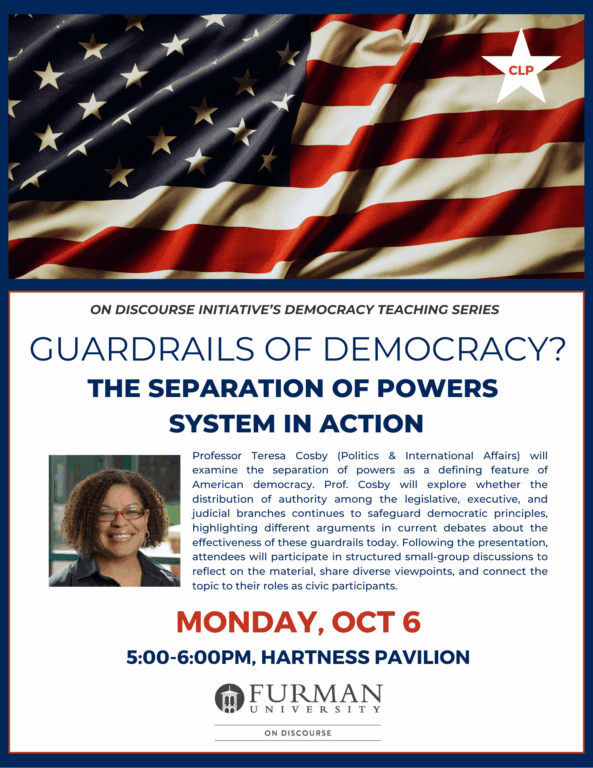
Separation of Powers System in Action
In this session, Professor Teresa Cosby will examine the separation of powers as a defining feature of American democracy. She will explore whether the distribution of authority among the legislative, executive, and judicial branches continues to safeguard democratic principles, highlighting different arguments in current debates about the effectiveness of these guardrails today. Following her presentation, students will participate in structured small-group discussions, offering an opportunity to reflect on the material, share diverse viewpoints, and connect the topic to their roles as civic participants. |
| Oct. 16
5-6pm
|
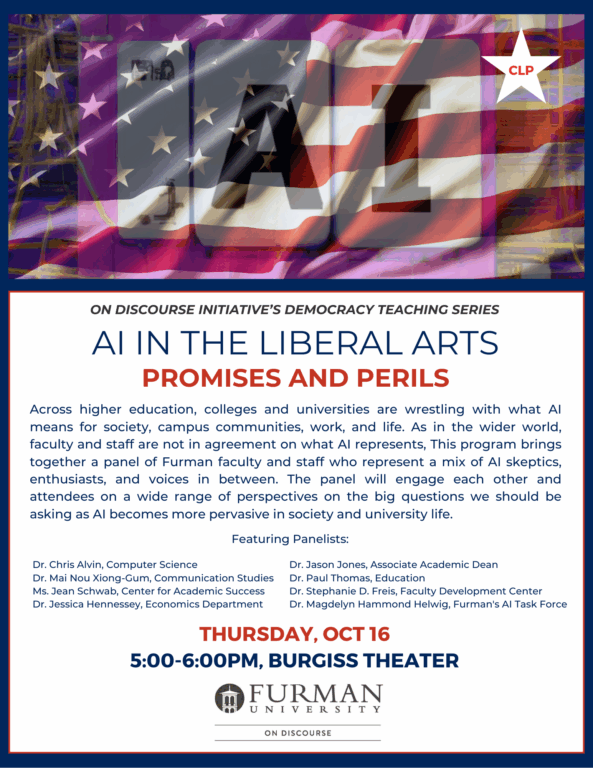
The Promises and Perils of AI
Across higher education, colleges and universities are wrestling with what AI means for society, campus communities, work, and life. As in the wider world, faculty and staff are not in agreement on what AI represents, whether it is good or bad, how or whether it should be used, what principles and practices should govern its ethical use and what it promises and risks are. This program brings together a panel of Furman faculty and staff who represent a mix of AI skeptics, enthusiasts, and voices in between, so that attendees can engage with a wide range of perspectives on the big questions we should be asking as AI becomes more pervasive in society and university life. |
| Nov. 3
5-6pm
|
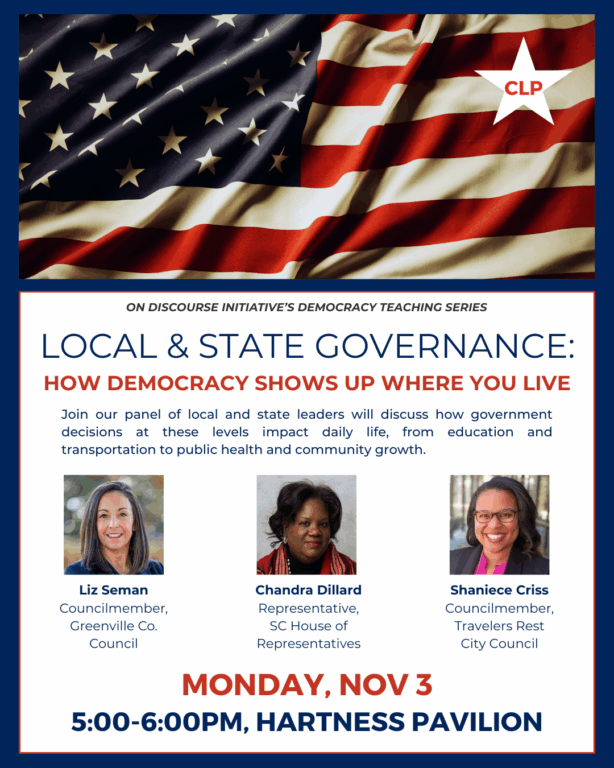
How Democracy Shows Up Where You Live
Democracy is not just shaped in Washington, DC; it is built every day in our cities, counties, and state capitals. In this session, a panel of local and state leaders will discuss how government decisions at these levels impact daily life, from education and transportation to public health and community growth. They will explore the challenges of fostering democratic participation close to home and share strategies for how students can play an active role in shaping their communities. Following the panel conversation, students will engage in structured small-group discussions to reflect on the material, share diverse viewpoints, and connect the topic to their own civic roles. |
| Nov. 18
5-6pm
|
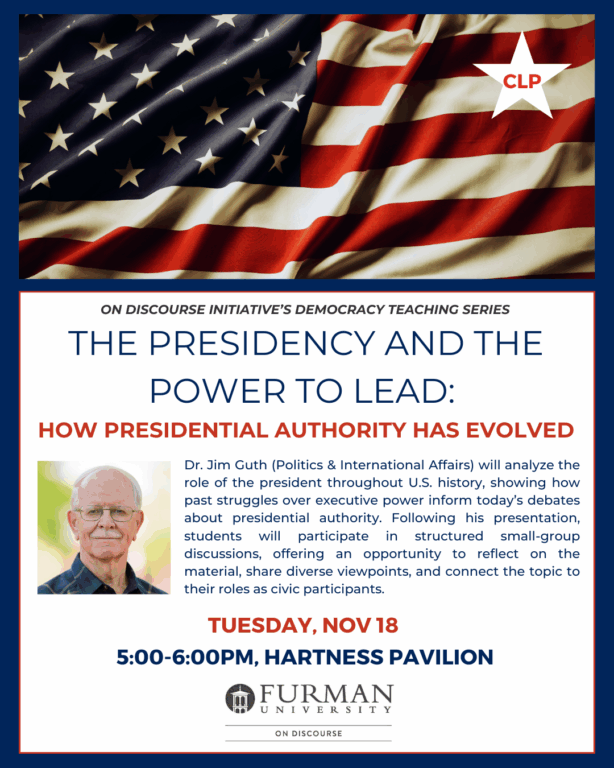
How Presidential Authority has Evolved
In this session, Dr. Jim Guth will analyze the role of the president throughout U.S. history, showing how past struggles over executive power inform today’s debates about presidential authority. Drawing on competing theories about the scope and limits of executive power, he will highlight how these perspectives shed light on the presidency’s role in sustaining a healthy democracy. Following his presentation, students will participate in structured small-group discussions, offering an opportunity to reflect on the material, share diverse viewpoints, and connect the topic to their roles as civic participants. This event is part of the On Discourse Initiative’s Democracy Teaching Series, which provides programs designed to help students and the campus community deepen their understanding of democracy in the United States. The series addresses documented gaps in civic knowledge and is grounded in academic inquiry and open dialogue. |