For alumni and friends
of the university
of the university
With Open Arms

Edward McCutcheon, campus minister for the Furman Wesley Fellowship, hosts a picnic in the amphitheater with a group of students on June 18, 2024. Photo by Nathan Gray, Furman University.

Members of the Wesley Fellowship jump while having their photo taken. Photo provided.
Sixteen years spent with college students means a lot of wedding invitations.
And the Rev. Edward McCutcheon shows up, attending, officiating, celebrating with students who have been part of Furman’s Wesley Fellowship.
But 16 years as a campus minister also means a lot of questions, struggles and tears. And McCutcheon is there, too, helping students explore faith, grapple with big issues and even face death.
Caroline Brawley ’24 was studying in Taiwan her senior year when her mom called to say her dad had died of a heart attack. Brawley’s head spun as she packed to return home. She tried to go to bed, but sleep wouldn’t come.
“God,” she prayed, “I need to talk to somebody.”
Then she remembered it was Thursday in South Carolina. It was lunchtime in Greenville. McCutcheon would be in the Dining Hall. She picked up her phone.
“He talked to me until I was like, ‘OK, I can go to bed now,’” Brawley says.
Back home, still reeling from shock and jet lag, she got a text from McCutcheon: “See you on Wednesday.” He meant in Tennessee, for her father’s celebration of life.
“He knows how to listen to us, how to be there for us,” says Dalmondeh “DD” Nayreau ’25.
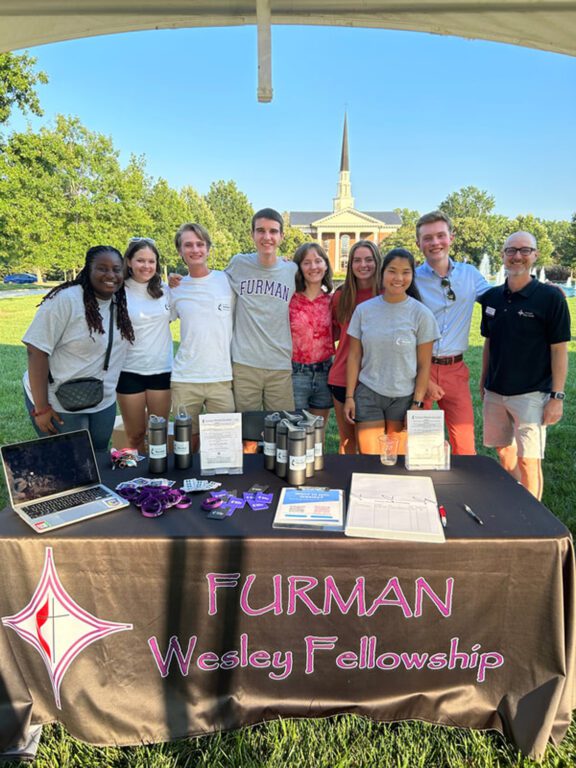
Edward McCutcheon, right, campus minister for the Furman Wesley Fellowship, poses for a photo with student members of the group. Photo provided.
Since 2008, McCutcheon has led Furman students in worship and given them space to wrestle with faith. He’s ready to talk about everything from broken relationships to NCAA tournament picks. He comes to mock trial competitions, concerts, volleyball games and, occasionally, the emergency room.
“He shows up for students,” Nayreau continues.
The Wesley Fellowship is one of several organizations that work with Furman’s Office of Spiritual Life to tend to students’ spiritual and religious needs. Student groups for other Christian denominations, as well as for Buddhist, Hindu, Jewish and Muslim faiths, meet regularly. There is a student-led Religious Council and ministers and advisors for Baptist, Catholic, Episcopal and other denominations.
“We are fortunate to have an excellent group of campus ministers to work with us in the Office of Spiritual Life. Edward has always been a leader among that group. He is a great colleague, a fine minister, and a caring soul. His presence at Furman has always helped us be better,” says Vaughn CroweTipton, associate vice president for spiritual life, university chaplain and associate professor of religion.
Answering the call
McCutcheon’s call to ministry goes back to his days at Wofford College, where a campus chaplain made a deep impact on him.
“I always thought that was kind of the dream job,” he says.
He earned a master of divinity at Duke Divinity School, was ordained by the United Methodist Church (UMC) in 2002 and served as associate minister at two churches. He soon discovered that while he enjoyed study and sermon preparation, they weren’t his favorite parts of pastoring.
“I would rather be with people than sitting in my office,” says McCutcheon. “I love that every day could be different.”
Open invitation
McCutcheon has a phrase he uses so regularly that Wesley students can quote it: “This is always an invitation, not an obligation.”
The invitation has nothing to do with UMC membership.
He estimates only half the students who find their way to Furman Wesley are connected to the UMC. A typical year for the fellowship is about 20 to 25 students. Other campus ministries host larger groups but McCutcheon is content.
“I know everybody,” he says. “I know people’s stories, I know their joys, I know their concerns.”
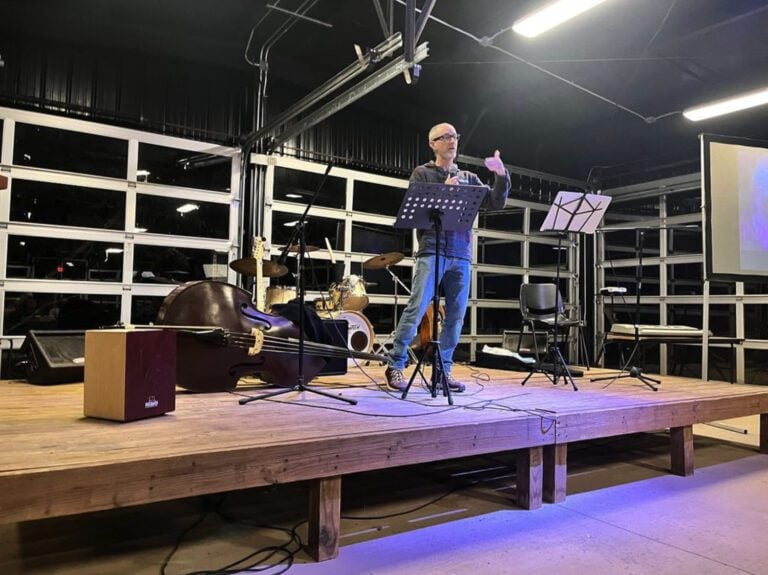
Edward McCutcheon, right, campus minister for the Furman Wesley Fellowship, speaks at an event. Photo provided.
Nayreau felt that connection from the beginning. She grew up in Liberia and attended a UMC church there. College was her chance to figure out what the family’s faith meant to her personally.
“I just wandered into the first meeting of the year,” she says. A student greeted her and McCutcheon was right behind, “which is the routine for him, whenever there’s a new face through the door.”
Brawley, who also grew up in the UMC, says Furman Wesley has space for students of all persuasions, and his example taught her how to meet people where they are.
“Edward was so good at just being around people that he made everybody feel welcome,” she says. “It’s not that those differences didn’t matter, they just never existed with hostility.”
The Wesley Fellowship schedule includes a Tuesday night meeting with singing, prayer, a sermon and fellowship. A first-year student group also meets weekly, and every Thursday students can find McCutcheon in the Dining Hall at lunch or at Starbucks in the afternoon.
Sometimes they’re gathered around the Bible; other times they’re simply gathered.
“One thing I’ve noticed,” Nayreau says, “we’re all open and committed to learning.”
McCutcheon has a leadership team of students who help him serve the group. He makes a point to meet with the leaders regularly as a pastor, not a supervisor.
“The leaders are helping to care for other students and now I need to care for your soul,” he tells them.
Nayreau has been part of the leadership team since her sophomore year, when she led the first-year group. She served as treasurer her junior year and this year is a student facilitator.
“I want to be a part of the team that ensures that Wesley remains a welcoming environment for incoming students, just as it has been for me through the effort of others,” she says.
Loving well
Church law isn’t central to his daily ministry, but he’s been glad for the chance to walk with students through the upheaval in the UMC over the last several years.
Some of his students have home churches that voted on disaffiliation because of the denomination’s changing stance on homosexuality. Others have come from congregations eager to make more room in the church.
“I have felt that it was even more important to stay in my role, because of bridging that gap,” says McCutcheon, who has seen relational impact in the broader church and is planning for the funding impact.
About one-quarter of the UMC’s U.S. congregations disaffiliated between 2019 and 2023, primarily because of delayed resolution over the church’s language and policies on issues of sexuality. The changes ultimately were approved by the General Conference in spring 2024.
For some, the revisions didn’t go far enough; for others they went too far. One conservative friend told McCutcheon he no longer felt there was a place for him in the denomination.
“I don’t want him to feel that way,” McCutcheon says. “But I don’t want people in the LGBTQ+ community to feel that way, either.”
He’s been available to talk through the turmoil with students, but it’s not been a formal agenda item for the Wesley Fellowship.
Nayreau says students know McCutcheon isn’t going to give them all the answers. Instead, he’ll guide them through difficult issues in a way that uncovers the facts and lets them decide for themselves how to apply those facts to their faith.
Conversations in the group tend to focus more on how to treat others with dignity, kindness and respect than on cultural or political debates.