News from campus and beyond
Shi Institute leads sustainability by weatherizing local homes
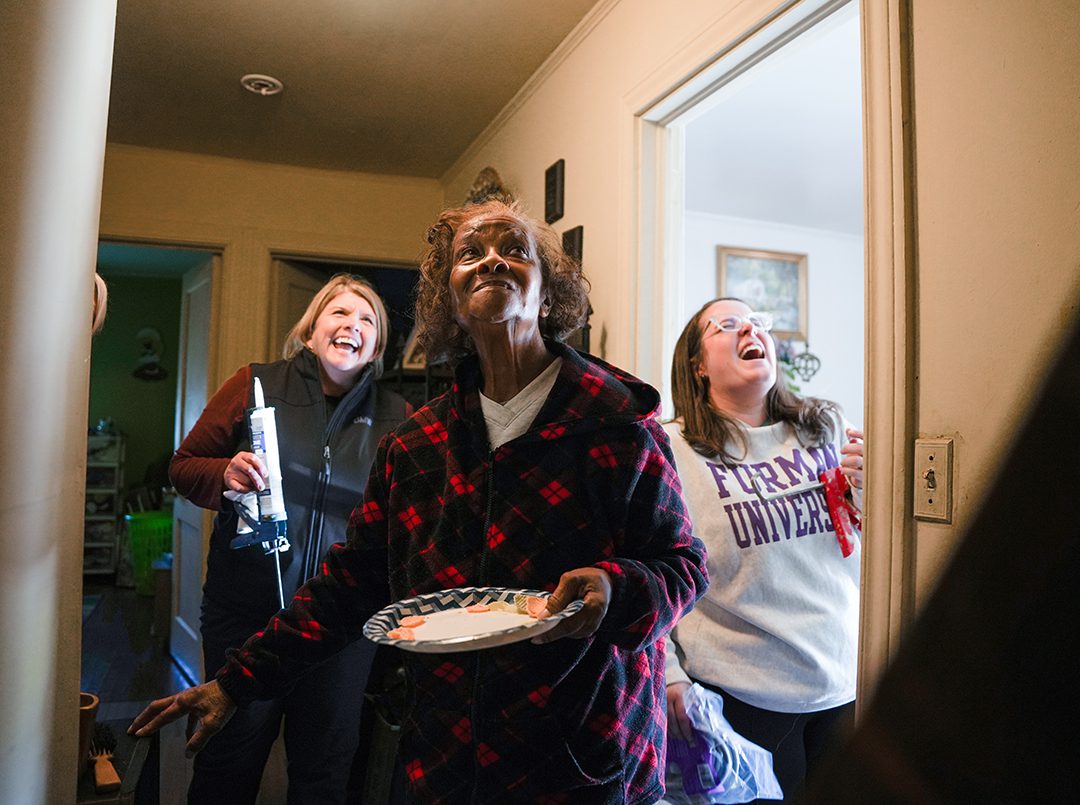
Betty Davis, middle, and Joy Baker, associate director of sustainable programs at the Shi Institute for Sustainable Communities, right, watch as volunteers from the Sustainability Leadership Initiative weatherize Davis’s attic on Thursday, Jan. 9, 2025. Photo by Nathan Gray, Furman University.
The principles of sustainability science can go over some people’s heads, but in Betty Davis’s living room they were as clear as day.
Davis, 78, has lived in her Jamison Street home for nearly five decades. She raised three children within those walls and has seen her neighborhood transform and grow for half a century.
“It means a lot to me to still be living here. I like this neighborhood,” she said.
But time has taken its toll, as it does on any home. When Davis received a letter in the mail from Joy Baker, associate director of sustainability programs for Furman University’s Shi Institute for Sustainable Communities, offering to do some home improvement projects for free, she leapt at the opportunity.
“I sure couldn’t have done it all on my own,” Davis said with a smile.
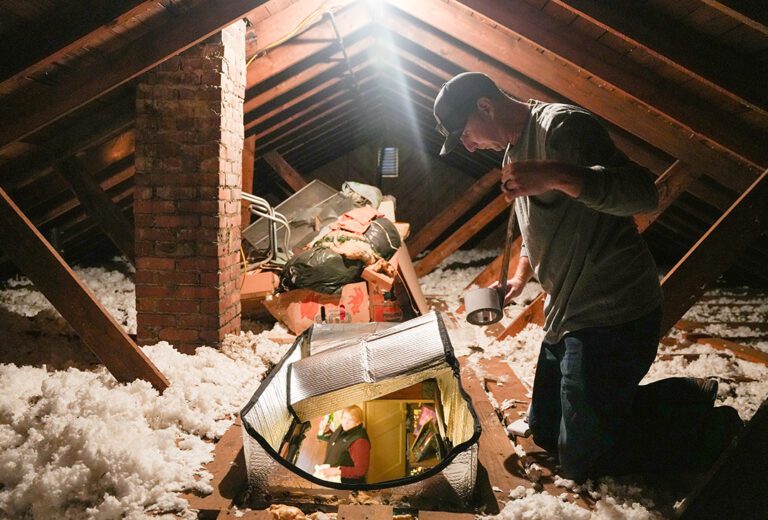
Brandon Money installs an attic tent in Betty Davis’s home as part of a Sustainability Leadership Initiative project on Thursday, Jan. 9, 2025. Photo by Nathan Gray, Furman University.
Shi’s Community Conservation Corps program, founded in 2009, provides free home weatherization for low-income homeowners throughout the community. Baker said the CCC partners with Habitat for Humanity of Greenville County to do these home-improvement projects. A little caulk, spray foam, LED light bulbs, insulation and other quick fixes can make a big difference to a home’s energy efficiency. On average, households weatherized through the CCC see a 20% reduction in energy use and an average $300 annual reduction in their power bills.
“The easiest way to think about it is we’re making homes warmer, safer and dryer,” Baker said. “Homeowners are getting weatherization from us and critical home repair from Habitat – it’s the whole package.”
The CCC has helped weatherize more than 190 homes, giving more than 380 residents more disposable income by making their homes more energy efficient.
On Jan. 9, the CCC rallied more than 20 helping hands to visit Davis and another homeowner, Ollie Bluford, and weatherize their homes. Shi’s Sustainability Leadership Initiative (SLI) is a statewide, eight-month program in partnership with the nonprofit Sustain SC that develops participants’ leadership skills while teaching about sustainability science. The 24 members of this year’s SLI group were invited to join Baker and the CCC to weatherize Davis and Bluford’s homes, getting a hands-on lesson in sustainability principles.
“This is, to me, where the rubber meets the road,” said Kristen Austin Gunter, senior vice president of conservation for Sustain SC. Gunter is part of this year’s SLI cohort.
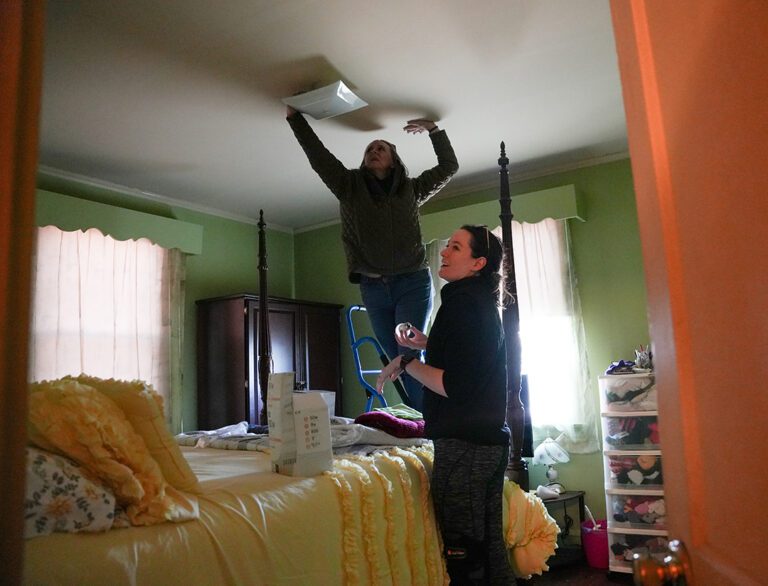
Christiane Farrell, left, and Samantha Maiche install high-efficiency LED lightbulbs in the home of Betty Davis in Greenville on Thursday, Jan. 9, 2025. Photo by Nathan Gray, Furman University.
Shi Institute Executive Director Andrew Predmore said taking the group to weatherize these homes gave the participants a tangible example of the principles of sustainability.
“A common misunderstanding about sustainability is that it’s just about protecting nature,” he said. “Sustainability is about the intersection of economic systems and environmentalism. Weatherizing a home lowers utility bills, making the resident more likely to stay in their home while lowering their carbon and climate footprint.”
Habitat for Humanity of Greenville Chief Programs Officer John Lattimore greeted the SLI and CCC participants as they came out of two vans at Davis’s home. In a matter of minutes, they had their marching orders. Some were equipped with caulk guns to check and seal the windows. Others were handed a box of LED lightbulbs to swap out older, less-efficient bulbs. A small group joined Lattimore as he climbed into the attic to check the insulation and install an attic tent, which is a zippered seal inside the attic entrance that stops heat transfer, keeping the house warmer in winter and cooler in summer.
“A lot of times people think they know what sustainability is,” said Samantha Maich, a sustainability specialist at Milliken in the SLI group. “Sometimes it’s changing a lightbulb.”
Beyond weatherization, the SLI class is slated to explore other elements of sustainability, including land management and conservation, forestry, agriculture, energy and emissions. The 24 participants in this year’s cohort will travel throughout the state for five sessions to earn their SLI certification.
But as Davis weaved her way through the dozens of people walking in and out of her home, she said she was grateful for the help and unbothered by the buzz of activity. She gestured to a table topped with framed pictures of her children and grandchildren and said, “I’m used to it.”