News from campus and beyond
Scholarship reception celebrates more than $8M in grants for research projects

Patricia Sasser, associate librarian of music, gives a four-minute speed talk called “Collecting Music Among the Kharbintsy” during the Furman Scholarship Reception at the James B. Duke Library on Friday, Feb. 14, 2025. Photo by Nathan Gray, Furman University.
When the library called for submissions, Furman University’s faculty and staff answered with more than 200 scholarly and creative works for the annual Furman Scholarship Reception on Feb. 14 in the James B. Duke Library.
Sponsored by the Office of the Provost and Furman University Libraries, the reception highlighted more than $8 million in grants that funded 214 scholarly submissions, more than were recognized at last year’s reception, said Director of Libraries Caroline Mills.
Every submitted work was included in the event, with long tables lined with abstracts or descriptions of each work. Topics and formats varied: Musical compositions, poetry and artwork were displayed beside papers on biology, mathematics, international politics, chemistry and other topics. Some researchers contributed to books, magazines or scholarly journals, and many of these publications had undergraduate student co-authors.
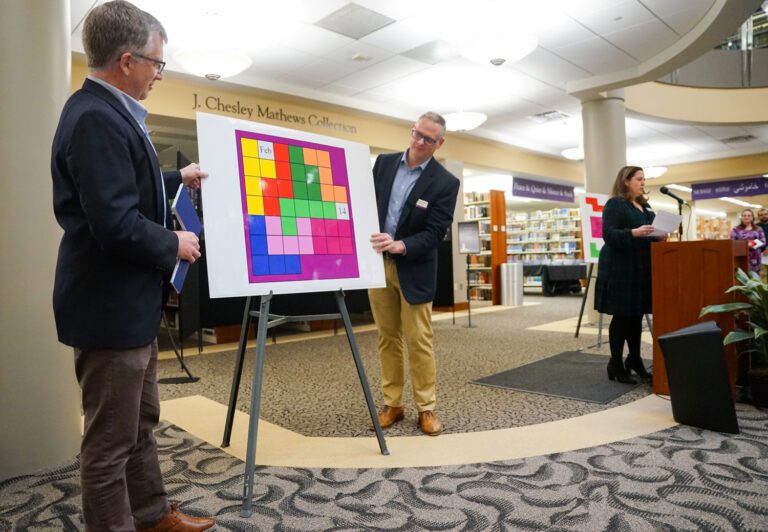
From right, math professors Liz Bouzarth, Kevin Hutson and John Harris give a four-minute speed talk on their project “Puzzle of the Day” during the Furman Scholarship Reception at the James B. Duke Library on Friday, Feb. 14, 2025. Photo by Nathan Gray, Furman University.
“Those of us in the library have decided that this work is too important to celebrate just once a year,” said Mills. “We have now made a permanent, public display of books written by Furman authors in the Duke library.”
Each year, the people who submit their works are asked if they’d be willing to give a four-minute presentation at the reception. Patricia Sasser, associate librarian of music, shared how her research began when she found two binders of sheet music anonymously donated to the music library. The binders belonged to Bella Tarakhovskaia, a young Jewish woman born in 1903 in Melitopol, Ukraine, then under the control of Imperial Russia. She found a home in the city of Harbin, China, and was one of many who turned the small railway city into a multiethnic urban center with more than 100,000 inhabitants, Sasser said.
In the margins of the sheet music Tarakhovskaia collected were handwritten notes in Russian. A Furman Advantage Summer Research Fellowship funded an undergraduate researcher to help Sasser early on in her work: CiGi Curry ’21 helped track down people and places named in the marginalia.
Their research traced the historic and cultural connections of the notes Tarakhovskaia and her contemporaries made in these binders, exploring a vast network of music printers, publishers and vendors. Not only did the research trace the transmission of these compositions through East Asia but it gave unique insight into the kind of education that was available to an aspiring young musician and how she responded to her changing environment.
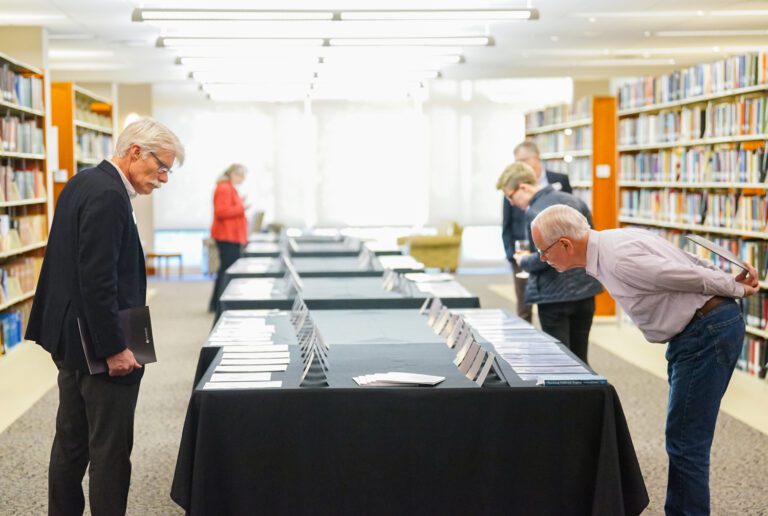
Furman faculty and staff members look at works by colleagues that have been published during the Furman Scholarship Reception held in the James B. Duke Library on Friday, Feb. 14, 2025. Photo by Nathan Gray, Furman University.
“It’s interesting to see the music people collect and what was important to them,” Sasser said. “It’s like making a mixtape – you can see the musical associations people make in this community.”
Other presentations covered real-time flood forecasting research by Gustavo Coelho, assistant professor of earth, environmental and sustainability sciences; mathematical approaches to solving the New York City Museum of Mathematics’ daily puzzle by math professors Liz Bouzarth, John Harris and Kevin Hutson; and the microtonal compositional techniques used in used in the live performance of “Alokinat” by Michael Vick, an instructional technologist.
“We are so fortunate to have such a talented, creative, forward-thinking faculty” that is pursuing academic excellence in so many settings and ways, Jeremy Cass, dean of the faculty, told the crowd.