News from campus and beyond
Predicting March Madness is a numbers game

The men’s basketball team celebrates after defeating the University of Virginia, 68-67, for their first NCAA tournament victory since 1974. Photo by Owen Withycombe
Every March, college basketball fans eagerly fill out their NCAA brackets, hoping to predict the unpredictable: the upsets. These Cinderella stories, where lower-seeded teams topple tournament giants, are the heart of March Madness. But what if there was a way to mathematically predict which underdogs would prevail? That was the question that drove professors of mathematics Liz Bouzarth, Kevin Hutson and John Harris at Furman University to dig into the numbers.
“The original project started with Kevin and John and college football rankings,” said Bouzarth. “They were helping journalists make sense of the numbers and the idea of that work extended to college basketball pretty seamlessly.”
Starting around 2013, when Bouzarth joined Furman, the trio began crunching the March Madness numbers. At a time when the popularity of the sport and the tournament was growing by leaps and bounds, figuring out the likelihood of an upset in one of the biggest sporting events of the year was a fun and applicable way to bring math to the masses and to Furman students.
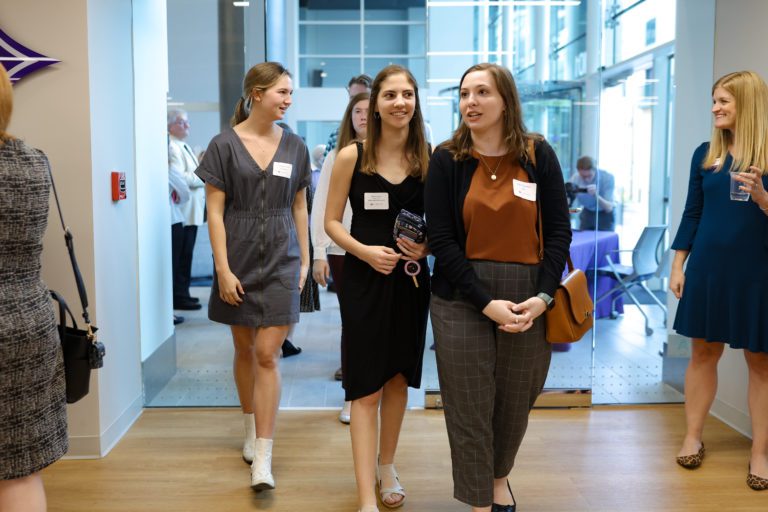
Megan Hubbard ’24, Lily Feingold ’25, and Regan Richardson ’24
Lily Feingold ’25, a senior majoring in applied math with a minor in data analytics, was one of those students. Her own love of sports, specifically basketball, and a passion for bringing numbers to life in practical, approachable ways made her a perfect fit for this research. The fact that undergraduates were encouraged to participate made it even more appealing.
“When math and March Madness is pitched to you, how can you say no to something so cool?” Feingold said.
Their goal was to analyze historical NCAA men’s basketball tournament data and uncover patterns behind upsets. Building upon previous research, they inherited a simple rating system that measured teams’ performances while accounting for strength of schedule. From there, they expanded their approach, testing various factors such as offensive and defensive efficiencies, three-point shooting percentages and a team’s pace of play.
One of the most intriguing theories they explored was whether underdog teams should adjust their playing style to counter their opponent. The belief was that if a team typically played fast, they should slow the game down against a high-paced opponent to increase their upset chances.
Lily and the team systematically tested these variables, eventually developing 18 different models to evaluate the probability of upsets, “then we combined them all into one big model using preferential weighting,” Feingold said. “So, the models that performed the best had the higher weights.”
When tested on tournament data from 2007 to 2021, their final combined model achieved a 76% accuracy among games where the gap between seeds was at least five. But what stood out most was its ability to pinpoint close games; even when it incorrectly predicted an upset, the matchups it flagged were often decided by just a few points. The ultimate validation came in 2023 when the model identified Furman’s upset over the University of Virginia as the most likely underdog victory of the tournament, a prediction that turned out to be stunningly accurate.
The research didn’t stop at just identifying upsets. The findings have been used by sportswriters Peter Keating and Jordan Brenner, who featured the study in articles for ESPN and The Athletic. Those results are currently in the writers’ upsets feature in The Athletic. Meanwhile, the Furman professors continue refining the model, using fresh data to improve predictions for each new tournament. Bouzarth said they will likely revisit the model soon due to actors like NIL deals, transfer regulations and conference realignments.
“It’s not about certainty, but about elevating interest in the most exciting matchups,” Bouzarth said. “And the real fun starts with the brackets drop.”
Those brackets dropped on Sunday and the team was ready to evaluate the matchups. Bouzarth said three matchups found their way to the top of the upset list this year including 6-seed Ole Miss being susceptible to either winner of the San Diego State University/University of North Carolina play-in game, 6-seed Brigham Young University has a good chance to be upset by 11-seed Virginia Commonwealth University, and 5-seed Memphis could fall to 12-seed Colorado State. Each of those picks has a 40% chance or more of upset potential according to the model – much higher than the usual 23% upset rate across the tournament.
Feingold has been away from the research for a couple years, but she is still excited to fill out a bracket and compare it to the model she helped bring to life. Even if the members of the team admit that it doesn’t give them a true advantage in predicting the tournament as a whole.
“I haven’t really used it, honestly,” Feingold said. “There is just too much emotion that goes into the tournament. Honestly, that’s what makes it fun in the first place.”