News from campus and beyond
Placing Furman project examines racist real estate practices of the past

Alester G. Furman Jr. at the groundbreaking ceremony for Furman University’s present campus. Furman Archives.
An analysis of real estate records from the 1930s and 1940s found that one of the most prominent real estate brokers in the Southeast, like many others at the time, used racist covenants to keep Black families out of more than a thousand homes in Greenville County, South Carolina.
The president of the brokerage firm, The Furman Company, was Alester G. Furman Jr., a long-time trustee of Furman University and the great-grandson of the university’s first president.
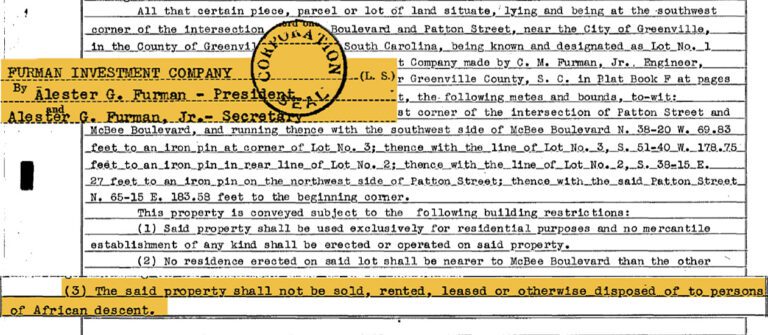
Racially restrictive covenants were common across the country in the first half of the 20th Century. Alester G. Furman used them extensively in Greenville.
The analysis is part of a research project by Ken Kolb, professor and chair of sociology, and other faculty and student researchers. Their project, “Placing Furman,” includes hundreds of photos, interactive data maps illustrating the scope of the project, and essays by Furman faculty and students providing context for the work.
“We think it paints an honest and objective picture of real estate practices in a Southeastern city in the 1940s,” Kolb said.
Alester Furman Jr. died in 1980, but, Kolb said, his name is still prominent on campus: the administration building, erected in 1957, is dedicated to him; a life-size statue of the man stands outside the visitor’s center; and the signature teaching award, announced each year at commencement, is named for him and his wife Janie Earle Furman. The Placing Furman report did not address changes.
Controlling real estate
Alester Furman Jr.’s real estate practices were hardly unique, Kolb said. Racist covenants were common across the United States in the early 20th century until the Supreme Court ruled them unenforceable in the 1948 case Shelley vs. Kraemer. They were made illegal in the 1968 Fair Housing Act.
The covenants specified in legal documents that “the premises shall not be sold, leased or released to any negro or person of negro blood,” or similar language. They became standard in the Southeast, including in Greenville, when textile mills began selling off “mill town” homes to their employees.
“It was a way to control who lived in the neighborhoods and who lived close to the mills” while earning revenue, Kolb said.
Racism was also a common way to generate wealth in a society where racism was openly accepted, said Kaniqua Robinson, assistant professor of anthropology and co-chair of the Placing Furman team.
“Alester Furman was a capitalist, and racism was a tool for capitalism. He had to use that tool,” Robinson said.
Kolb and student Isaac Lewis ’26 found deeds on 1,238 homes in Greenville County that included racially restrictive covenants written by The Furman Company. But, Kolb said, the firm operated throughout the Southeast. “There could be thousands more.” He also found evidence of racially restrictive deeds four years beyond Shelley vs. Kraemer.

Alester G. Furman Jr. Furman Archives.
The negative effects of racially restrictive covenants are still being felt, Kolb said. Owning real estate is a means to produce generational wealth. Without the ability to own property, Black families were placed at a disadvantage that has lasted generations. Banks and local governments were complicit in creating and continuing segregated neighborhoods, Kolb said. “It’s related to the serious wealth gap we have today,” Kolb said.
In August of 2022, Kolb and former student Sam Hayes ’20 worked with Furman’s Shi Institute for Sustainable Communities to map all the racially restrictive covenants in Greenville County. There were more than 5,000 of them.
Soon after that, Kolb was reviewing materials and, for the first time, saw the name Alester Furman Jr.. It was for land where a Bon Secours hospital parking lot now sits. He soon found another for Graceland Cemetery, restricting Black people from being buried there.
“We had done all this public scholarship, but we had omitted our own participation in it,” Kolb says of Furman’s name. “We have a professional obligation to bring information to light, to admit the omission.”
The research findings are also important for the university and the community at large to move forward, by providing accountability, Robinson said. “This is a way of countering the erasure of the Black experience and other cultures who were part of Greenville and communities nationwide.
The website includes essays by other researchers that provide more historical, societal and economic context and detail. Researchers who wrote essays are Robinson, assistant professor of anthropology; Steve O’Neill, professor of history; Kelsey Hample, chair of poverty studies and associate professor of economics, Claire Whitlinger, associate professor of sociology, who worked with Jillian Hall ’25; Jeffrey Makala, associate director for special collections and university archivist, Taha Kasim, associate professor of economics; and Sarah Archino, associate professor and chair, Stephen Mandravelis, assistant professor, and Kylie Fisher, assistant professor, all of the art department.
Now that the information is public, Kolb says he wants to hear from the public. He’s inviting comments, even those disagreeing with the research or the essays, on the Placing Furman website. “In the spirit of thoughtful dialogue, we promise to review and reply to each submission you send us,” Kolb said. “Our goal is to foster a constructive conversation.”