For alumni and friends
of the university
of the university
The Roots Run Deep
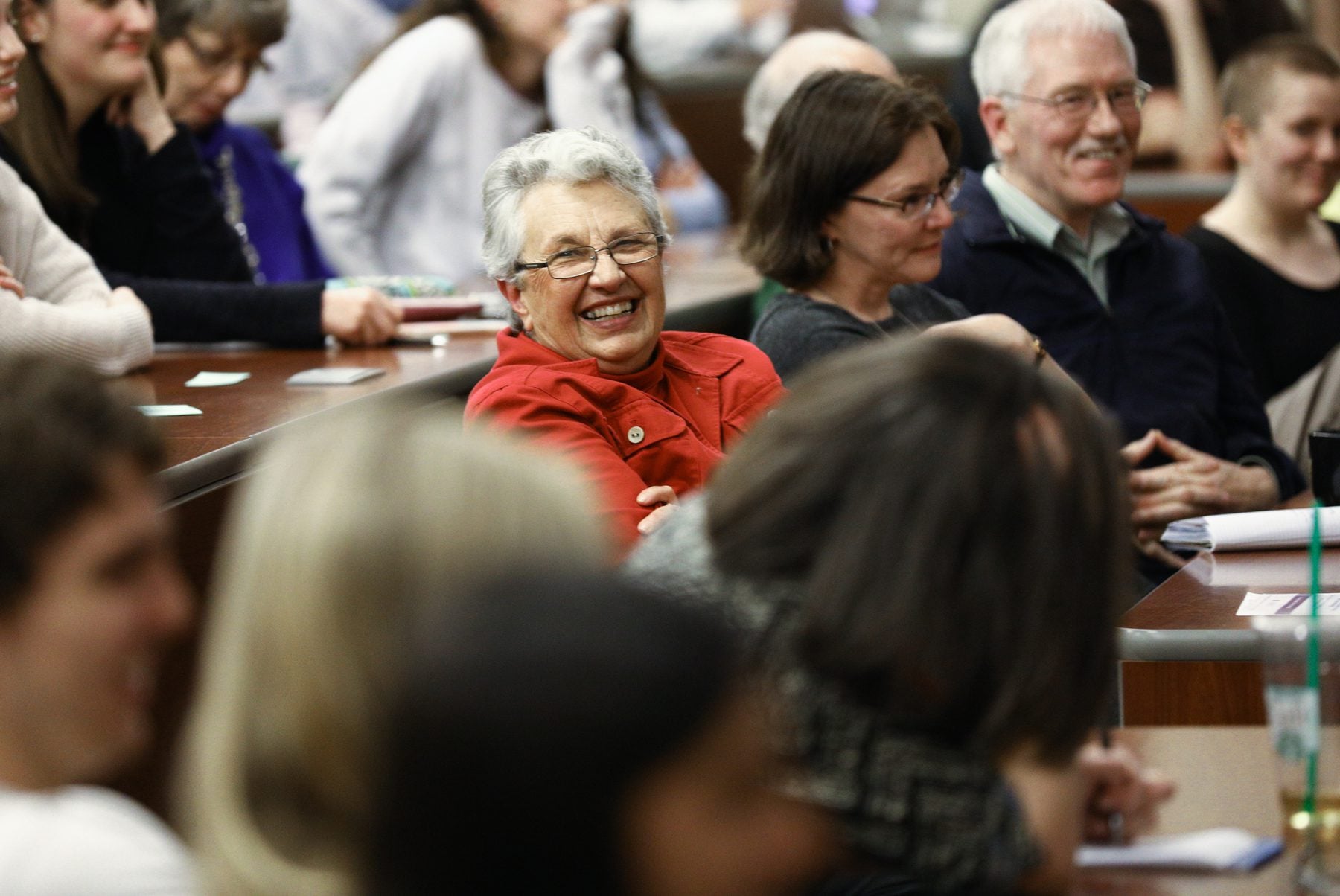
Willard Pate
As we celebrate Furman University’s Bicentennial, the anniversary invites us to reflect on the people whose daily presence and dedication have molded this institution. Among them are the active, longest-serving faculty and staff members. These mentors, problem-solvers, innovators, stewards and living archivists are the source of so many cherished memories. They’ve spent decades fostering young minds and supporting the campus at large through eras of growth, reinvention and innovation. Their passion has rooted them at Furman long enough to see generations of Paladins go on to change the world. Their work – often unsung — has made Furman a thriving, inclusive community, ready to pave the path to tomorrow.
61 Years
Willard Pate
Professor of English
Joining Furman in 1964, Pate said she learned from “the giants of Furman’s past” like Jim Stewart, Frank Bonner and Meta Gilpatrick. Now Pate is among them – she passed away in December. A native of small-town Georgia, Pate’s passion for Southern literature came naturally. Seeing students connect with the written word fueled her decades of teaching. She was on the ground floor of Study Away, leading some of the earliest international trips to the British Isles. The courage to take on new experiences helped students develop not only their understanding of the world, but their values. “Many had never been on an airplane, but they were brave enough to leave home for three months,” she said. “When they got back, I knew every single one of those kids could have turned right around and gone back on their own.”

William Brantley, professor of physics. Photo by Nathan Gray, Furman University.
59 years
William Brantley
Professor of Physics
Long before Brantley joined Furman, he grew up in the halls of Virginia Intermont College, where his father served as president. That was where Brantley’s passion for the study of physics blossomed. When he was ready to teach as a professor himself, Furman’s motto was part of what convinced him to join the university: Christo et Doctrinae, “For Christ and Learning.” While the growth of campus since he joined in 1966 has created some physical distance between departments, Brantley said the university has only gotten better at recognizing the interconnectedness of the work each department does. Students are encouraged to see how their major relates to other fields of study and bring their unique skills and knowledge to every class they take. “When I walk into a classroom, there’s far more brainpower on their side of the desk than mine,” he says. “The only thing is I have a little more experience than some of them, but there’s no shortage of brainpower.”
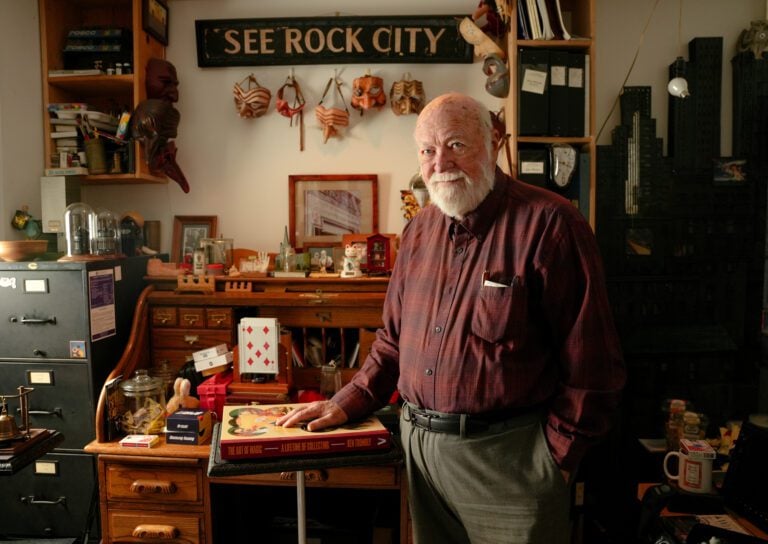
Rhett Bryson is a professor of scenic and lighting design in the theatre department at Furman University. Photo by Nathan Gray, Furman University.
53 years
Rhett B. Bryson
Professor of Science and Lighting Design
Bryson originally turned down a job at Furman, saying McAlister Auditorium was too large a space to teach in. The Playhouse, however, offered the perfect setting, small enough to teach the intimacy of theater. “A smaller space means they’re forced to be honest in their performances, because the audience is so close they can sense artifice and fakery,” Bryson says. For him, the theater is a living laboratory, where collaboration is key and the discipline students learn in their other classes is the tinder for their passion onstage. Bryson also views Furman like The Playhouse. There may be bigger stages, but “we’re small and intimate enough that it’s eminently possible to navigate any challenges facing it in its third century.”

Jim Guth, professor of politics and international affairs, has taught at Furman University since 1973. Photo by Nathan Gray, Furman University.
52 years
Jim Guth
Professor of Politics and International Affairs
When Guth joined the Politics and International Affairs Department in 1973, class sizes were a lot bigger than they are today. “When I came here you had one or two people teaching all of American politics and one or two teaching all of world politics,” he says with a laugh. He remembered trimming the blank parts of paper surveys to save on postage weight when they were mailed out and having parents lick stamps for him during family weekends. This resourcefulness served him well as Furman evolved, bringing on dedicated faculty and expanding its programs. Now, he says initiatives like the Tocqueville Lecture Series and On Discourse ensure that Furman’s students experience a diversity of perspectives and opinions as they navigate a world that is transforming alongside them.

Steve Long is a project manager at Furman University. Photo by Nathan Gray, Furman University.
51 years
Steven Long
Project Manager in Facilities Services
Long was a drafting and design technician working for an architectural engineering firm when Furman hired him in 1974. He started as a draftsman and estimator, designing essential campus improvements and keeping their costs reasonable. With his drafting tools, Long drew up the plans for office renovations, classroom upgrades and even the building of the Herring Center for Continuing Education and the Pearce-Horton Football Complex. His involvement in so many major changes to the university landed him the role of project manager, where he presided over the move of the Cherrydale Alumni House. “When I arrived at Furman it was a small village. Now it’s a thriving metropolis. We’re a team; everyone has the same goal, and everybody cares,” he says.

Mickey Fray is the department assistant for mathematics at Furman University. Photo by Nathan Gray, Furman University.
46 years
Mickey Fray
Department Assistant in Mathematics
Fray used to live “out the back gate” of Furman. She raised her family so close to the university she regularly brought her children here to feed the ducks. She says she was hired in the “B.C. era” – before computers. As a department assistant, Fray used to type up professors’ handwritten notes on a typewriter. But what made her love her job was connecting with students. From her battle station at the Math Department’s front desk, she meets every new student as they come in. Before cellphones, when students were homesick, she made it her job to comfort them; she still keeps a box of tissues beneath her desk for the rough moments. “Some of the math majors who came through years ago have children here now,” she says. “I guess I’m a bit of a ‘den mother.’”
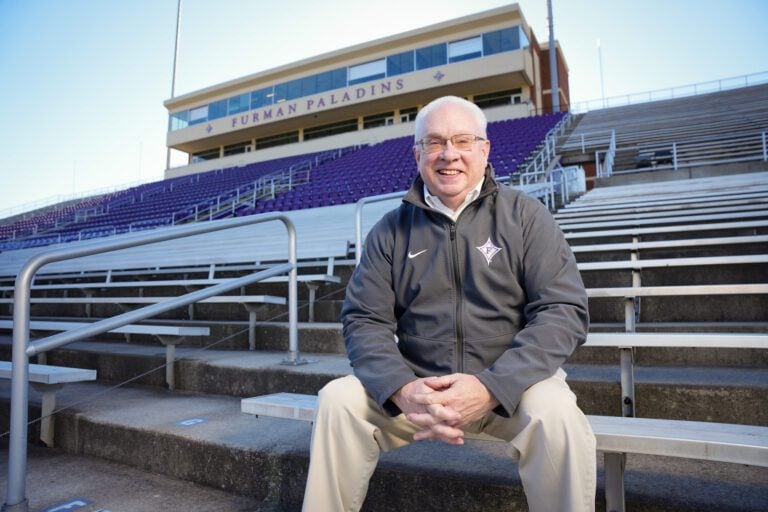
Hunter Reid is the associate athletics director at Furman University. Photo by Nathan Gray, Furman University.
40 years
Hunter Reid
Associate Athletics Director and Athletic Communications
When Reid joined Furman in 1985 as an assistant sports information director, it had long packed an impressive reputation for athletic and academic excellence. Out of the more than 350 Division I schools in America, Reid said “the opportunity to represent an elite institution in that group – one that had figured out how to win athletically and succeed in its highest mission with remarkable student-athletes and coaches – is an opportunity and a blessing I will always cherish.” He saw the expansion of athletics as the Southern Conference began incorporating women’s sports in the late 1980s. Furman’s success regionally and nationally came by “fully embracing who we are,” he says. “Athletics has been part of Furman’s rich fabric for well over a century and has contributed in a prodigious way toward the excellent reputation the university now enjoys.”
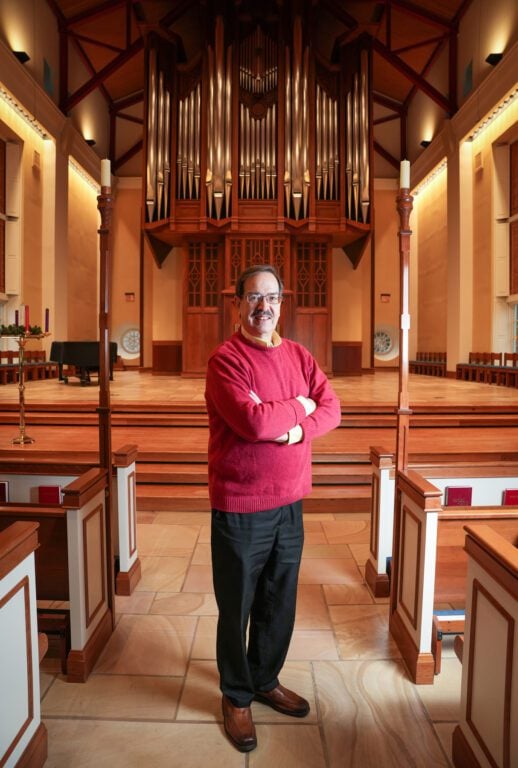
Charles Tompkins, university organist and professor emeritus of music. Photo by Nathan Gray, Furman University.
40 years
Charles Tompkins
University Organist and Professor Emeritus of Music
Organs are as much architecture as instruments, and Tompkins had a hand in both elements in Daniel Chapel. He helped design both the building and the organ in it and sees himself as an advocate for the instrument. “I look at it like it’s my mission to say, ‘Listen to what this organ can do,’” he says. Most music students coming into Furman have little to no experience with an organ. They’re custom-built for the space they occupy and flood the room with music the second they’re played. But it’s the other instrumentalists in Furman’s Music Department who have shaped Tompkins. “I’ve learned a tremendous amount from my colleagues. It’s been a liberating experience working with non-organists who have challenged my preconceptions. It opens your mind,” he says.