News from campus and beyond
Furman English Faculty Turn Book Projects Into Mentoring Opportunities
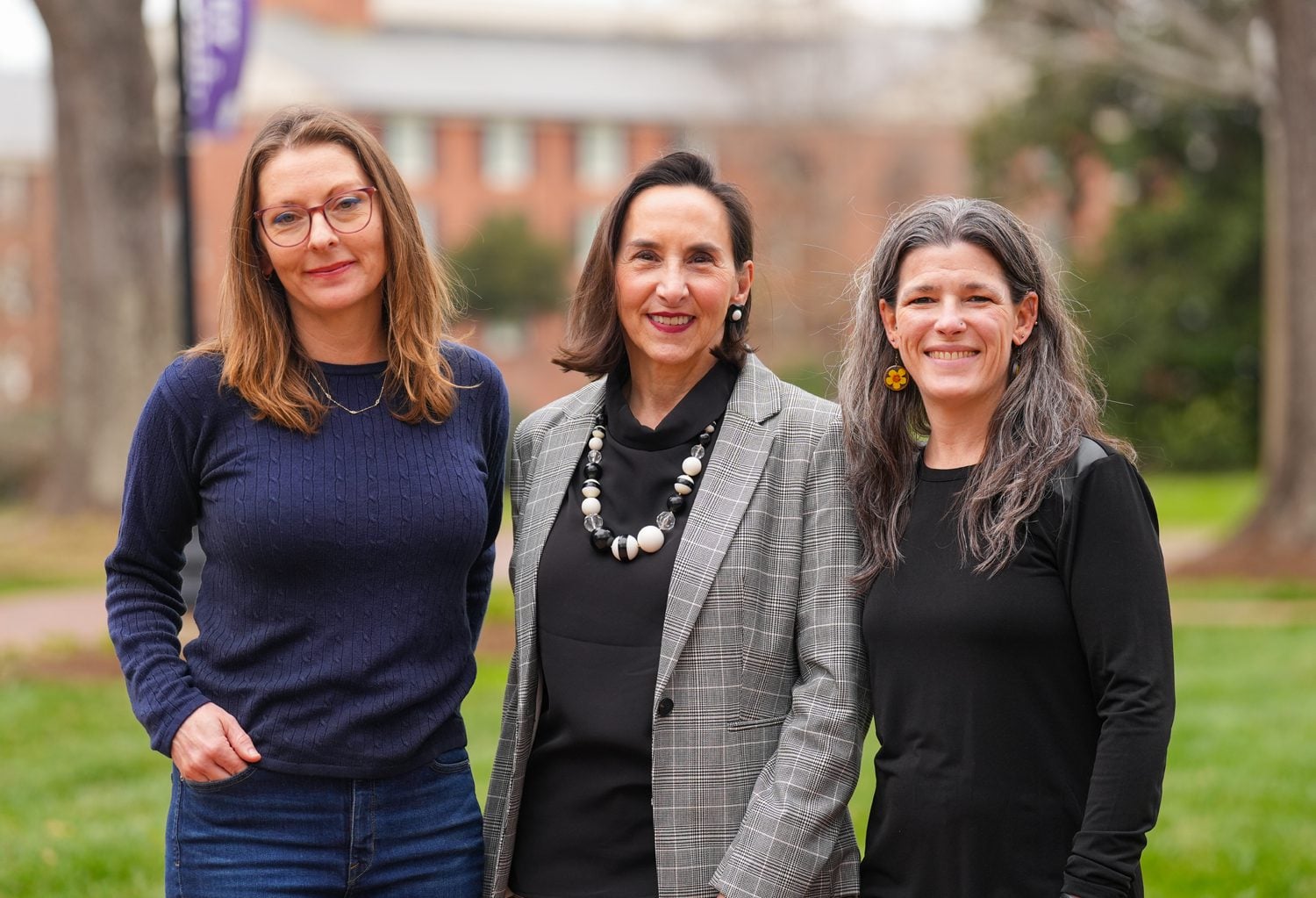
Furman University English professors, from left, Michele Speitz, Margaret Oakes and Laura Morris published books last year, while teaching, sharing their expertise with their students. Photo by Nathan Gray, Furman University
Margaret Oakes likes to bring a mess into her classroom.
The English professor edits her scholarly writing on paper, a tactile process of literal cutting and pasting. And then she invites her students to look.
“When I tell you your first draft is going to be terrible, you’re going to have to revise it – this is proof,” she tells them.
The recent publication record of Furman’s English department tells a story of commitment to weaving professional work and classroom instruction into a deep academic experience for students.
The faculty were especially busy in 2022 and 2023.
- Gretchen Braun, a professor who also teaches in the women’s gender and sexuality studies program, published “Narrating Trauma: Victorian Novels and Modern Stress Disorders.”
- Joni Tevis, the Bennette E. Geer Professor of English, won her second Pushcart Prize for an essay in The Georgia Review titled “If Your Dreams Don’t Scare You,” a look at hazing through history, including her own experience.
- Professor Nicholas Radel wrote the introduction for the seminal “King Richard II” in the anthology “Shakespeare: The Critical Tradition.”
- Professor Gregg Hecimovich published “The Life and Times of Hannah Crafts,” which won The Los Angeles Times Book Award, the American Book Award and many other honors.
Last year, three English professors – Oakes, Laura Morris and Michele Speitz – each published books, continuing the department’s high level of activity.
Melinda Menzer, English professor and department chair, said teachers consistently incorporate their research into classroom conversations. They also conduct research alongside students and workshop their writing with them.
“These collaborative projects are high-impact experiences for our students, and they broaden a Furman education from teaching to mentoring,” Menzer said.
Chapter One: Learning Together
Oakes led a 2018 study away program in the United Kingdom. The group saw 16 plays and Oakes was struck by the fact that the UK is more experimental with gender in its production.
Women played men more frequently, or characters were switched from male to female. Sometimes it worked well and brought fascinating insights to the play; sometimes it made no difference.
The observation sparked the research that would ultimately become her 2024 book “To Gender or Not to Gender: Casting and Characters for 21st Century Shakespeare.”
Oakes brought a student into the work in the most tangible way possible, by hiring a research assistant.
Emily Enlow Banks ’22 helped create a database for the project. She read theater reviews from the past 25 years to study how language has changed. She developed interview questions and participated in interviews with theater professionals.
“We are learning as we do our research and this always gets passed into the classroom,” Oakes said. “We have to grow in the field in order to serve our students.”
Chapter Two: Writing Together
Morris, associate professor of English, published her first novel, “The Stone Catchers” in 2024. She published a book of short stories in 2018.
Through those same years, she also was shepherding students through their own submission and publication processes.
“My students and I, we’re all working writers,” she said. “And I treat us all like working writers.”
Morris would sketch out her book’s plot structure on the board to identify gaps or flaws, while her students practiced the same process on their own writing.
“We’re working through problems together,” she said.
Morris considers any first draft a “discovery.” Her 80,000-word manuscript went through 11 drafts before publication. “I want them to understand that is the reality of becoming a writer.”
After watching the draft process unfold, students learned about sending out a finished manuscript and saw what it takes to bring a book to the public after its release.
“What does it mean to market your book? What does it mean to attend events around your book?” Morris said. “I think it opens up their eyes a bit around what the world of writing looks like.”
Her “Stone Catchers” experience also led to the development of a new novel writing class that Morris is now teaching.
“It never doesn’t come back to the classroom,” she said.
Chapter Three: Professional Together
Speitz, associate professor of English, published twice in 2024. Her book “The Romantic Sublime and Representations of Technology” explores machines, tools and built environments in British Romantic literature. “Romanticism and Sound Studies” is an edited collection of essays.
More than a dozen students were involved in the two projects.
“You set out to write an article or a book and inevitably, as you write, you are learning and rewriting more than just what you set out to do,” Speitz said. “We learn together.”
Her students conducted research, learned coding and engaged with experts outside of Furman.
“These publications basically make an avenue for more of the Furman Advantage,” Speitz said. “The more I’ve been able to publish, the more I’ve been able to work, the payoff for the students has been greater.”
The professional research and publication process allows students to learn alongside their teachers while also beginning to pursue their own academic interests.
“All good teaching and all good research or writing comes out of a genuine passion for learning,” Speitz said.
When she asks students to critique each other’s work, she walks them through the peer review process that her writing faces. The classroom assignment is “not a rote exercise; it’s how we work in the professional world.”
Epilogue: The New Teacher
Banks double-majored in theater and English. Her summer as a research assistant with Oakes was a valuable learning experience.
“She prioritized me getting a fundamental understanding of the theories she was using,” Banks said. “She was teaching me through her research.”
The work introduced Banks to the role of a dramaturg – the person who conducts research on what makes a play relevant and what directorial choices are consistent with the text.
“It felt like the first time that I was really able to synthesize the English major with the theater major in a way that made sense,” Banks said.
She is now the musical theater teacher at River Bluff High School in Lexington, South Carolina. And her professor’s book was part of her path there.
“They are out doing the thing that they’re teaching us to do,” she said.