News from campus and beyond
Fran ’72 and George ’71 Ligler fund cross-disciplinary science award at Furman
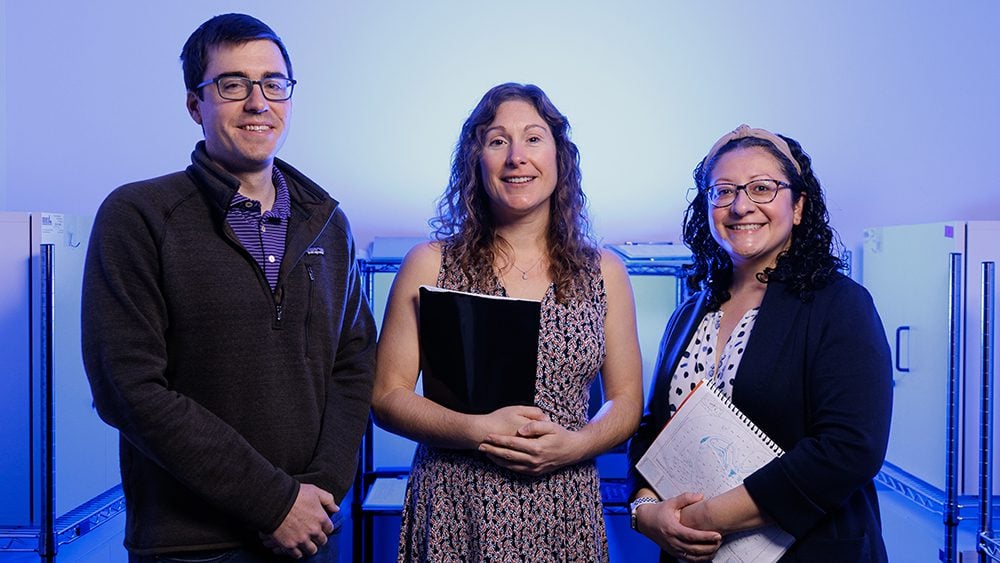
Mac Gilliland, associate professor of chemistry; Linnea Freeman, associate professor of biology; and Veronica Flores; assistant professor of psychology received the first Ligler Cross-Disciplinary Science Research Award.

Fran Ligler ’71, a former Furman University trustee, and George Ligler ’72, one of Furman’s Rhodes Scholars, have created an award to encourage cross-disciplinary science.
A new gift to Furman University is creating opportunities for science faculty from different disciplines to work together, bringing multiple perspectives, tools and talents to bear on research.
Earlier this year, Fran Ligler ’72 H’18 and husband George Ligler ’71, renowned scientists and engineers whose careers have spanned academia, government labs and industry, created the $10,000 Ligler Cross-Disciplinary Science Research Award. For each of the next five years, the prize will be awarded to a team of Furman faculty from at least two different science disciplines to catalyze the kind of cross-disciplinary research at which the Liglers have excelled.
When people with different perspectives work together to solve problems, “their chance of making breakthroughs are on an order of magnitude higher,” said Fran, who holds 39 patents, mostly in the field of biosensors, and has commercialized 11 products.
Fran, a professor of biomedical engineering at Texas A&M University who has received recognition from President George W. Bush and President Barack Obama, notes that science and engineering problems are almost always solved through interidisciplinary approaches in industry. However, academia has been slower to adapt to this model, said George, one of Furman’s five Rhodes Scholars who is a professor of multidisciplinary engineering at Texas A&M.
“We were not interested in perpetuating the silo model,” George said.
Furman’s faculty readily responded when the Ligler Award was announced in August. Six teams totaling 14 faculty members from seven of Furman’s eight STEM departments applied.
“We were very pleased with the proposals,” Fran said.
A faculty panel scored the submissions, awarding the Ligler prize to the team of Linnea Freeman, associate professor of biology; Veronica Flores; assistant professor of psychology; and Mac Gilliland, associate professor of chemistry.
The Freeman-Flores-Gilliland project studies the impact of maternal fat and sugar consumption during pregnancy on offspring. Freeman’s previous research shows that female rodents have a higher demand for fat and sugar than male rats. The team will now test whether offspring exposed to high fat/sugar through the mother also exhibit changes in motivation, taste processing and brain activity that may lead to obesity and metabolic syndrome.
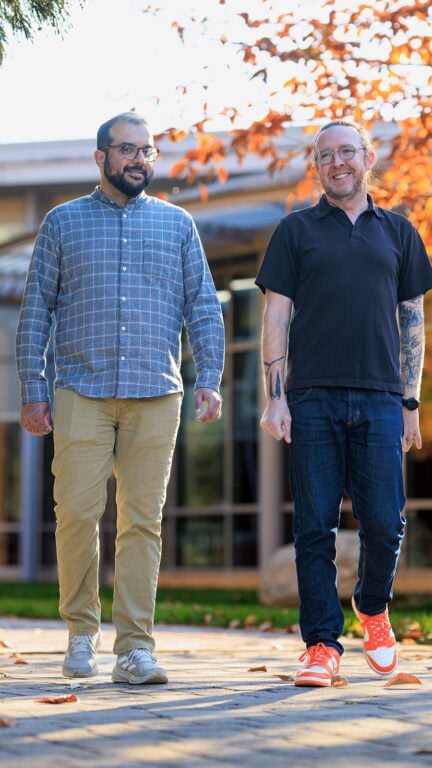
Fahad Sultan, assistant professor of computer science, and John Quinn, the Henry Keith and Ellen Hard Townes Professor of Biology, received a second award from the university to combine songbird research with AI tools.
Freeman, who spearheaded the application, brings deep experience in cellular biology, neurochemistry and a behavioral economics approach to understanding nutrition-related questions. Flores has expertise in using behavioral neuroscience to answer questions on how taste processing is affected by experience across the lifetime. Gilliland adds expertise in mass spectrometry, which can be used to measure molecules that affect brain chemistry.
The Ligler Award, Flores said, “is amazing,” noting that interdisciplinary science at liberal arts and sciences universities, like Furman, is rare. “It’s going to make Furman even more innovative,” Flores said. And students, she said, will be extremely competitive. “It’s going to make them better scientists in any way they use science in the future.”
Impressed by the high level of interest and the quality of submissions, Furman awarded a second $10,000 grant funded by the Office of Integrative Research in the Sciences to the team of Fahad Sultan, assistant professor of computer science, and John Quinn, the Henry Keith and Ellen Hard Townes Professor of Biology.
The Sultan-Quinn project was sparked by a former student, Caleigh Stivers ’25, who double-majored in biology and computer science and recognized the opportunity for research crossovers between her professors.
Quinn collects birdsong as a way to gauge the health of an ecosystem, from commercial farms to small acreage. He has terabytes of data, audio recordings of birds singing. By working with Sultan and his expertise in machine learning, the number of birds singing, and their species, can be identified more accurately.
Sean Rowland ’26 continued Stiver’s work over the summer and presented at the National Bobwhite and Grassland Initiative meeting at Clemson University.
“I was very excited” about the Ligler award and the newfound financing that enabled collaboration, Sultan said. “It’s good to know that such interdisciplinary work is being supported. It’s unfortunate that John and I didn’t start this work earlier. We were sitting in our own silos. A lot of research is spurred on by these grant applications. They get you thinking, who can I reach out to to partner on these grants.”
Indeed, the Liglers hope their award will enable faculty to create work that attracts larger grants and more opportunities.
With international reputations – they’re both members of the National Academy of Engineering, Fran is also an inductee of the National Inventors Hall of Fame and a fellow of several other professional organizations while George consults around the world – they could have made their gift anywhere. Why Furman?
“We love Furman,” said Fran, who is a past trustee of the university. Their son Adam Ligler, a physician in Charlotte, and daughter in law Dianna are 2005 graduates.
“I believe in the culture of Furman, the belief in the undergraduates, the building of individuals and the capability to do whatever they want to do,” Fran said.
“Furman,” said George, “prepares its students so that they can go anywhere.”