News from campus and beyond
CLP commemorates 60 years since Furman’s desegregation

Russell Gambrell ’79, left, joins a panel of alumni and current students during the 60th Anniversary of Furman’s Desegregation CLP in the Watkins Room of the Trone Student Center on Feb. 19, 2025.
Early one morning in his dorm room, surrounded by friends, Joseph Vaughn suddenly stopped a card game. “I have a term paper to write!”
“It must have been 2 o’clock in the morning,” Raymond McGee ‘71 said during a Cultural Life Program commemorating 60 years of desegregation at Furman University. “I asked him if he was serious. He said, ‘Yeah, in French!”
Laughter rolled through the CLP crowd as current students recognized their own shared experiences in this early-morning bonding moment between McGee and Vaughn, the first Black undergraduate student at Furman. Vaughn came to Furman in 1965, but Furman President Elizabeth Davis said just as important were the days and years after his arrival.
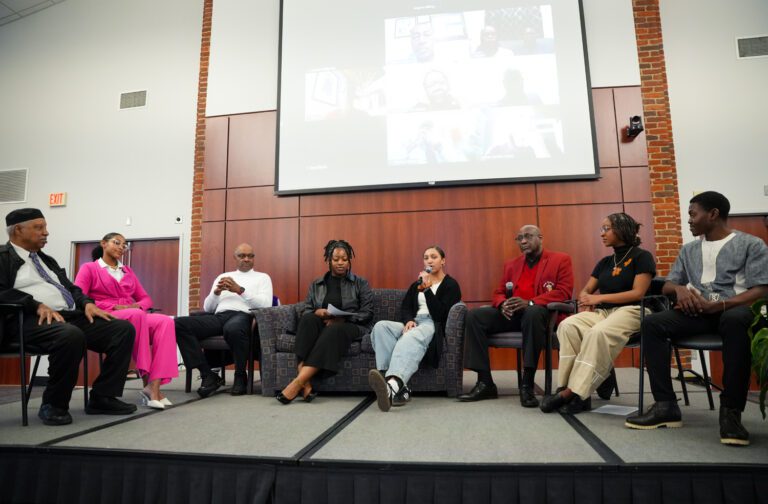
A panel of alumni and current students share their experiences during the 60th Anniversary of Furman’s Desegregation CLP in the Watkins Room of the Trone Student Center on Feb. 19, 2025.
“Joseph Vaughn came, he stayed, and he brought others with him,” she said.
The CLP featured a panel of seven in-person alumni and current students to talk about their experiences as Black students at Furman. They were joined by several more alumni who attended the discussion virtually.
“Joe Vaughn was vitally important,” said Cynthia King, associate dean for diversity, equity and inclusive excellence. But the CLP aimed to describe what Furman was like after he left.
Friendships and bonds helped many of the panelists through difficult experiences. Several panelists described moments when they were the only Black student in their environment, whether on or off campus.
Psychology major Jada Session ’25 grew up in a suburb of Atlanta surrounded by other Black people.
“Coming to Furman and walking into my first class to see I was the only Black student, it was shocking,” she said. But she found belonging and support when she joined Alpha Kappa Alpha, a sorority that’s part of the National Pan-Hellenic Council. “Having that outlet is one of the best experiences I could have. They’re going to be my sorority sisters for life, and Furman gave me that.”
In 1978, Russell Gambrell ’79 was captain of the Paladins football team for their first championship in Southern Conference history. His love for Furman runs so deep he still comes back for homecoming each year, he said. But amid the academic and athletic rigor, he said he kept his attention on the opportunities Furman afforded him to persevere through difficult times.
“We had to focus on the fact that we got to come here to Furman at all,” he said.
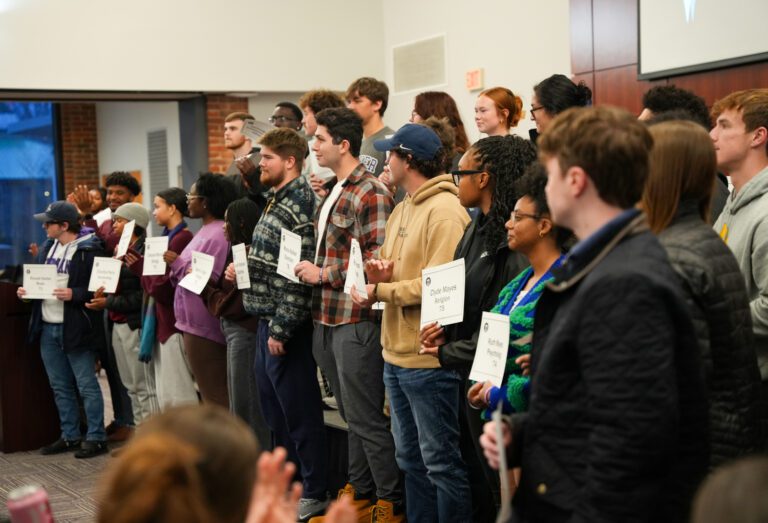
Furman students hold papers with the names of Black alumni during the 60th Anniversary of Furman’s Desegregation CLP in the Watkins Room of the Trone Student Center on Feb. 19, 2025.
When health sciences major Jennifer Woolrey ’25 studied abroad in Nepal for eight weeks through the Freeman Fellowship, she gained perspective on what it means to be a global citizen and share her experiences with people unlike herself. She told the crowd about catching a man staring at her in a café.
“He signaled at me to pull my headphones off and said, ‘I’m so sorry, I’ve been living here for 12 years, and I’ve never seen a Black person,’” she said. They’ve became fast friends, and she said even now she has a connection with the 50-year-old Nepalese farmer living almost 8,000 miles from Furman.
The CLP also honored Black alumni who broke barriers by being among the first Black students to graduate from their respective academic programs. Students from the audience were invited up to the stage to hold up printouts displaying the names and majors of these alumni who couldn’t attend the CLP.
“Students come to Furman not knowing their own potential. They come unsure about their own possibilities,” King said. “These stories and experiences, that’s part of Furman’s story. I hope this discussion gave students a sense of their shared history.”