

BY KEN KOLB, Ph.D.
Sociology
_

_
In the fall of 2022, Furman University had just released a comprehensive geographic analysis of all racially restrictive covenants embedded within property deeds in Greenville County[i]. That study found over 12,000 property deeds in Greenville County between 1900 and 1968 that contained racially restrictive covenants.
It was a very difficult undertaking. Student researchers and post-baccalaureate fellows at the Shi Institute for Sustainable Communities had painstakingly scanned every deed book in Greenville County, converted every page into machine readable text, and set about documenting any references to race they could find.
That project garnered a lot of positive press from local[ii] and statewide[iii] media outlets. However, it also made no mention of the fact that Alester G. Furman Jr., as head of The Furman Company, was one of the most prolific users of racially restrictive covenants in Greenville County during the 1940s. This was because I discovered it by chance about a month after we made the data public.
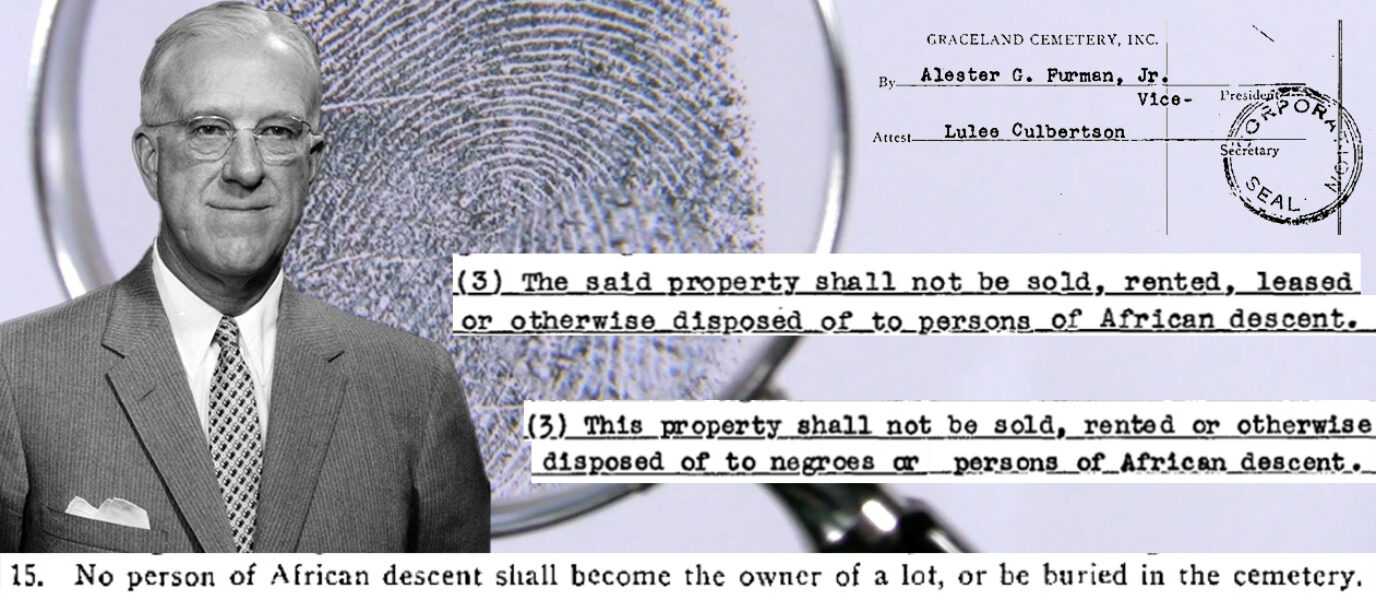
At the time, I was researching the history of the Judson Mill community and I found a since abandoned subdivision located where a parking lot now operates for Bon Secours Hospital. That document, deed number 191 in Greenville County deed book number 216 [link to Vol 216 – Deed 191], details the sale of a parcel of land in 1939 for $925. The seller is listed as “The Furman Investment Company.” [iv] The deed stipulates that the buyer must not establish any type of “mercantile establishment” on the property and also must agree to never sell, rent, or lease the property to anyone of “African descent.”
_

_
The deed lists Alester G. Furman, Jr. as the secretary of the company, but this does not reflect his actual role at the time.
According to page 23 of The Furman Company’s own account of its history, “Although his father remained listed on company stationery and in advertisements as senior partner until his death in 1962, Alester, Jr., became responsible for the company and heir to the Furman real estate legacy in 1932.”
Once I discovered this deed, I searched for more and found more. And then when I conducted more research into his work at The Furman Company during those decades, I found many, many more with similar language written by the company under his leadership. At that point I knew I had to do something. [See this essay]

Alester G. Furman, Jr. is one of Furman University’s most cherished former leaders. As most people familiar with the university know: he was the chair of the board of trustees when the campus left downtown and moved to its current location. During the course of this project, I came to learn that for a time the university was also his client.
As head of the The Furman Company, he not only helped execute the land deal for the new campus, he also developed the downtown land of the old campus into a retail mall. Furman University enjoyed the rental proceeds of that land for years until his company ultimately brokered its sale on the university’s behalf.
Because of all of his work and all he had given to the university (his family donated the iconic campus Bell Tower), the administration building on campus is named after him today, as is a major faculty award for teaching excellence. A statue of him is also located just outside the admissions building.
Yet, despite all of the ways Furman University has benefited from Alester G. Furman, Jr.’s generosity and leadership, his use of racially restrictive covenants needed to be investigated with diligence and care.
In 2019, the university had released an extensive report detail the institution’s relationship with the practice of slavery entitled, Seeking Abraham: A Report from Furman University’s Task Force on Slavery and Justice. In it, the university declared its commitment to “do the work” of reconciling past injustices.
_

Sadly, the discovery of racially restrictive covenants authored directly by, or under the direction of, a former chair of the university’s board of trustees, meant that there was more work to be done.
Documenting the full extent of The Furman Company’s use of racially restrictive covenants while Alester G. Furman, Jr. was its leader was a lengthy project. On my own, I was able to identify 72 deeds with racist covenants on them with his name on them. These were notarized documents filed in the Greenville County office of the Register of Deeds.
Verifying the connection to the remaining 1,166 deeds required more work. The first clue came when I found deeds of textile mill villages that did not contain Alester G. Furman, Jr.’s name, but did contain the names of individuals who appeared alongside his name on other deeds. After conducting research into The Furman Company, I came to learn that a number of textile mills had hired Alester G. Furman, Jr.’s company to handle the sales of their mill village properties during that time. [For more on The Furman Company, see Jeffrey Makala’s essay]
I soon came to learn that Alester G. Furman, Jr. and his company expanded the business by using RRCs to help sell property. Much of this information came from the company’s own historical account. It stated: “Starting in 1939, however, and continuing well into the 1960s, the Alester G. Furman Company earned most of its substantial profits and a wider regional reputation by working with textile companies to sell off their houses” (see page 36).
This was the business model that enabled The Furman Company grow and it ultimately transformed the local economy by helping mill villages transition from renter to owner-occupied. Coming out of the depression, the Furman Company had suffered like all other businesses. Yet, under Alester G. Furman, Jr’s direction, it recovered. And then it thrived. And all this was enabled, in part, by the use of racially restrictive covenants. [For more on how racially restrictive covenants operate as a real estate development strategy, see my essay, “What are RRCs and Why Do They Matter?”]
Initially, textile mills in the area were wary of selling the properties in their mill villages. Textile mill villages are a classic example of the relationship between housing and jobs. Businesses need employees and employees need housing. Because there wasn’t enough, the mills originally built their own homes and rented them to employees. This brought extra income for companies, but also saddled the mills with depreciating assets over time.
Over time, as the mill village housing stock aged, the idea of selling them off became more attractive because it could bring in an infusion of capital to modernize mill machinery. But mill management was in the business of making textiles, not selling profits. They would need help.
Judson Mill was the first in Greenville County to ask the Furman Company to sell off their housing for them. It was in an RRC for a Judson Mill property deed from September 1st, 1939[v] that I found the first instance of language which was slightly different than other deeds with Alester G. Furman, Jr’s name on them, but would become sadly familiar throughout the rest of my search and appear on nearly a thousand other deeds:
_

“That the lot above shall not be sold, leased, or released to any negro or person of negro blood”
What I came to find is that The Furman Company turned the selling of mill village housing into an efficient and streamlined process for white homebuyers. The company mapped the streets, surveyed the lots, assessed their value, set up a storefront near the mill, opened their doors, and invited white mill workers to join the ranks of American homeowners. [For more on the racial segregation of textile mills in Greenville County, see this article.]
In total, a student researcher (Isaac Lewis) helped me track down 1238 RRCs connected to the Furman Company when it was under Alester G. Furman, Jr.’s leadership. And keep in mind, this is just for Greenville County. The Furman Company later worked with the JP Stevens company to sell mill village properties throughout the southeast. There may be more, but we do not have them in our possession, so we do not include them in our count.
_
So how can we know for certain that 1238 RRCs are connected to Alester G. Furman, Jr.?
_
First, as stated above, 72 of them feature his name on the document. With his father he developed a small subdivision in downtown Greenville [see Vol 216 – Deed 191] as well as an all-white cemetery (Graceland) [see Vol 289 – Deed 7]. Both had RRCs embedded in the deeds. In the instance of the cemetery, the deeds for the burial plots.
Second, we found RRCs in deeds of textile mill villages in Greenville County that The Furman Company’s own historical accounts acknowledge that they sold at the request of the mill owners at that time (Judson Mill, Monaghan Mill, Slater Mill, and Dunean Mill).[vi]
Third, we cross referenced the names on the deeds with RRCs for mill village properties known to have been sold by the Furman Company under his leadership to identify the known associates of Alester G. Furman, Jr. When his name appeared with three other people on one Judson Mill deed, and then those three other people appeared on another Judson Mill deed without his name, we included it in the sample.
Fourth, we conducted a forensic analysis of the syntax of RRCs across thousands of deeds. Starting in 1939, the Furman Company adopted very specific racial language it would use for the next 13 years. This language is as follows: “That the lot above shall not be sold, leased, or released to any negro or person of negro blood.” This exact language in this precise order can be found deeds written by the Furman Company in 1939 all the way up to 1952.

In summary, finding 1238 racially restrictive covenants directly connected to Alester G. Furman, Jr., either with his name on them or written by The Furman Company under his leadership, was a difficult and painful process. Not simply because poring over PDFs for months became a monotonous task, but because of the repeated exposure to the language within them. These documents represented standard real estate practice at the time, no matter how much they make us wince today. They are a part of our country’s past, and they are a part of Furman University’s past as well. Grappling with that past must begin with the facts, and the effort we put forth to document these deeds shows our commitment to the truth, no matter where it leads us.
ENDNOTES
_
_
[i] https://storymaps.arcgis.com/stories/ba7d720f0907475db068cb159cb71f78
[v] See Vol 214 – Deed 137
[vi] An additional business, McCall Manufacturing, had a housing village with properties managed by the Furman Company, evidence of that relationship can be found in Alester G. Furman Jr.’s archives at Clemson University
Legal Battle Over Downtown Campus Property

