

BY KEN KOLB, Ph.D.
Sociology
_

_
Let me begin by saying that Furman University’s campus is beautiful. I have invested my entire professional life into this institution and I do not take the task of uncovering painful truths lightly. I have taught at this university for 17 years. I’ve walked around its lake hundreds of times. My daughter learned how to ride a bicycle on the quad just outside my office.
Two years ago, I discovered a racially restrictive covenant (RRC) written by a former chair of Furman’s board of Trustees.
RRCs are clauses written into property deeds that prevent non-white people from buying property.
The former board chair was a real estate developer and the document I found was evidence that his company was in the business of creating exclusively white neighborhoods in the 1940s.
When I found the deed with his name on it and the racist contractual language inserted at the end of it. I was not entirely surprised. I knew RRCs were a common real estate tactic at the time. But despite my familiarity with the topic, this document produced more questions than answers.
Every story I had ever read about the university during this time frame included references to this person’s guidance and vision. Yet, as I read the words on the 1939 deed on my computer, I knew the history was more complex and nuanced than I had previously assumed.
Alester G. Furman, Jr. is, to this day, one of Furman University’s most revered leaders. He was the chair of the Board of Trustees at a time when it made one of its most important decisions in the University’s modern history: relocating its campus from downtown to just north of the city of Greenville. He helped acquire the land for the new campus and brokered the sale of the property where the old campus once stood.
To acknowledge Alester G. Furman, Jr.’s many contributions to Furman University, there is a building named after him as well as a major faculty award. There is also a statue of him outside of our admissions building. His image is the first that many prospective students see when they visit our campus.
“Ultimately, I would find 1238 RRCs inserted into deeds by The Furman Company while Alester G. Furman, Jr. was running the company.”
_
_
I am a sociologist by training, not a historian, and although I do have expertise on the relationship between housing policy and racial inequality, I had other things on my plate. When I found the first deed with his name on it, I did not know what to do. This was in the fall of 2022 and I was well into the research process for my next book. I was not eager to take on a new project about racist real estate practices of the past.
I asked some trusted colleagues if they might consider unraveling the threads of my initial finding to learn the full scope and extent of what I had found. Ultimately, I would find 1238 RRCs inserted into deeds by The Furman Company while Alester G. Furman, Jr. was running the company. I had to do something about this information, but I did not want to release the documents I found without context, either.
The language on these deeds in my possession was stark. It was racism in black and white. But I knew the story was bigger than just one piece of paper, so I looked again for someone to find all the evidence, good and bad, and tell the entire story. However, this was not so easy.
Racially restrictive covenants written over a half century ago are hard to find, hard to decipher, and hard to put into the appropriate context. As I tried to recruit another scholar to take over this project for me, I could not find anyone willing to take on something of this complexity.
So I decided that if I couldn’t find someone else to do the work on their own, I would ask others to share the burden with me. I first approached Dr. Kaniqua Robinson. One of the racially restrictive covenants I had found connected to Alester G. Furman, Jr. was in a batch of deeds to burial plots in Graceland Cemetery. Graceland sits adjacent to Freetown, the first community in Greenville County that allowed Black families to buy homes.
Dr. Robinson is an anthropologist with expertise in race, death, and dying in America; there are few scholars with expertise necessary to analyze the context surrounding racially restrictive covenants and cemeteries. I approached Dr. Robinson for help and she agreed to co-chair an organizing committee for this project.
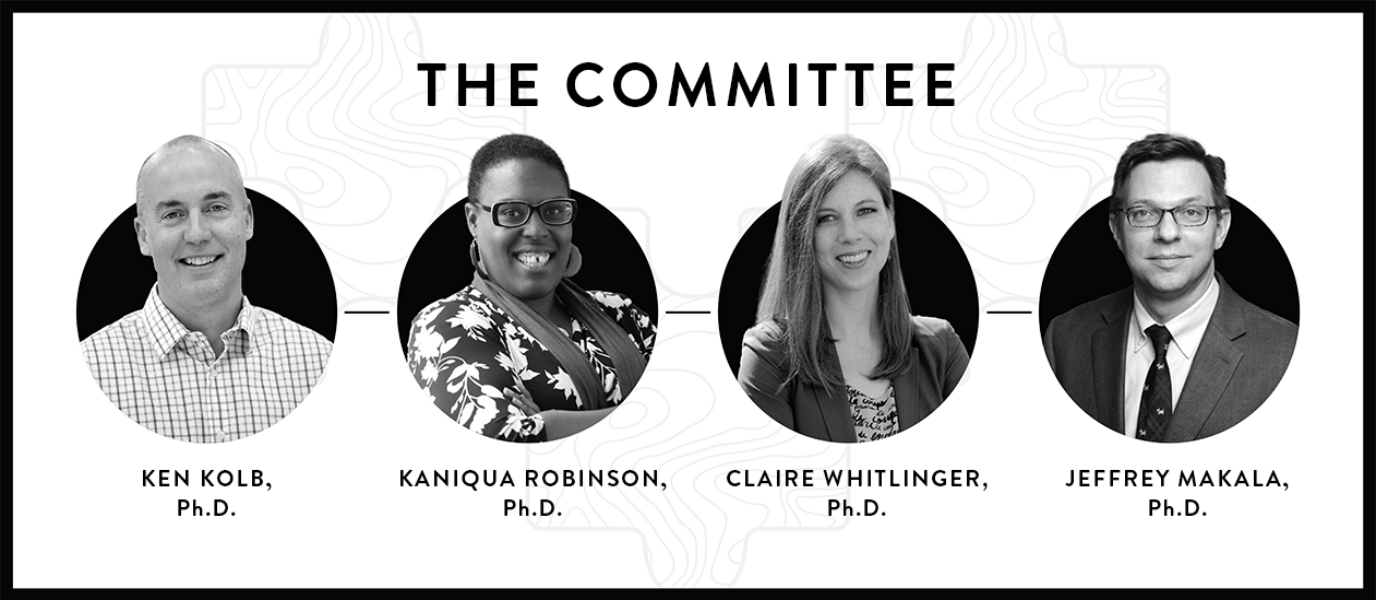
Later, we would fully staff the committee by inviting Dr. Claire Whitlinger—a sociologist specializing in collective memory—and Dr. Jeffrey Makala, Furman University’s official archivist. Together, the four of us recruited the other faculty whose essays are featured on this site.
Our job, if we did it correctly, was not to debunk past accounts of Furman University’s history and replace them with our own. Instead, we set out to add new information to one small chapter: the story of how and why Furman University chose to leave downtown and move to its current location.
“In this project, we include the good and the bad…[it’s] a story about connecting business practices of the past to racial inequalities that persist today.”
_
_
Placing Furman is not meant to replace the most popular version of why we moved. We simply found more information that needed to be shared. Some of what we discoverd was painful, but not all.
As stated above, in this project, we include the good and the bad. Put together, we learned that Furman’s move away from downtown was about more than just debates over classroom space: it was a story about real estate in America; it was a story about racial demographic shifts in cities and suburbs in the post WWII era; and most importantly, it was a story about connecting business practices of the past to racial inequalities that persist today.
_
What are Racially Restrictive Covenants and Why do they Matter?

