

_
BY KEN KOLB, Ph.D.
Sociology
_
Racially restrictive covenants (RRCs) were tools of residential segregation, most popular in America in the 1930s and 40s. While many people are familiar with the term “redlining,” that strategy was different.[i]
RRCs achieved the same general outcome, but in a different way. In Greenville County, where Furman University is located, RRCs were contractual agreements that white property owners used to prevent Black people from moving into white neighborhoods.[ii]
RRCs worked like this: A (white) seller offered to sell property to a (white) buyer contingent upon the buyer’s promise that if they ever decided to sell or rent it, they would only do so with another white family. In many ways, RRCs operated like home owners association (HOA) agreements do today.
In theory, HOA agreements today are meant to increase the value of all the property in a neighborhood by requiring every household do their part to maintain appearances (i.e., mow the lawn, keep up with repairs, etc.). HOA agreements often have a bad reputation because the requirements seem arbitrary and overly detailed.
But at their core, HOA agreements are designed to maintain or increase the value of everyone’s home in the community. This is a key takeaway: HOAs are designed to help families build wealth.
In the case of RRCs, entering into this promise meant agreeing to more than paint colors or parking regulations. RRCs were more insidious. RRCs required buyers to promise to keep the neighborhood white. RRCs were essentially racist HOA agreements and they were meant to help white families build wealth while also preventing Black families from doing the same.
For homebuyers, if you were white and wanted to live in the neighborhood, you had to uphold the pact. It was a racial conspiracy hiding in plain sight and one of the primary causes of the racial wealth gap in the US today.
For real estate developers, RRCs were a business strategy that exploited the racial prejudices of potential white homebuyers. Remember, developers don’t just sell subdivision lots in a vacuum, they sell the idea of what it would be like to live in a particular community.
Because every deed in the entire development had the same racial clause, developers could guarantee white families that their neighbors and their neighbors’ neighbors would always be white. That was part of the sales pitch. Developers profited off of RRCs through commissions on sales of subdivision lots.
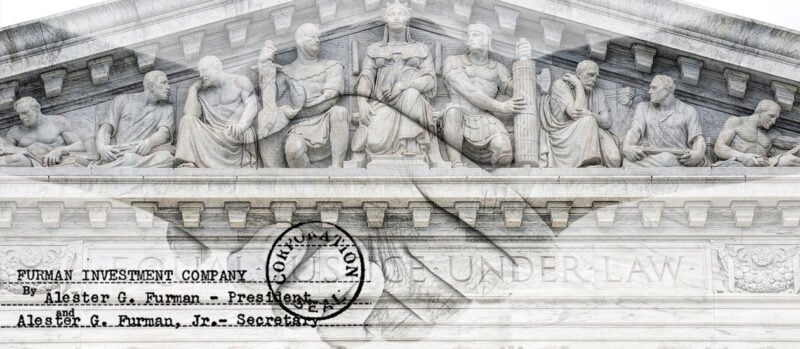
Ultimately, in the 1948 Supreme Court Case Shelley v. Kraemer, the justices found that RRCs violated the fourteenth amendment to the constitution, the Equal Protection Clause. However, this did not make RRCs illegal, just “unenforceable.”
That is, white owners could still choose to sell their property to only white buyers. And white buyers could still promise to never resell (or lease) that property to Black buyers (or renters). But if a white buyer were ever to change their mind, the person who sold them the property would no longer have grounds to sue them for breaking their covenant.

This distinction between illegal and unenforceable is important because the 1948 Supreme Court ruling didn’t immediately stop people from writing RRCs into deeds.
In our investigation of Alester G. Furman Jr.’s archives at Clemson University, we found boilerplate deed language authored by The Furman Company with RRCs dating as late as 1952. It wasn’t until the Fair Housing Act of 1968 that it became illegal to insert any type of RRCs into a deed.
Today, residential segregation is still a feature of American life, but no longer requires racist practices like redlining or RRCs[iii]. Now, residential segregation is achieved through economic means which are not illegal. The wealthiest can live wherever they choose.
However, the differing economic circumstance of average white and Black households in America is a direct result of racist real estate practices of the past. Redlining and RRCs essentially prevented Black families from building wealth through homeownership on equal terms with white families until 1968.
The effects of redlining and RRCs are still evident today.

“This is what makes residential racial segregation today so ironic: it is now an explicitly legal phenomenon based on price even though its primary cause (the racial wealth gap) is a product of the now-illegal real estate tactics of the past.”
_
In 2025, the median white household has six times more wealth than the median Black household.[iv] This means that while the average Black family (in terms of wealth) is legally allowed to live anywhere they want, the most expensive places to live in this country are still predominately white neighborhoods, making it harder to move in.
The irony of residential segregation today is that it is now also happening in reverse. Wealthy white households are moving back into urban centers they fled from in the 70s and 80s. And while this racial integration appears laudable on the surface, it also is increasing property values in historically Black communities.
When you combine rising rents with America’s racial wealth gap, you risk displacing Black residents from communities that once were the only places where they were allowed to live during the days of redlining and RRCs.
In America, home ownership is the path to accumulating generational wealth. For white families after WWII, home ownership was encouraged and even subsidized by the federal government.[v]
For Black families during that time, home ownership was either forbidden via RRCs or denied by banks who deemed mortgages in non-white neighborhoods to be a bad investment.
The Supreme Court in 1948 and Congress in 1968 put an end to these practices, but their economic legacy is still felt today. This is what makes residential racial segregation today so ironic: it is now an explicitly legal phenomenon based on price even though its primary cause (the racial wealth gap) is a product of the now-illegal real estate tactics of the past.
For more on the role that RRCs of the past play in debates surrounding gentrification today, see this essay on the racial displacement occurring in the Judson Mill community today.
ENDNOTES
_
[i] Redlining referred to the practice of banks who refused to offer mortgages to people who wanted to buy homes in neighborhoods that were deemed poor investments by the federal Home Owners’ Loan Corporation. And when it came to deciding whether any given neighborhood merited investment, federal bureaucrats looked to their existing racial composition. Too many non-white residents in a community and these financial analysts would draw a red line on the map around it. Hence the term, “redlining.” This designation effectively made it impossible to invest in and improve Black neighborhoods.
[ii] In our research identifying all Racially Restrictive Covenants in Greenville County, we found prohibitions against the sale or lease of property to other non-white racial groups, but Black residents represented over 95% of the sample.
[iv] https://www.brookings.edu/articles/black-wealth-is-increasing-but-so-is-the-racial-wealth-gap/
How the Furman Company Grew by Selling Mill Village Housing

