Interview with Eric Kaufmann on Populism, Universities, and the Future of Democracy
About Dr. Eric Kaufmann
Eric Kaufmann Eric Kaufmann is Professor of Politics at The University of Buckingham and Director of the Centre for Heterodox Social Science. Previously, he was a Lecturer at the University of Southampton and a Lecturer and Professor at Birkbeck, University of London. He was also a stipendiary Fellow at the Kennedy School of Government, Harvard University. In addition, he is affiliated with the Manhattan Institute, Policy Exchange, the Center for the Study of Partisanship and Ideology, and the Macdonald-Laurier Institute. Kaufmann earned his BA at the University of Western Ontario, in his native Canada. He received his MA and PhD from the London School of Economics. Kaufmann has published extensively in professional journals but is also found frequently in the pages of The New York Times, The Wall Street Journal, The Financial Times, and many others. He has published many books including Shall the Religious Inherit the Earth?: Demography and Politics in the Twenty-First Century (2010); Whiteshift: Immigration, Populism and the Future of White Majorities (2019); and The Third Awokening: A 12-Point Plan for Rolling Back Progressive Extremism (2024). His most recent book is Taboo: How Making Race Sacred Produced a Cultural Revolution (2024). Dr. Kaufmann recently spoke at the Tocqueville Center’s “Populism in America” lecture series.
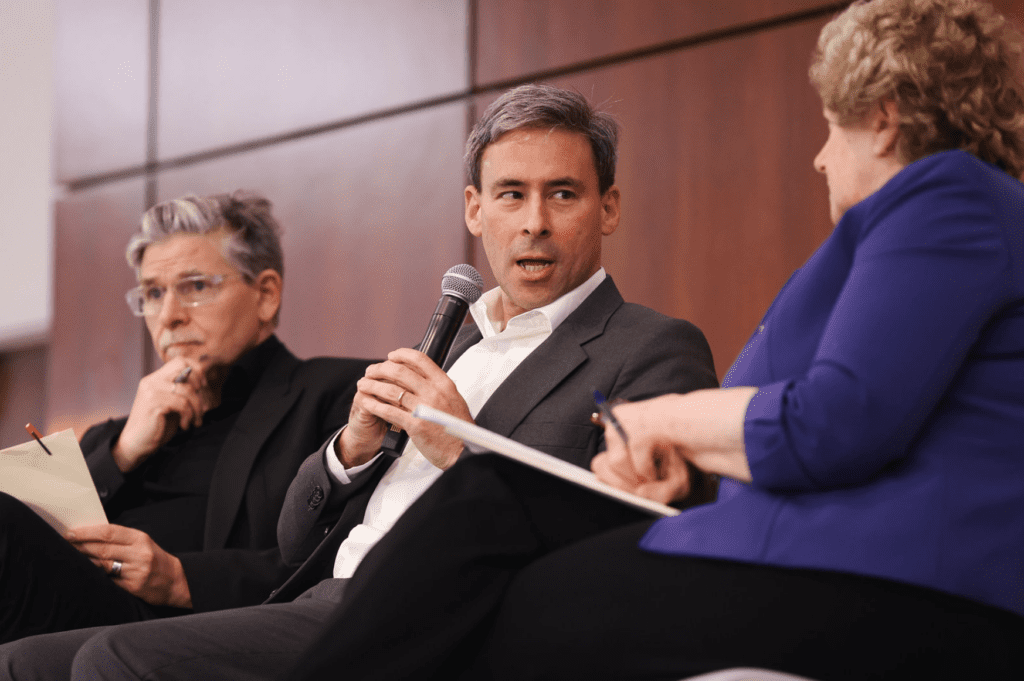
Eric Kaufmann (center), Pippa Norris (right), and Jan-Werner Müller (left) discuss the future of populism at the Tocqueville Center’s Populism in America event.
Populism and Liberal Arts Campuses: Cultural Issues Take Center Stage
Q: In the context of liberal arts colleges and the rise of populism, what trends are you seeing?
Eric Kaufmann:
The first commonality is cultural issues. Topics like DEI (Diversity, Equity, and Inclusion) and free speech—these are cultural issues now entering electoral politics. For example, in the 2024 election, the trans issue featured heavily in ads and may have influenced results at the margins.
You can see the Trump administration paying a lot more attention to universities now—fining or withholding funds from places like Columbia and Harvard. Trust in universities has collapsed among Republicans—from about 55% in 2015 to 20% today.
This drop in trust is not just among Republicans but also among independents. I understand where that sentiment is coming from. It’s not unreasonable.
However, while universities do face real issues, some government responses have been excessive. Ideally, solutions would come from within universities, but I believe external government intervention is probably necessary. Universities are not going to reform on their own.
“Trust in universities has collapsed among Republicans—from about 55% in 2015 to 20% today.”
Government Intervention and Political Monoculture on Campus
Q: What kind of government intervention would you support?
There are two main concerns:
-
Restrictions on speech
-
The political monoculture in academia
Among Ivy League faculty, the political donation ratio is around 98% Democrat to 2% Republican. Even among less politically active faculty, the imbalance is profound. This creates a campus atmosphere far removed from the political median.
Universities made explicit political statements after George Floyd and Black Lives Matter, clearly aligning with the cultural left. Yet they expect taxpayers—across the political spectrum—to fund research grants, student loans, and operations. Universities leaned into partisanship rather than pushing back against it.
Conservative academics report a hostile climate:
- 70–75% feel hostility toward their beliefs
- 50–70% admit to self-censorship
Universities, unlike journalism outlets like The New York Times or The Washington Post, did not seriously attempt to balance perspectives. They only began modest reforms under political pressure.
“Universities leaned into partisanship rather than pushing back against it.”
Funding, Free Speech, and the Role of Government

Q: Should the government withdraw funding when political bias is extreme?
Yes, but there’s a clear distinction.
Governments are justified in choosing not to fund certain academic programs or initiatives based on extreme political bias. However, it would be wrong for the government to directly ban teaching particular ideas.
For example, banning Critical Race Theory would violate free speech principles. However, choosing not to fund radical DEI programs is legitimate. Universities cannot claim a right to unlimited public funding while refusing to maintain intellectual diversity.
Universities already accept many forms of regulation (e.g., Title IX), so it’s consistent for public funding to come with expectations. The Higher Education and Academic Freedom Act in Britain, which I supported, makes this principle clear: universities cannot simply censor dissenting views at will.
“Universities cannot claim a right to unlimited public funding while refusing to maintain intellectual diversity.”
Populism Across Canada, Britain, and the United States
Q: Turning to international politics, how would you describe the current populist landscape across Western democracies?
The common denominator is immigration and the ethnic and cultural shifts it brings. People react differently based on psychological traits—some see change as exciting, others see it as loss. These dispositions are partly heritable and now deeply shaping political identities.
In all three countries—Canada, Britain, and the United States—the culture war dynamic is largely derivative of immigration debates:
- In Canada, immigration has been a major factor in Trudeau’s decline.
- In Britain, immigration remains central to political realignment.
- In the U.S., immigration underpins both Republican populism and Democratic cultural liberalism.
Unless mainstream parties address immigration seriously, populist, anti-elite movements will continue to grow. In Canada, political sorting is increasingly mirroring U.S. patterns, solidifying around Liberal/NDP versus Conservative/PPC blocs. Britain shows a similar Tory-Reform versus Labour-Lib Dem split.
Populism is not going away. Without major shifts in immigration policy from mainstream parties, populist right appeals will remain strong.
“Unless mainstream parties address immigration seriously, populist, anti-elite movements will continue to grow.”
Conclusion
In this conversation, Dr. Eric Kaufmann highlights how cultural conflict, declining trust in institutions, and demographic shifts are reshaping politics and higher education alike. Universities, he argues, must confront their own political monocultures if they are to regain public trust—and societies must grapple with immigration and identity if they hope to resolve the deeper forces driving populism.
“The status quo is not tenable. Reform must happen—with respect for law and civil norms, but with urgency.”
— Eric Kaufmann