Summary of Furman University’s Baptist Heritage and Baptists in American Life
Two Tocqueville Center Homecoming events explored Furman’s Baptist history and the influence of Baptists on American religion, politics, and culture.
Watch the Event Recordings
Furman University’s Baptist Heritage — October 21, 2026
Baptists in American Life — October 22, 2026
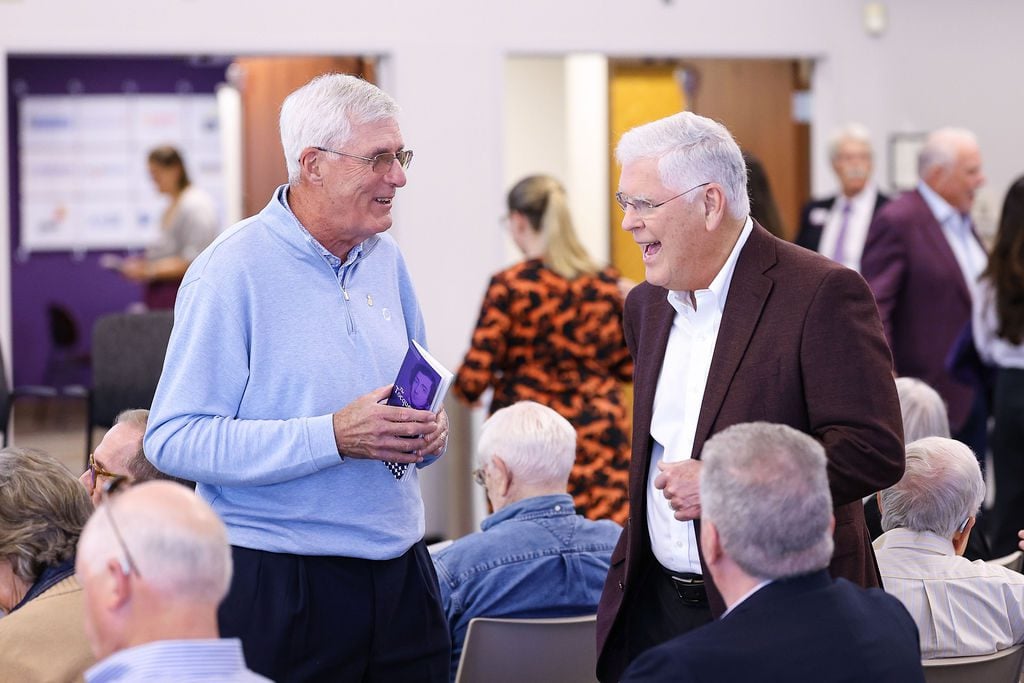
Guests mingle before the Baptist Heritage program. Photo by Jeremy Fleming.
For 166 years, Furman University was affiliated with the South Carolina Baptist Convention. That relationship shaped the university’s academic life, student culture, and institutional identity. Its end in 1992 remains one of the most consequential moments in Furman’s history.
As part of Furman’s bicentennial Homecoming celebration, the Tocqueville Center for the Study of Democracy and Society hosted two events on October 21 and 22, 2026. The first revisited Furman’s Baptist heritage and its separation from the South Carolina Baptist Convention. The second examined the place of Baptists in American life, from questions of religious authority to the increasingly complicated relationship between Christianity and politics.
Both evenings featured lively exchanges, surprising personal stories, and disagreements about the meaning and future of the Baptist tradition.
Furman University’s Baptist Heritage: A Complicated Inheritance

Furman students at “Baptists in American Life,” October 22, 2026. Photo by Jeremy Fleming.
“Since no one else seemed willing to talk about the school as a religious project, we decided to boldly go where no respectable Furmanite dared to go by uttering the B word.”
With that introduction, Tocqueville Center Director Brent Nelsen opened an unusually candid examination of Furman’s Baptist past.
Every participant in the October 21 panel had firsthand experience of Furman under the South Carolina Baptist Convention (SCBC), the events surrounding its separation in 1992, or both. Their recollections offered a sometimes humorous, sometimes pointed account of a university whose Baptist inheritance remains more complicated than the familiar story of institutional independence might suggest.
Courtney Tollison ’99, Furman’s Distinguished University Public Historian and Scholar and author of Furman University: A Bicentennial History, 1826–2026, moderated the discussion. The panel featured James L. Guth, William R. Kenan, Jr. Professor of Politics and International Affairs; Helen Lee Turner, Professor of Religion; and Danielle Vinson ’89, Professor of Politics and International Affairs.
They were joined by R. O’Neil Rabon, Jr. ’81, an attorney involved in the alumni effort to secure Furman’s independence; Jeff Rogers, pastor of Ridgeland Drive Baptist Church and former Furman religion professor; and Robert D. “Bob” Shrum, retired pastor of Oakland Baptist Church, who represented the SCBC in negotiations surrounding the university’s separation.
Tollison began by reminding the audience that Baptist identity had never been uniform. Furman had long occupied an uncomfortable position within the denomination.
“Furman was both the black sheep of the SCBC and its crown jewel.”
She recalled a 1955 pamphlet denouncing the university as South Carolina Baptists’ Delinquent Child. Disagreements over theology, dancing, fraternities, student conduct, and civil rights had repeatedly tested the relationship.
Vinson, who attended Furman during the final years of its Baptist affiliation, offered an entertaining account of student life. Although fraternities and sororities were officially absent, students belonged to social clubs that looked remarkably similar. As sports editor of The Paladin, she recalled being instructed not to use Greek letters in headlines, lest readers discover what everyone on campus already knew.
The campus was officially dry, although its actual practices were considerably more flexible.
“We had a damp campus,” Vinson recalled.
She also remembered the Baptist Student Union as the center of her campus community and described the political and theological divisions that emerged among its student leaders during the denominational controversies of the 1980s.
The Baptist influence extended beyond campus rules. Religion courses introduced students to scholarly approaches to Scripture, while chapel and its successor programs encouraged reflection on moral and religious questions.
Was Furman’s Separation Necessary—or a Loss?
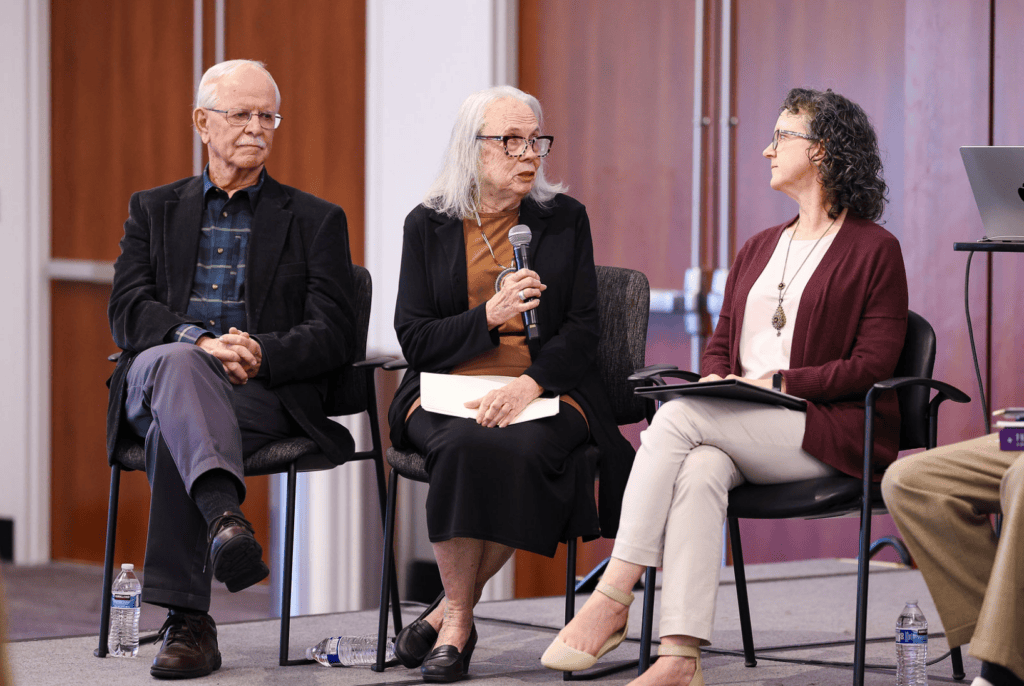
From left: James L. Guth, Helen Lee Turner, and Danielle Vinson participate in the Tocqueville Center’s Furman University’s Baptist Heritage panel discussion on October 21, 2026.
The panel’s most compelling exchanges concerned what Furman gained and lost when it separated from the SCBC.
Turner, an ordained Baptist minister who joined Furman’s faculty in the early 1980s, offered a striking argument: the university’s separation had been necessary precisely because of its Baptist heritage.
She recalled the distinguished Baptist scholars who had taught at Furman, including faculty members active in civil rights and other reform movements. In her account, the denomination’s increasing theological rigidity threatened a tradition that had once encouraged freedom of conscience and independent inquiry.
“A break was necessary to protect our Baptist heritage, not to flee from it.”
— Helen Lee Turner
Turner emphasized the Baptist traditions of religious liberty, congregational independence, and an educated laity. But she also questioned whether Furman had subsequently distanced itself too thoroughly from its religious past.
“Furman’s Baptist heritage is not something to bury on our website, nor something to keep disparaging,” she argued.
Guth agreed that the separation had become unavoidable but offered a more complicated judgment.
“It was necessary, it was probably inevitable, and it was unfortunate all at the same time.”
— James L. Guth
The threat to academic freedom made the break necessary, Guth explained, while broader trends in American higher education made it increasingly difficult for Protestant institutions to combine religious identity with academic excellence.
But Guth also suggested that Furman had lost something important.
The denominational connection brought students from a wider range of socioeconomic backgrounds and provided an intellectual counterweight to prevailing academic orthodoxies. Without it, he argued, the university faced new challenges in sustaining genuine diversity of opinion.
Guth explicitly connected these concerns to the Tocqueville Center’s mission of encouraging intellectual disagreement and serious engagement with competing philosophical, political, and religious perspectives.
The exchange complicated any simple division between religious authority and academic freedom. Turner and Guth agreed that the university had needed independence, yet both questioned whether Furman had sufficiently preserved the best elements of its Baptist inheritance.
Inside the Battle for Furman’s Independence
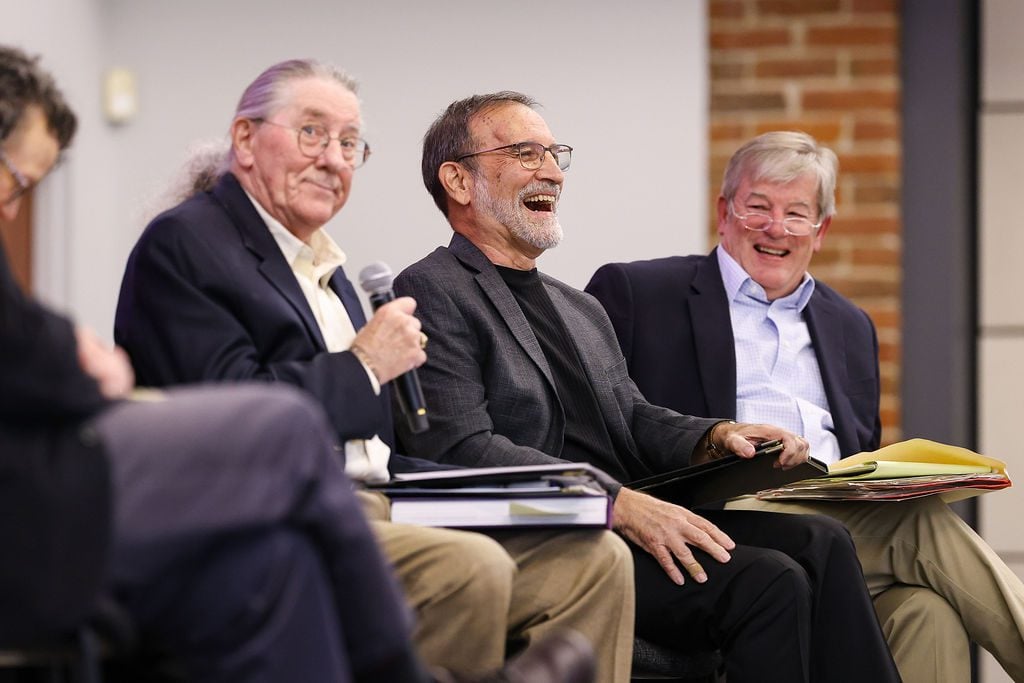
From left: Bob Shrum, Jeff Rogers, and Neil Rabon (Furman ’81) during the Baptist Heritage panel. Photo by Jeremy Fleming.
The second portion of the October 21 program brought the audience closer to the events that ended Furman’s formal denominational affiliation.
Rogers described the conflicts within the Southern Baptist Convention during the 1980s, when disputes over biblical interpretation and institutional authority increasingly affected Baptist colleges and seminaries.
He recalled interviewing at two Baptist universities in 1988. At one, a professor warned him that faculty had to consider whether their teaching might offend influential Baptist families.
At Furman, President John Johns gave a dramatically different answer.
“If you come here, you teach what you know and we’ll take care of the rest.”
— John Johns, recalled by Jeff Rogers
The contrast captured what Rogers believed was at stake. Changes in the convention’s trustee nomination process threatened to place academic decisions under greater denominational control.
In 1988, three of the five newly elected Furman trustees came from outside the university’s recommended list. Rogers recalled that one was so unfamiliar with the institution that he called the president’s office to ask where Furman was located.
Rabon then recounted the alumni-led effort to protect Furman’s independence.
He helped organize a task force that included attorneys charged with finding a legal solution to the governance crisis. Their solution rested on a straightforward legal argument: Furman’s trustees could not permanently surrender their authority to determine the composition of their own board. Although a charter amendment in the 1950s had given the South Carolina Baptist Convention control over trustee elections, the attorneys maintained that this fundamental corporate power could not be irrevocably transferred to an outside body. Even if it could be delegated, the trustees retained the right to reclaim it.
Acting on that argument, Furman’s board voted in October 1990 to amend its charter and establish a self-perpetuating board, securing control over its own governance.
The stakes were enormous. Rabon remembered Johns warning the group:
“If you’re going to shoot at the king, you better kill him.”
Shrum, who served as a principal mediator and negotiator for the SCBC, offered a perspective from the other side of the negotiations.
He recalled the growing influence of fundamentalist factions within the Southern Baptist Convention and the difficulty of finding a settlement that would satisfy both the university and the denomination.
His account underscored the personal dimensions of the dispute. Those involved were not simply representatives of competing institutions but people with longstanding commitments to Furman, Baptist churches, and religious education.
The speakers’ recollections revealed the complexity of Furman’s separation: a struggle over governance and academic freedom that also raised difficult questions about the university’s relationship to the religious tradition that had sustained it.
Baptists in American Life: A Historian’s Unexpected Conversion
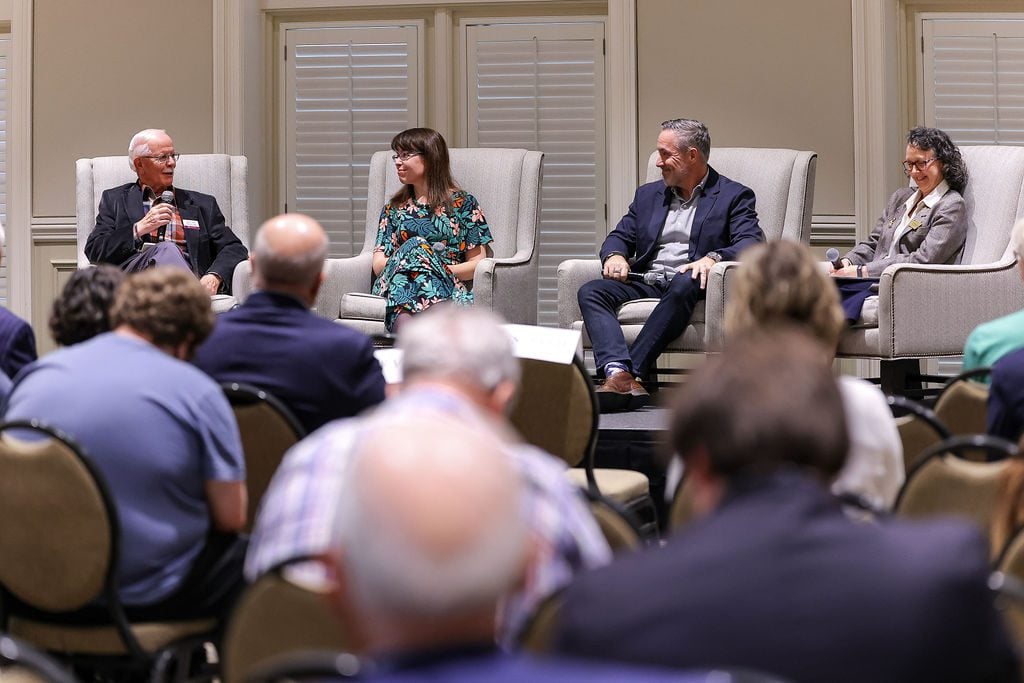
Baptists in American Life conversation at Furman Homecoming. Photo by Jeremy Fleming.
The following evening, October 22, the Tocqueville Center turned from Furman’s institutional history to the broader influence of Baptists on American society.
Molly Worthen, Professor of History at the University of North Carolina at Chapel Hill and author of Apostles of Reason: The Crisis of Authority in American Evangelicalism and Spellbound: How Charisma Shaped American History from the Puritans to Donald Trump, joined JD Greear, pastor of The Summit Church in Raleigh-Durham and former president of the Southern Baptist Convention.
Furman professors Danielle Vinson and James L. Guth moderated the conversation.
The evening began with Worthen’s remarkable account of her conversion to Christianity.
Raised in a secular household, Worthen had built a scholarly career studying American religious history without accepting Christianity’s central claims. Her relationship with Greear began through a journalistic assignment about The Summit Church, but their conversations developed into a sustained examination of religious belief.
Worthen described how dissatisfaction with certain assumptions of secular intellectual life led her to reconsider questions she had previously set aside.
“My church was the university.”
— Molly Worthen
She explained that she had regarded the university as a community devoted to the pursuit of Enlightenment ideals. But the politicization of higher education and the narrowing of intellectual inquiry had begun to disillusion her.
Her historical training eventually prompted her to investigate the Gospels and Christianity’s claims about the resurrection of Jesus.
Worthen was struck by the realization that Christianity’s central claim concerned an event that either had or had not occurred in history. Although historical methods could not prove a miracle, she reasoned that they could examine the testimony and circumstances surrounding the claim.
She began reading scholarship she had previously overlooked and reconsidering her own assumptions about the supernatural.
Her intellectual reconsideration also produced an unexpected religious destination.
Worthen had imagined that, if she ever became a Christian, she would gravitate toward the historical richness of Catholicism, Orthodoxy, or Anglo-Catholicism.
Instead, she found herself attending The Summit Church, a Baptist megachurch whose architecture she compared to a Costco.
“The closest you get to incense is the fog machines,” she joked.
Yet she found Greear’s preaching intellectually demanding and the congregation’s straightforward presentation of Christianity unexpectedly compelling.
Worthen eventually professed her faith and was baptized at The Summit Church.
Greear described the experience from his perspective, emphasizing Worthen’s intellectual seriousness while insisting that conversion involved more than argument or historical evidence.
He recalled recognizing early in their correspondence that Worthen’s questions had become personal rather than merely journalistic.
Their exchange offered a striking illustration of the relationship between intellectual inquiry and religious conviction, particularly within a university culture that often treats the two as separate.
Has Politics Become a Substitute for Religion?
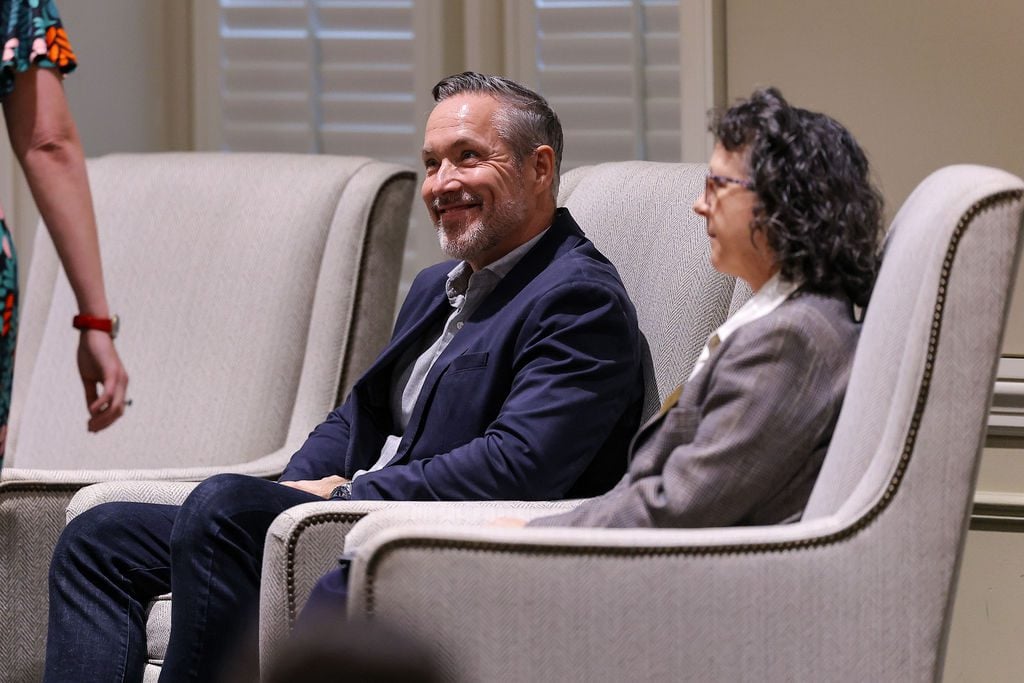
From left: JD Greear and Danielle Vinson, on-stage during Baptists in American Life. Photo by Jeremy Fleming.
The discussion then turned to declining religious affiliation and the growing identification of evangelical Christianity with partisan politics.
Guth asked whether the association between evangelical churches and the Republican Party had contributed to Americans’ withdrawal from religious institutions.
Greear acknowledged the dangers of identifying Christianity too closely with any political movement. Religious convictions, he argued, must remain distinguishable from political allegiances, even when believers consider particular political positions consistent with their faith.
Worthen placed the problem within a longer history of secularization, suggesting that the decline of religious participation reflects changes in authority, individualism, and institutional belonging that extend beyond recent political controversies.
She also questioned whether declining religious affiliation necessarily means that religious impulses have disappeared. The desire for meaning, identity, and devotion may instead find expression in other commitments, including political movements.
The discussion became especially lively when Guth asked how pastors should decide when to speak on political questions.
Greear distinguished between moral principles he believes follow directly from Scripture and particular political judgments about which Christians may reasonably disagree. He described the distinction as one between a “straight line” and a “dotted line.”
Churches, he suggested, must be willing to address moral questions without presenting every political judgment as possessing the authority of religious doctrine.
He also acknowledged mistakes in his own public commentary, including occasions when he had spoken too quickly about controversial events before the facts were established.
Vinson brought the discussion to the practical challenges of religious community. She described the difficulties that arise when political divisions make it increasingly uncomfortable for church members to speak openly with one another.
“Can I invite my neighbor to church?”
— Danielle Vinson
Vinson explained that she sometimes worried a politically outspoken member of her congregation might alienate a visitor who did not share the prevailing views.
She also described fellow church members seeking her out privately to discuss political questions they felt unable to raise openly.
The problem extended beyond congregational life. As a political scientist, Vinson worried that increasingly homogeneous communities contribute to polarization and weaken Americans’ willingness to hold their own political allies accountable.
Greear agreed that churches should resist becoming communities organized around political or socioeconomic similarity. Drawing on the New Testament, he argued that Christian congregations are meant to bring together people who would not naturally associate with one another.
Who Has Authority to Interpret Christianity?
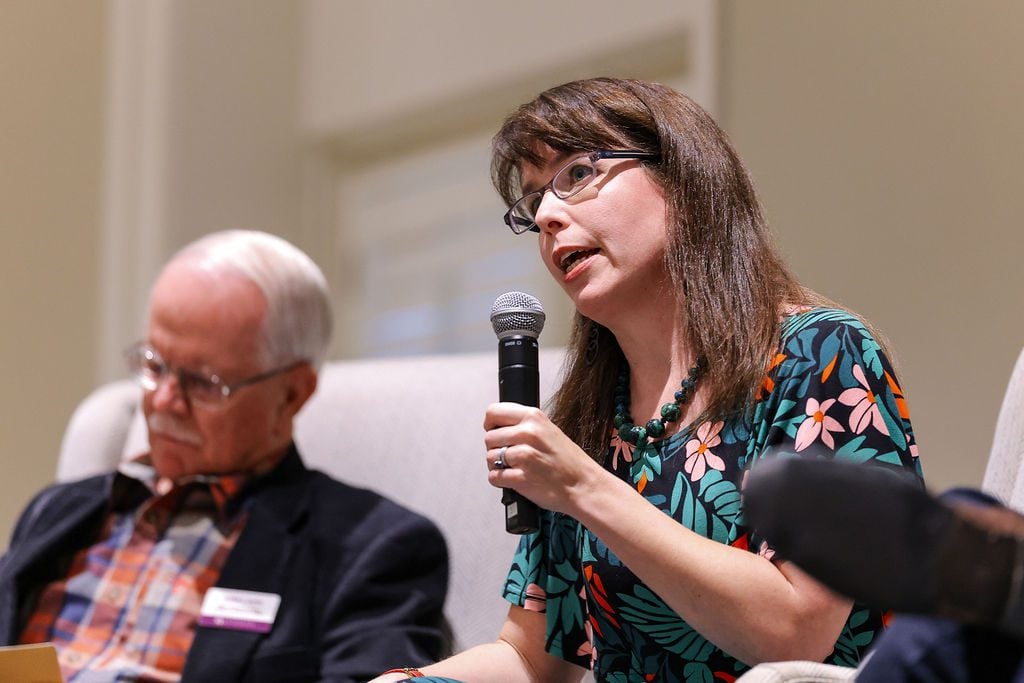
Molly Worthen discussing Baptists in American Life. Photo by Jeremy Fleming.
The conversation also examined questions of authority within Protestant Christianity.
Worthen discussed the challenges that arise when individual interpretations of Scripture compete with the authority of religious institutions and traditions.
Her conversion had prompted her to reconsider both the strengths and limitations of different Christian traditions.
She described the importance of drawing on the breadth of Christianity’s 2,000-year history rather than treating the assumptions of any contemporary denomination as identical to the faith itself.
Greear defended the Baptist commitment to congregational autonomy while acknowledging the difficulties it can create, particularly when churches must address misconduct, maintain doctrinal commitments, or cooperate across institutional boundaries.
The discussion ranged from the authority of Scripture to the divisions among Protestant denominations and the difficulties of maintaining Christian unity.
Worthen emphasized the importance of recognizing one’s interpretive limitations and remaining open to correction from other Christians and from the broader historical tradition.
“The problem is not the commitment to scripture. It’s jumping from there to ‘I am certain about everything’.”
— Molly Worthen
Greear likewise acknowledged that congregational independence, while central to Baptist identity, can create serious challenges for accountability and institutional cooperation.
Their exchange offered a revealing view of the tensions within contemporary Baptist life: between freedom and authority, local independence and institutional responsibility, and doctrinal conviction and cooperation.
Religious Liberty and the American Experiment
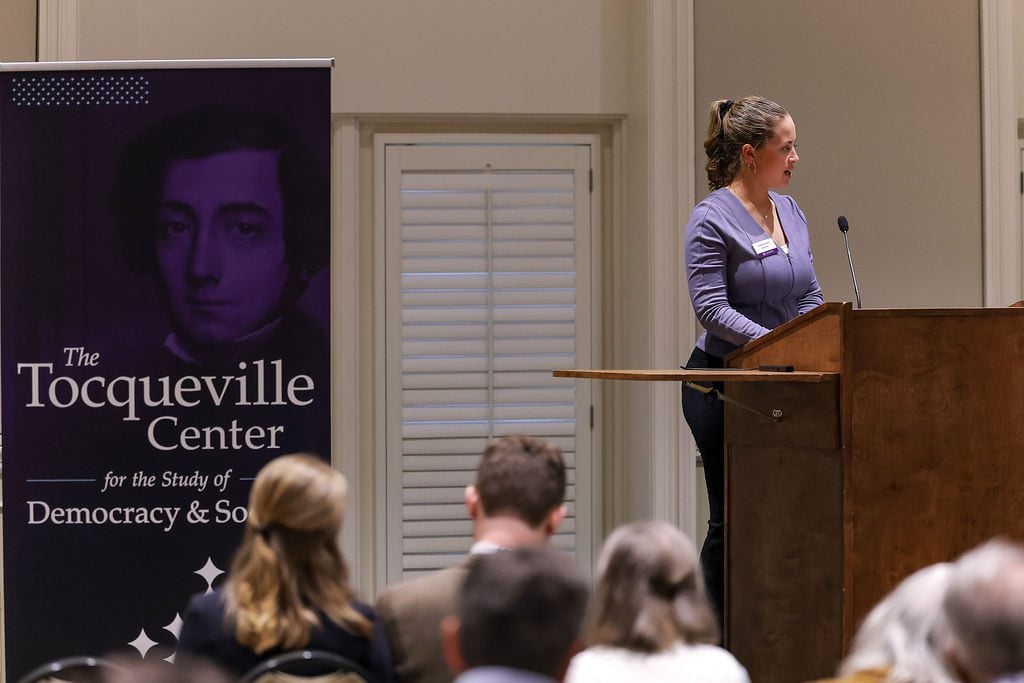
Tocqueville Fellow Ellison White asks an audience question during “Baptists in American Life,” October 22, 2026. Photo by Jeremy Fleming.
The evening concluded with a discussion of Christian nationalism and the proper relationship between religion and government.
Worthen cautioned against imprecise uses of the term Christian nationalism, arguing that it can obscure significant differences among American Christians and their political commitments.
She criticized survey questions that conflate conventional Christian beliefs with more radical political positions, while also acknowledging legitimate concerns about efforts to connect religious orthodoxy with governmental authority.
Greear likewise emphasized the importance of defining the term carefully and discussed the Baptist tradition’s commitment to religious liberty.
The conversation returned to questions that had animated both evenings: how religious communities preserve their convictions, how institutions exercise authority, and how freedom of conscience can be sustained amid political disagreement.
From Furman’s struggle for institutional independence to contemporary debates over Christianity and American politics, the two events demonstrated the enduring significance—and continuing complexity—of the Baptist tradition.