Tocqueville Fellows Blog, by Liza Sherbert: “The Declaration of Independence: From Its Original Purpose to Its Legacy of Equality”
Liza Sherbert ’28 is a Furman University student from Beaufort, South Carolina, studying Strategic Communications and Urban Planning. She is a Tocqueville Fellow at the Tocqueville Center for the Study of Democracy and Society, where she participates in discussions exploring the philosophical and moral questions at the heart of democratic life.
On September 29–30, 2026, the Tocqueville Center welcomed David Armitage, professor of history at Harvard University, for its On Discourse series, “The Declaration of Independence. Discuss.” The program invited students and faculty to reconsider the Declaration’s original purpose and enduring significance, culminating in Armitage’s Walters Lecture, “The Declaration of Independence in Global Context.” In this reflection, Liza considers why a document written to declare American independence is now remembered primarily for its language of equality.
If you ask the average citizen to quote the Declaration of Independence (DOI), they will undoubtedly quote something along the lines of “we hold these truths to be self-evident,” that we have “inalienable rights,” or that the DOI promises “life, liberty, and the pursuit of happiness.” These words have become the cultural shorthand of the document itself. So why is a document originally written to declare independence now remembered primarily for its language of equality?
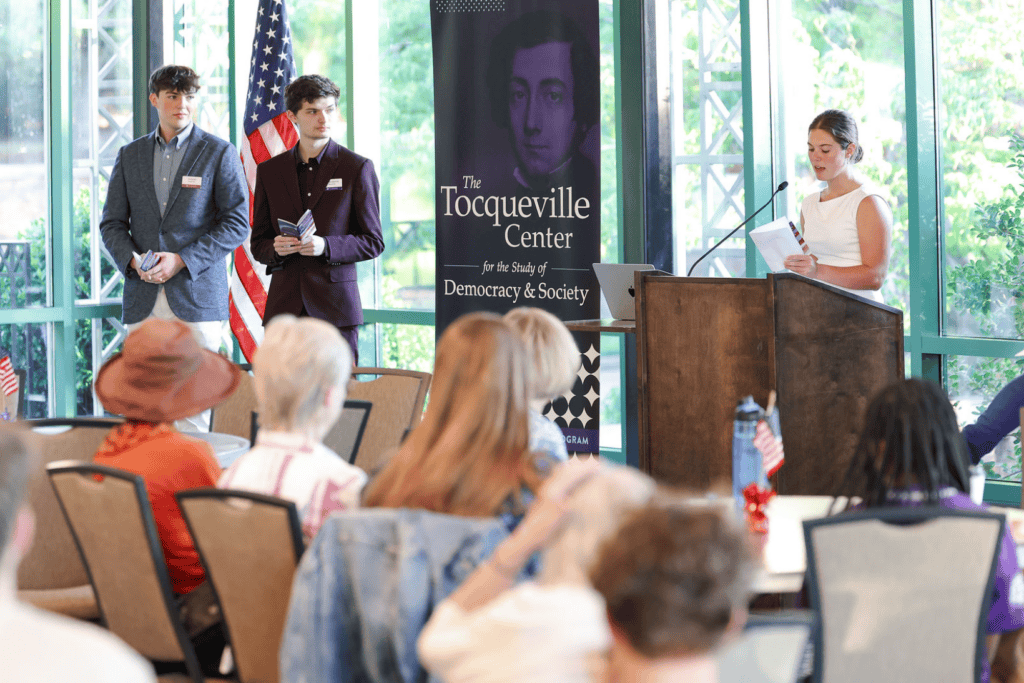
Tocqueville Fellow Liza Sherbert reads the Declaration of Independence aloud during “The Declaration of Independence. Discuss.”, an On Discourse event featuring historian David Armitage.
David Armitage on the Declaration of Independence’s Original Purpose
David Armitage, a historian, professor of history, and former chair of the Department of History at Harvard University, challenges us to reimagine the declaration’s original intent as a document of international agency rather than as individual rights. To declare oneself as an independent state was completely unprecedented at the time. Internationally, the tone was set by America presenting itself as a mature adult, who all stand equal, not a child asking for parental consent from Britain. This declaration meant the power to levy war, trade, and operate independently on the world stage. It was bold, brave, and, as noted by Armitage, only supported by a shocking 30% minority. The patriot cause was, in reality, only a fraction of the population compared to the neutral, undecided, and loyalist majority.
With this in mind, I wonder how a declaration created by what appears to be a largely divided population became a document whose ideals later generations would claim as their own?

A Furman student poses a question during “The Declaration of Independence. Discuss.”, an On Discourse event featuring historian David Armitage.
How the Declaration’s Ideals of Equality Shaped American History
At its founding, the DOI did not immediately guarantee rights to everyone living in the new nation. In 1776, it proclaimed that all men are created equal, yet slavery was still a common practice, especially in southern agrarian societies. Political rights were continuously denied to large portions of the population on account of sex and race. Now, however, such a thing would be illegal. Though the physical text did not change, the way those ideals have been interpreted has evolved over time. For one explanation for this evolution of interpretation, Armitage points back to the Declarations’ founders. He shared that the 2nd clause of the DOI could have been meant for future use, not the present when it was written. Perhaps our founders were so forward thinking that the intended use was set for a time when we would need it most. More likely, in my opinion, was the nature in how people interpreted their rights, even if the exact words within the declarations clauses did not change.
The Civil War and Reconstruction brought profound constitutional changes. The 13th Amendment abolished slavery, the 14th established national citizenship, and the 15th prohibited racial discrimination in voting. Later on, the 19th Amendment prohibited the discrimination of the right to vote on account of sex. All of these legal implementations marked a pivotal point in our nation where we used the DOI ideals specifically talked about in the 2nd paragraph. These Amendments addressed distinct social and political struggles and used the declaration’s ideals as a way to challenge the gap between who those rights were, and were not, extended to. Without the declaration America would not have had the written rhetoric to extend basic rights to everyone within our country. Though the legal framework was technically done through the reconstruction Amendments (13, 14 and 15) and the later 19th Amendment in the constitution, they were all inspired by the declaration’s ideals. The declaration’s legacy has grown not only through what the original founder wrote, but through what all Americans have challenged the words to mean.

Historian David Armitage (Harvard University) delivers the Walters Lecture, “The Declaration of Independence in Global Context,” during the Tocqueville Center’s On Discourse series.
Understanding the Declaration of Independence as a Whole
There is an evolving legacy at play here that is too important to ignore. The move from the independence America declared to the promise of individual rights within that nation was an enormous shift. One of the most striking methods at play here is the logical breakdown of how the declaration is written. The document’s preamble argues why the colonies need to claim their independence and take their place on the world stage. The second paragraph then articulates what exactly those basic rights look like. The Declaration then lists a series of grievances against the Crown before concluding in a final paragraph with the formal declaration that the colonies are free and independent states. With only three principled paragraphs outside the list of grievances, the first, second, and last were meant to work in tandem with one another. In both essence and action they all mutually reinforce one another. Therefore, it would be misleading to look at only part of the declaration without the whole in mind.
Yet, Americans and beyond do this everyday by only citing the second paragraph. Perhaps the answer lies in how the later generations have emphasized certain paragraphs.

A packed room gathers to discuss the Declaration of Independence with historian David Armitage (Harvard University) during the Tocqueville Center’s On Discourse event, “The Declaration of Independence. Discuss.”
Why Americans Remember the Declaration for Equality
The declaration’s current understanding reveals another layer of cultural understanding. The reason we remember the second paragraph as the cultural shorthand of the DOI is in an effort to understand our society as we want it presently. In essence – What a society remembers about its founding documents tells us how that society understands itself. Or even just how they want to understand themselves. As it stands in our current political state, the United States is a pillar for freedom, expression, and equality for all.
The declaration’s long-standing significance may therefore lie somewhere between what America originally declared and what it has become. We remember its language of equality, not because we no longer value independence but because equality has remained an ideal which Americans understand. The way Americans remember the declaration reflects a shift in emphasis, not a complete change in meaning. While the part we remember most fluently only denotes a small part of our founding, the way we choose to educate ourselves on the whole will stand the test of time. Has our emphasis on equality told us more about the Declaration’s original meaning or does it tell us about the kind of nation Americans aspire to become?